

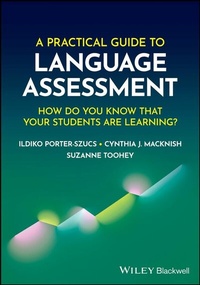
A Practical Guide to Language Assessment
Description

An essential resource on effective language assessment, invaluable for a new generation of teachers and education researchers
A Practical Guide to Language Assessment helps educators at every level redefine their approach to language assessment. Grounded in extensive research and aligned with the latest advances in language education, this comprehensive guide introduces foundational concepts and explores key principles in test development and item writing. Authored by a team of experienced language teacher educators, this book addresses the potential impacts of poorly designed tools and prepares teachers to make informed, effective assessment decisions.
Perfect for developing test blueprints and crafting effective assessment tools, including those for young learners, A Practical Guide to Language Assessment bridges the gap between theory and practice to provide the real-world training educators need to successfully navigate the complexities of modern language assessment. Clear and accessible chapters highlight the critical role of well-designed assessments, emphasize the importance of selecting appropriate tools to accurately measure student proficiency, and discuss recent innovations and emerging needs. With practical examples and a focus on current innovations, including 'ungrading' and the use of AI, A Practical Guide to Language Assessment:
- Explains the foundational concepts of language assessment with practical examples and clear explanations
- Bridges theoretical principles with practical applications, enabling educators to create effective test blueprints and assessment items and tasks
- Provides up-to-date coverage of timely topics such as the integration of AI in assessments and the ethical and legal considerations of language testing
- Features a wealth of in-depth examples of how theoretical concepts can be operationalized in practice
A Practical Guide to Language Assessment is an essential read for students in language education, as well as teachers, assessment managers, professional development trainers, and policymakers in language program evaluation.
More details
Other editions
Additional editions
Persons
Ildiko Porter-Szucs is Professor of ESL and TESOL at Eastern Michigan University, a K-12 certified ESL and German teacher, and co-founder of the Polish Language Center of Ann Arbor. She has extensive experience teaching Polish, Hungarian, German, and English to diverse age groups in public schools, language schools, corporate settings, refugee programs, and higher education. She spent four years working for a high-stakes standardized testing organization.
Cynthia J. Macknish is Professor of ESL and TESOL at Eastern Michigan University. She has taught at a range of levels in several countries, including Canada, the Bahamas, and Singapore, where she taught pedagogy and assessment courses to pre- and in-service teachers at the National Institute of Education. Cynthia was also a certified IELTS examiner for 14 years.
Suzanne Toohey is Supervisor of Instruction and Pedagogy at Oakland Schools. She has taught ELs for seventeen years, with her passion for second language acquisition ignited during her service as a Peace Corps volunteer. She has published work in the Detroit Free Press and MITESOL Messages as well as for TESOL Press and the National Association of English Language Program Administrators.
Content
Acknowledgments vii
Introduction ix
1 Concepts 1
2 Qualities of Test Usefulness and the Assessment Use Argument 31
3 Test Design 51
4 Crafting Assessments 79
5 Tools of the Trade 123
6 Assessing Young Learners 143
7 PK-12 in the United States and Canada: Assessment Is Not a Dirty Word 157
8 Assessing Exceptional Language Learners 177
9 Assessing Listening, Viewing, Representing, Speaking, and Pronunciation 193
10 Assessing Reading, Vocabulary, Grammar, and Writing 225
11 Grading, Evaluation, and Feedback 261
12 Ethics, Fairness, and Security 285
13 Technology for Language Assessment 295
14 Improving Assessments Through Statistics 313
15 Conclusion 331
Appendices 333
Appendix A: Diagnostic Test (Pre-Test) 333
Appendix B: Achievement Test (Post-Test) 339
Appendix C: Answer Keys 345
Glossary 347
Bibliography 355
Index 377
