

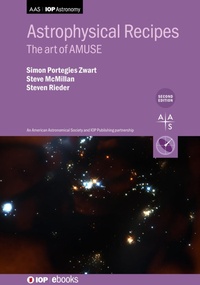
Astrophysical Recipes (Second Edition)
Description

Computational astrophysics connects observational data with theoretical models, driven by advances in both telescope technology and computing power. As simulations grow in scale and realism, software must evolve to keep pace. This book introduces AMUSE, a Python-based framework for modular, multi-physics simulations, allowing users to combine solvers and build complex models. The updated edition supports Python 3 and includes new examples in hydrodynamics and planetary systems. It also offers practical guidance for running AMUSE on supercomputers, using SLURM, enabling GPU support, and executing multi-node simulations. With downloadable scripts and reproducible figures, it serves as a comprehensive resource for both beginners and experienced researchers in the field.
Key features:
- Provides an introduction to the fundamentals of computational astrophysics
- Second edition is considerably expanded with three new chapters and two appendices
- Update throughout to be compatible with Python Version 3
- Includes downloadable source code and python notebooks
More details
Other editions
Additional editions
Persons
Simon Portegies Zwart leads since 2009 an interdisciplinary research team on Computational Astrophysics at Leiden Observatory, focusing on understanding the universe through simulation while developing algorithms and tools to handle its complexity and multi-scale nature. He founded the IAU Commission C.1B on Computational Astrophysics, as well as the AMUSE project, and was honored by the IAU for naming steroid 12946 "portegieszwart".
Steve McMillan is the head of the department of physics at Drexel University and his research interests lie in stellar dynamics and computations of stellar systems. Both authors have dedicated extensive amounts of time to this book and continue to work on AMUSE as an ongoing project.
Steven Rieder is a Scientific Research Software Engineer at the Anton Pannekoek Institute for Astronomy at the University of Amsterdam. His interests lie in the formation and evolution of dense stellar systems, the development of software that enables such research, and in science visualisation.
Content
- What is Computational Astrophysics?
- Fundamental Concepts
- Initial Conditions
- Gravitational Dynamics
- Stellar Structure and Evolution
- Hydrodynamics
- Radiative Transfer
- Elementary Coupling Strategies
- Advanced Coupling Strategies
- Expanding and Extending AMUSE
Appendix A: AMUSE Fundamentals
Appendix B: How to Add a Code to AMUSE
Appendix C: Programming Primer
