

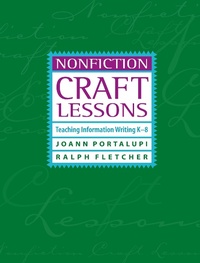
Nonfiction Craft Lessons
Teaching Information Writing K-8
Published on 10. October 2023
160 pages
978-1-003-84407-5 (ISBN)
Description

Writing nonfiction represents a big step for most students, yet when they try to create a report or persuasive essay, they are often anxious and frustrated. JoAnn Portalupi and Ralph Fletcher created Nonfiction Craft Lessons: Teaching Information Writing, K-8 to help teachers bring the passion from student writing while helping students scaffold their ideas in this challenging genre. The authors divided this book into grade-specific sections for K-2, 3-4, and middle school (grades 5-8) students. These divisions reflect various differences between emerging, competent, and fluent writers. In each section you'll find a generous collection of craft lessons directed at the genre that's most appropriate for that particular age. In the K-2 section, for example, a number of craft lessons focus on the all-about or concept book. In the 3-4 section there are several lessons on biography. In the 5-8 section a series of lessons addresses expository writing. Throughout the book each of the 80 lessons is presented on a single page in an easy-to-read format. Every lesson features three teaching guidelines:
Discussion --A brief look at the reasons for teaching the particular element of craft specifically in a nonfiction context. How to Teach It --Concrete language showing exactly how a teacher might bring this craft element to students in writing conferences or a small-group setting. Resource Material --Specific book or text referred to in the craft lesson including trade books, or a piece of student writing in the Appendixes.
This book will help students breathe voice into lifeless "dump-truck" writing and improve their nonfiction writing by making it clearer, more authoritative, and more organized. Nonfiction Craft Lessons gives teachers a wealth of practical strategies to help students grow into strong writers as they explore and explain the world around them.
Discussion --A brief look at the reasons for teaching the particular element of craft specifically in a nonfiction context. How to Teach It --Concrete language showing exactly how a teacher might bring this craft element to students in writing conferences or a small-group setting. Resource Material --Specific book or text referred to in the craft lesson including trade books, or a piece of student writing in the Appendixes.
This book will help students breathe voice into lifeless "dump-truck" writing and improve their nonfiction writing by making it clearer, more authoritative, and more organized. Nonfiction Craft Lessons gives teachers a wealth of practical strategies to help students grow into strong writers as they explore and explain the world around them.
More details
Language
English
Place of publication
London
United Kingdom
Publishing group
Taylor & Francis Ebooks
Target group
Professional and scholarly
Product notice
Reflowable
File size
0,80 MB
ISBN-13
978-1-003-84407-5 (9781003844075)
Copyright in bibliographic data and cover images is held by Nielsen Book Services Limited or by the publishers or by their respective licensors: all rights reserved.
Schweitzer Classification
Other editions
Additional editions
Book
04/2001
1st Edition
Stenhouse Publishers
€52.18
Shipment within 3-4 weeks
Persons
She began her career in education as a fourth-grade teacher in Epsom, New Hampshire. I was bit by the writing bug my second year of teaching when I was lucky enough to attend the University of New Hampshire's first Institute on Teaching Writing where I met and worked with Tom Newkirk, Lucy Calkins, Donald Murray, and Donald Graves. In that summer I discovered a pedagogy that resonated with my own belief about teaching and learning: that a strong teacher-student relationship lies at the heart of both. Since then she has worked in education as a classroom teacher, a staff developer at Teachers College Writing Project, a university professor at the University of Alabama at Birmingham, and most recently as an independent consultant. JoAnn is also the co-author with her husband, Ralph Fletcher, of numerous professional books and videos. Her four sons have given JoAnn plenty of opportunity to refine her thinking about teaching writing. Raising school age boys gave me a panoramic view of teaching. Engaging as a parent at home continually challenges me to think about the responsibility of teaching another parent's child. Discovering up close the four distinct personalities in my own children is a constant reminder of the diversity of each and every learner. After years of traveling to work with teachers, JoAnn prefers putting her time into two new endeavors that continue to inform her thinking about education. She currently serves on the Oyster River Cooperative School Board. My experience as a board member allows me to work with a fine group of administrators, teachers, and staff in the exciting and complex task of building and maintaining an excellent school district.
Content
Introduction; Setting the Table for Nonfiction Craft; Adorning the Table: Nonfiction Literature for Students; Nonfiction Craft Lessons K-2; Nonfiction Craft Lessons 3-4; Nonfiction Craft Lessons 5-8; Questions and Answers
