

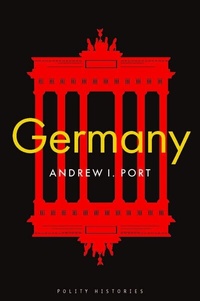
Germany
Description

In this refreshing book, Andrew I. Port tells the story of that extraordinary transformation. Tracing the histories of the Eastern and Western halves of postwar Germany in tandem, he highlights their obvious differences and unexpected commonalities. This novel approach explains not only the country's many accomplishments since the fall of the Berlin Wall, but also the challenges it has faced - from the difficulty of unifying two distinct societies to violent forms of xenophobia and the rise of extremist parties. Whether the Federal Republic remains a stable and successful power is the new "German Question" of the twenty-first century.
More details
Other editions
Person
Content
Introduction
1. Defeat (1945-1949)
2. Revival (1949-1961)
3. Consolidation (1961-1973)
4. Crisis (1973-1989)
5. Dis-Unity (1989-1998)
6. Normality? (1998-2024)
Notes
1
Defeat (1945-1949)
When the guns of battle fell silent in the spring of 1945, Germany's "total war" had ended in total defeat, and Hitler's "thousand-year empire" lay in ruins. Did that mean that the German Question had finally been resolved? In a way, it had been - in the original sense of the question. At no time were the Germans more united than they were that spring, at least in terms of hunger and hardship, deprivation and desperation, political apathy and impotency. Tens of millions of uprooted Germans and displaced foreigners were on the move; roughly a sixth of the prewar adult population had perished. Aerial warfare had destroyed about a third of all dwellings and a quarter of German industry; the country's infrastructure and transportation system were reduced to rubble. Severe shortages of food and other necessities served as a great equalizer, too, as did the collapse of the Reichsmark, the country's currency since the mid-1920s. This quickly gave rise to a thriving black market, where scarce items were available at exorbitant prices to those who could somehow afford them - resulting in inequities that quickly whittled away any superficial semblance of societal uniformity.
Appearances aside, then, Germans were not all in the same boat. Rural folk were, as a rule, better off than those who lived in urban and industrial areas, which had borne the brunt of British and American bombing raids. Geography mattered, just as it had during the Thirty Years' War of the seventeenth century. Those whose homes and factories had been destroyed, or who had fled or been forced to flee from regions where their families had lived for generations, were much worse off, say, than those who had movable property that could be exchanged on the black market or in the countryside for food and fuel. The arrival of millions of ethnic Germans expelled from the East only exacerbated the burden and increased social fissures by intensifying existing sources of envy and resentment.
Allied policies aimed at "solving" the German Question once and for all further accentuated the differences and divisions. The Big Three (the US, the UK, and the USSR) had already hammered out the broad outlines of those policies at major wartime conferences in Tehran and Yalta, then solidified them shortly after war's end in the imperial city of Potsdam, right outside Berlin. The main goal was to eradicate Nazism from German society and prevent Germany from ever again posing a threat to its neighbors - or itself. Following unconditional surrender, the defeated nation was to be demilitarized, democratized, and "denazified," its economy defanged through far-reaching reform and restructuring. Large swathes of land were taken away, roughly a quarter of Germany's prewar territory. The Allies agreed at Potsdam to the compulsory clearing of ethnic Germans from territory in the East that their ancestors had seized or settled centuries earlier but insisted this be done in an "orderly and humane" fashion.
It was anything but for the roughly 12 million individuals who embarked on a traumatic trek westward to escape the advancing Red Army - or were unceremoniously forced from their homes by vengeful Poles and Czechs. These refugees and expellees, primarily women, children, and the elderly, were among those Germans who paid the highest price for the war unleashed by their leaders. Some 2 million perished or went missing along the way, and many of those who made it to the Federal Republic would experience the intense resentment of their new neighbors well into the 1950s.
More punitive, Carthaginian plans to partition and "deindustrialize" the country - and thus turn it into a vast farmland - fell to the wayside when it became clear that that would only undermine efforts to force the Germans to pay for the damage and devastation they had caused. The lessons of Versailles loomed large, and John Maynard Keynes, whose Cassandraesque warnings about a vindictive settlement had gone unheeded after the last world war, must have felt vindicated.1 Still, despite the lessons of Versailles and Weimar, the Germans were to pay weighty reparations once again, to the official tune of some $20 billion - half of which was to go to the USSR, which had borne the brunt of destruction. The reparations issue soon created serious divisions among the victorious Allies themselves, with control of the invaluable Ruhr industrial region in the West proving to be the greatest bone of contention.
Reparations and Reforms, Dismantling and Denazification
Those tensions played a major role in the outbreak of the Cold War, a conflict that would dominate world affairs for the next four decades. In the meantime, Allied policies engendered a great deal of bitterness in Germany itself, which, along with the capital Berlin, was divided for administrative purposes among the Americans, British, French, and Soviets. Rebuffed in the Ruhr, the Soviets took their piece of flesh from their own zone of occupation east of the Elbe, seizing and rigorously removing assorted infrastructure and thousands of factories in recompense for Germany's brutal wartime destruction of the USSR. That "giant sucking sound" in the East prompted some locals to bitterly quip that "our railroad tracks are made of Krupp steel - the Russians' of what they steal."2
Industrial dismantling was much less systematic in the three Western zones of occupation, where authorities focused instead on breaking apart banking behemoths, large industrial conglomerates, and infamous chemical combines like IG Farben, which had supplied German death camps in the East with Zyklon B during the war. The Soviets went a step further: they expropriated and nationalized, without any compensation, thousands of private firms, both big and small. At the same time, they dismantled large landholdings, especially those of the notorious Junker, the aristocratic landowners in the East who, they believed, were among the main culprits responsible for Nazism.
For all their differences, that was one thing the erstwhile Allies could agree on. Prussian militarism and the Junker, along with other traditional social and economic elites, had lain at the root of Hitler's rise to power and thus had to be eliminated root and branch. Their destruction would solve, once and for all, the German Question - which was why the Allies officially abolished the state of Prussia by decree in February 1947.
These administrative and economic responses to past and potential threats posed by Germany met in the main with sullen resignation. Few were greeted with universal acclaim in the former Reich itself, though the hundreds of thousands in the countryside who benefitted from the Soviet land reform were no doubt grateful for the sudden windfall. There was angry resistance in some circles to educational and administrative reforms intended to change mindsets and mentalities and thus make German society more "democratic," such as the American effort to abolish corporal punishment and the privileged position enjoyed by higher-level civil servants (Beamte), another supposed bulwark of German authoritarianism.
But that was just the tip of the iceberg. The millions expelled from the East pined for their lost Heimat (homeland), and the brutal sexual abuse of German women, especially though not exclusively in the East, became sources of simmering discontent. Yet nothing seemed to raise the ire of the German populace, at least vocally, as much as the Allies' efforts to root out and punish National Socialists.
That was no easy task, given the high percentage of the population that had belonged to the Nazi Party or one of its many affiliated associations. The Allies arrested tens of thousands of Germans during the months immediately after the war and conducted criminal proceedings against Nazi elites at a series of public trials in the medieval city of Nuremberg. Two dozen prominent figures who had occupied key political, military, and industrial positions during the Third Reich were the focus of the first and most famous trial, which began in November 1945 and lasted almost a year. These "bigwigs" were accused of committing war crimes, crimes against humanity, and wars of aggression - novel legal categories. Other elites - Nazi jurists who had sent political dissidents to their deaths; doctors who had sterilized women, committed euthanasia, or performed "medical" experiments; industrialists who had plundered foreign lands and profited from slave labor - faced the music in a series of subsequent trials, which brought to light the mass crimes perpetrated by and in the name of the German people. Sentences ranged from acquittal to long-term imprisonment to death by hanging.
All four Allies collaborated at the main Nuremberg trial, but after that, they went their separate ways during a second phase that focused on lower-level elites and the "masses." The goal was to determine personal responsibility, identify dyed-in-the-wool ("active") Nazis, and prevent their return to influential positions in public life as judges, teachers, and civil servants. As a rule, the weeding-out process was most far-reaching in the Soviet zone, where occupation authorities carried out a radical purge of the public sector and threw tens of thousands into internment camps - often the same ones the...
