

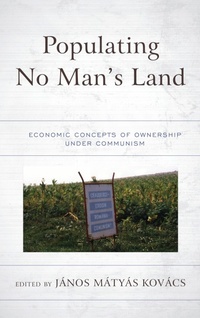
Populating No Man's Land
Economic Concepts of Ownership Under Communism
Lexington Books (Publisher)
1st Edition
Published on 15. September 2018
368 pages
979-8-216-33706-5 (ISBN)
Description

This edited volume opening the new series Revisiting Communism: Collectivist Economic Thought in Historical Perspective focuses on the concepts of ownership, the cornerstone of political economy in Soviet-type societies. The authors' main objective is to contribute to the still unwritten chapter on collectivism in the history books of modern economic thought. They trace the lengthy evolution of economic ideas of property reform under communism leading from the doctrine of blanket nationalization to projects of moderate privatization in eight countries of Eastern Europe and China.
The comparative analysis sheds light upon the tireless attempts of reform-minded economists in communist countries to populate the no man's land of "social property" with quasi-private economic actors such as bodies of workers' self-management and managers of state-owned companies. For a long time, these were expected to crowd out the communist nomenklatura from its actual ownership position without challenging the primacy of collective property rights. The fact that even the most radical reformers came to the conclusion that such surrogate owners would not be able to break the power of the ruling elite only on the eve of the 1989 revolutions demonstrates the immense strength of collectivist ideas. The authors coin the term "trap of collectivism" to warn those demanding nationalization or other forms of non-private ownership today: it is rather easy, even with the best intentions, to walk into this trap but it may take long decades to break out from it.
The comparative analysis sheds light upon the tireless attempts of reform-minded economists in communist countries to populate the no man's land of "social property" with quasi-private economic actors such as bodies of workers' self-management and managers of state-owned companies. For a long time, these were expected to crowd out the communist nomenklatura from its actual ownership position without challenging the primacy of collective property rights. The fact that even the most radical reformers came to the conclusion that such surrogate owners would not be able to break the power of the ruling elite only on the eve of the 1989 revolutions demonstrates the immense strength of collectivist ideas. The authors coin the term "trap of collectivism" to warn those demanding nationalization or other forms of non-private ownership today: it is rather easy, even with the best intentions, to walk into this trap but it may take long decades to break out from it.
More details
Series
Edition
1. Auflage
Language
English
Place of publication
United States
Publishing group
Bloomsbury Publishing Plc
Target group
Professional and scholarly
Illustrations
1 table
ISBN-13
979-8-216-33706-5 (9798216337065)
Copyright in bibliographic data and cover images is held by Nielsen Book Services Limited or by the publishers or by their respective licensors: all rights reserved.
Schweitzer Classification
Other editions
Additional editions
Book
09/2018
Lexington Books
€149.50
Shipment within 15-20 days
Persons
János Mátyás Kovács is permanent fellow at Institute for Human Sciences, senior lecturer at Eötvös Lorand University, and guest professor at Central European University
Content
Acknowledgments
Introduction: Why Ownership? Why Communism?
by János Mátyás Kovács
Chapter 1: From Nationalization to Nowhere. Ownership in Bulgarian Economic Thought
(1944-1989),
by Roumen Avramov
Chapter 2: From Control of the 'Commanding Heights' to Control of the Whole Economy and
Back. Chinese Ownership Theories Since 1949,
by Fan Shitao
Chapter 3: From Nationalization to Privatization. Understanding the Concept of Ownership in
Czechoslovakia (1948-1990),
by Julius Horvath and Vitezslav Sommer
Chapter 4: Ownership under East-German Communism-A One-Way Street,
by Hans-Jürgen Wagener and Franz Rudolph
Chapter 5: From Two to One (And Only)? Theorizing Ownership in Communist Hungary,
by János Mátyás Kovács
Chapter 6: From Soviet-type Ownership through Self-Management to Privatization. Debating
Ownership in Communist Poland,
by Maciej Tyminski
Chapter 7: The Silence of the Herd. Exploring Ownership Concepts in Communist Romania,
by Radu Ioan Simandan, Gabriel Claudiu Mursa and Vlad Pasca
Chapter 8: Fighting Dogma, Rescuing Doctrine. Toward a History of Ownership Debates in
Soviet Economic Literature,
by Oleg Ananyin and Denis Melnik
Chapter 9: Social Property and the Market. An Uneasy Symbiosis in Yugoslavia,
by Joze Mencinger
Conclusion: Expeditions to No Man's Land. Comparing Economic Concepts of Ownership
under Communism: An Evolutionary View, by János Mátyás Kovács
About the Contributors
Introduction: Why Ownership? Why Communism?
by János Mátyás Kovács
Chapter 1: From Nationalization to Nowhere. Ownership in Bulgarian Economic Thought
(1944-1989),
by Roumen Avramov
Chapter 2: From Control of the 'Commanding Heights' to Control of the Whole Economy and
Back. Chinese Ownership Theories Since 1949,
by Fan Shitao
Chapter 3: From Nationalization to Privatization. Understanding the Concept of Ownership in
Czechoslovakia (1948-1990),
by Julius Horvath and Vitezslav Sommer
Chapter 4: Ownership under East-German Communism-A One-Way Street,
by Hans-Jürgen Wagener and Franz Rudolph
Chapter 5: From Two to One (And Only)? Theorizing Ownership in Communist Hungary,
by János Mátyás Kovács
Chapter 6: From Soviet-type Ownership through Self-Management to Privatization. Debating
Ownership in Communist Poland,
by Maciej Tyminski
Chapter 7: The Silence of the Herd. Exploring Ownership Concepts in Communist Romania,
by Radu Ioan Simandan, Gabriel Claudiu Mursa and Vlad Pasca
Chapter 8: Fighting Dogma, Rescuing Doctrine. Toward a History of Ownership Debates in
Soviet Economic Literature,
by Oleg Ananyin and Denis Melnik
Chapter 9: Social Property and the Market. An Uneasy Symbiosis in Yugoslavia,
by Joze Mencinger
Conclusion: Expeditions to No Man's Land. Comparing Economic Concepts of Ownership
under Communism: An Evolutionary View, by János Mátyás Kovács
About the Contributors
