

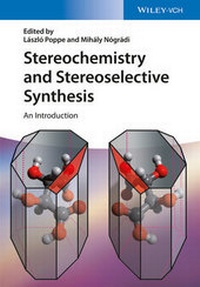
Stereochemistry and Stereoselective Synthesis
An Introduction
1st Edition
Published on 14. June 2016
XIV, 265 pages
978-3-527-69630-7 (ISBN)
Description

Written by well-respected and experienced authors, this textbook fills the gap for a concise introduction to the key concepts of organic stereochemistry and the most important classical and modern methods in stereoselective synthesis.
The concepts are extensively illustrated in color, with practical examples and question-answer sets to help consolidate the reader's knowledge. In addition, animations are available from the Wiley website.
A must-have for students in chemistry, biochemistry, and life sciences, as well as researchers in pharmaceutical and agrochemical companies in need of a quick introduction to the field.
The concepts are extensively illustrated in color, with practical examples and question-answer sets to help consolidate the reader's knowledge. In addition, animations are available from the Wiley website.
A must-have for students in chemistry, biochemistry, and life sciences, as well as researchers in pharmaceutical and agrochemical companies in need of a quick introduction to the field.
Reviews / Votes
"Das Buch ist sehr schön und auf den Punkt aufbereitet und eignet sich gut als Begleitwerk für organische Chemie bzw. Stereochemie Basisvorlesungen (...). Die Beispiele sind gut gewählt und decken alle relevanten Bereiche des Faches ab (...)." Prof. Dr. Mario Waser, Johannes Kepler Universität Linz, Österreich.More details
Other editions
Additional editions
László Poppe | Mihály Nógrádi | József Nagy
Stereochemistry and Stereoselective Synthesis
An Introduction
Book
08/2016
1st Edition
Wiley-VCH
€59.90
Shipment within 5-7 days
Persons
Mihály Nógrádi is emeritus professor at Budapest University of Technology and Economics (BME), Hungary. He obtained his diploma at the Faculty of Chemistry at the Technical University of Budapest in 1957 and then became the head of the control laboratory at the pharmaceutical company EGyT (now Egis Pharmaceuticals PLC) in Budapest. In 1962 he joined the alkaloid chemistry group at the Technical University of Budapest. He completed his PhD under the supervision of Prof. L. Farkas in 1964 and prepared his "Candidate of Chemical Sciences" thesis in 1967. After spending one year at Sheffield University, UK, he became professor at Technical University of Budapest and was appointed scientifc advisor by the Hungarian Academy of Sciences. He retired in 1996 but retained his laboratory at BME until 2012. He has published 150 papers, authored two books and is coinventor of several patents (e.g. Osteochin© / Osten©, a drug against osteoporosis which was marketed in Japan and Hungary).
László Poppe is a professor at Budapest University of Technology and Economics (BME), Hungary. He graduated as a chemical engineer from Technical University of Budapest in 1983 and completed his PhD in organic chemistry with Prof. L. Novák in 1987. He then was a research fellow at the Central Research Institute for Chemistry of the Hungarian Academy of Sciences and spent one year (1991-1992) as an Alexander von Humboldt Fellow with Prof. J. Rétey at the University of Karlsruhe, Germany. He became professor and head of the Bioorganic Chemistry group at the Department of Organic Chemistry and Technology at BME in 2005. His research interests are centered on stereoselective synthesis of biologically active compounds, biocatalysis, and enzyme mechanisms.
József Nagy is a research fellow in the group of Prof. L. Poppe at Budapest University of Technology and Economics (BME), Hungary. He graduated as a chemical engineer and completed his PhD with Prof. J. Nyitray in 1980.
Gábor Hornyánszky is an associate professor at the Department of Organic Chemistry and Technology at Budapest University of Technology and Economics (BME), Hungary. After having obtained his PhD, he worked as postdoctoral fellow, and then became a researcher in the alkaloid chemistry group at BME. Currently he is working in the group of Prof. L. Poppe at BME. He is also the Head of the Dean's Office at the Faculty of Chemical Technology and Biotechnology.
Zoltán Boros is a reserch fellow of the group of Prof. L. Poppe at Budapest University of Technology and Economics (BME), Hungary. He graduated as a chemical engineer and completed his PhD with Prof. L. Poppe in 2014.
László Poppe is a professor at Budapest University of Technology and Economics (BME), Hungary. He graduated as a chemical engineer from Technical University of Budapest in 1983 and completed his PhD in organic chemistry with Prof. L. Novák in 1987. He then was a research fellow at the Central Research Institute for Chemistry of the Hungarian Academy of Sciences and spent one year (1991-1992) as an Alexander von Humboldt Fellow with Prof. J. Rétey at the University of Karlsruhe, Germany. He became professor and head of the Bioorganic Chemistry group at the Department of Organic Chemistry and Technology at BME in 2005. His research interests are centered on stereoselective synthesis of biologically active compounds, biocatalysis, and enzyme mechanisms.
József Nagy is a research fellow in the group of Prof. L. Poppe at Budapest University of Technology and Economics (BME), Hungary. He graduated as a chemical engineer and completed his PhD with Prof. J. Nyitray in 1980.
Gábor Hornyánszky is an associate professor at the Department of Organic Chemistry and Technology at Budapest University of Technology and Economics (BME), Hungary. After having obtained his PhD, he worked as postdoctoral fellow, and then became a researcher in the alkaloid chemistry group at BME. Currently he is working in the group of Prof. L. Poppe at BME. He is also the Head of the Dean's Office at the Faculty of Chemical Technology and Biotechnology.
Zoltán Boros is a reserch fellow of the group of Prof. L. Poppe at Budapest University of Technology and Economics (BME), Hungary. He graduated as a chemical engineer and completed his PhD with Prof. L. Poppe in 2014.
Content
BASIC PRINCIPLES AT THE MOLECULAR LEVEL
1.) Structure and Properties
2.) Concepts of Stereochemistry
PROPERTIES AT THE LEVEL OF MOLECULAR SETS
3.) Time Scales, Conformational Changes
4.) Tautomerism
5.) Absolute Configuration
6.) Enantiomeric Composition
GENERAL CHARACTERISTICS OF SELECTIVE REACTIONS
7.) Main Types of Selectivities
8.) Classification of Selectivities
9.) Stereospecific and Stereoselective Reactions
10.) Applications of Stereoselective Reactions
11.) Stoichiometric Methods
12.) Catalytic Methods
1.) Structure and Properties
2.) Concepts of Stereochemistry
PROPERTIES AT THE LEVEL OF MOLECULAR SETS
3.) Time Scales, Conformational Changes
4.) Tautomerism
5.) Absolute Configuration
6.) Enantiomeric Composition
GENERAL CHARACTERISTICS OF SELECTIVE REACTIONS
7.) Main Types of Selectivities
8.) Classification of Selectivities
9.) Stereospecific and Stereoselective Reactions
10.) Applications of Stereoselective Reactions
11.) Stoichiometric Methods
12.) Catalytic Methods
