

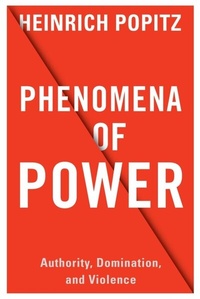
Phenomena of Power
Authority, Domination, and Violence
1st Edition
Published on 12. June 2017
224 pages
978-0-231-54456-6 (ISBN)
Description

In Phenomena of Power, one of the leading figures of postwar German sociology reflects on the nature, and many forms of, power. For Heinrich Popitz, power is rooted in the human condition and is therefore part of all social relations. Drawing on philosophical anthropology, he identifies the elementary forms of power to provide detailed insight into how individuals gain and perpetuate control over others. Instead of striving for a power-free society, Popitz argues, humanity should try to impose limits on power where possible and establish counterpower where necessary.
Phenomena of Power delves into the sociohistorical manifestations of power and breaks through to its general structures. Popitz distinguishes the forms of the enforcement of power as well as of its stabilization and institutionalization, clearly articulating how the mechanisms of power work and how to track them in the social world. Philosophically trained, historically informed, and endowed with keen observation, Popitz uses examples ranging from the way passengers on a ship organize deck chairs to how prisoners of war share property to illustrate his theory. Long influential in German sociology, Phenomena of Power offers a challenging reworking of one of the essential concepts of the social sciences.
Phenomena of Power delves into the sociohistorical manifestations of power and breaks through to its general structures. Popitz distinguishes the forms of the enforcement of power as well as of its stabilization and institutionalization, clearly articulating how the mechanisms of power work and how to track them in the social world. Philosophically trained, historically informed, and endowed with keen observation, Popitz uses examples ranging from the way passengers on a ship organize deck chairs to how prisoners of war share property to illustrate his theory. Long influential in German sociology, Phenomena of Power offers a challenging reworking of one of the essential concepts of the social sciences.
All prices
More details
Other editions
Additional editions
Book
04/2017
Columbia University Press
€68.14
Article not available at the moment
Persons
Heinrich Popitz (1925-2002) was professor of sociology and founding director of the Institute for Sociology at the University of Freiburg. In 1971-72, he was Theodor Heuss Professor at the New School for Social Research.
Gianfranco Poggi is professor of sociology at the University of Trento and emeritus professor of sociology at the University of Virginia and the European University Institute.
Gianfranco Poggi is professor of sociology at the University of Trento and emeritus professor of sociology at the University of Virginia and the European University Institute.
Content
Editors' Introduction
Translator's Note
Acknowledgments
1. The Concept of Power
Part I: Forms of Enforcement
2. Violence
3. Threatening and Being Threatened
4. The Authority Bond
5. Needs for Authority: The Change in Social Subjectivity
6. Technical Action
Part II: Forms of Stabilization
7. Processes of Power Formation
8. Power and Domination: Stages of the Institutionalization of Power
Notes
Index
Translator's Note
Acknowledgments
1. The Concept of Power
Part I: Forms of Enforcement
2. Violence
3. Threatening and Being Threatened
4. The Authority Bond
5. Needs for Authority: The Change in Social Subjectivity
6. Technical Action
Part II: Forms of Stabilization
7. Processes of Power Formation
8. Power and Domination: Stages of the Institutionalization of Power
Notes
Index

