

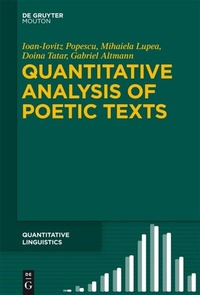
Quantitative Analysis of Poetic Texts
Description

The book presents methods for the objective analysis of poetic language. Common objects of literary studies such as rhythm, semantic explications, interpretation and personal impressions are avoided. Only those properties of poetic texts are taken into account that could be quantified. The major chapters contain the analysis of phonic phenomena (frequency, euphony, assonance, alliteration, aggregation, rhyme), word properties (aspects of frequency, length, richness, word classes, sequences of word properties, characterisations). The synergetic control cycle is the result of the study of mutual links between properties. For all methods both statistical tests (evaluation, comparison), theoretical derivations (models), and examples are presented.
The book is dedicated to the work of the famous Romanian poet Mihai Eminescu whose complete work was analysed, which made detailed illustrations of the method possible. The methods can be used mutatis mutandis for any language and text. It is the first comprehensive quantitative analysis of a poetic work.
More details
Other editions
Additional editions
Persons
Content
- Intro
- Foreword
- Contents
- 1 Introduction
- 2 Phonic phenomena
- 2.1 Occurrence without pattern
- 2.1.1 Phoneme frequencies
- 2.1.2 Euphony In general
- 2.2 Assonance
- 2.2.1 The diagonal
- 2.2.2 Symmetry
- 2.2.3 Poem length and significant sequences
- 2.3 Alliteration
- 2.4 Aggregation
- 2.5 Rhyme
- 2.5.1 Word length
- 2.5.2 Open and closed rhymes
- 2.5.3 Masculine and feminine rhyme
- 2.5.4 Parts of speech In rhymewords
- 3 The word-
- 3.1 Introduction
- 3.2 Frequency distribution
- 3.2.1 Stratification
- 3.2.2 Ord's criterion
- 3.2.3 The lambda indicator
- 3-2.4 Entropy and repeat rate
- 3.2.5 Glnl's coefficient
- 3.2.6 Geometric properties
- 3.2.6.1 The triangle
- 3.2.6.2 Writer's view and the golden section
- 3.3 Vocabulary richness
- 3.4 Word length
- 3.4.1 Ord's scheme
- 3.4.2 Word-length distribution
- 3.5 Word classes (parts of speech)
- 3.5.1 Frequencies
- 3.5.2 Descrlptivenessvs. activity
- 3.5.3 Runs
- 3.5.3.1 Sequential dependence
- 3.5.3.2 Run length
- 3.5.3.3 Placing tendency
- 4 The control cycle
- References
- Index
