

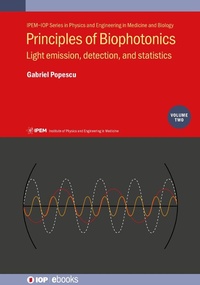
Principles of Biophotonics, Volume 2
Description

Principles of Biophotonics, volume two describes detection and statistical representation of optical fields. Beginning by placing the visible spectrum in the context of the electromagnetic frequency range, this presentation stresses how thin of a sliver is normally called the optical spectrum. To be able to describe properties of light with technical accuracy, the most common radiometric quantities are introduced, and conversion to photon-based quantities is explicitly presented. For completeness, an analogy to the photometric quantities is also made. Additionally, this volume covers the three fundamental mechanisms for generating light: blackbody radiation, fluorescence and laser emission, as well as emphasizing the specific properties of each type of radiation, especially in terms of the optical power spectrum. Each chapter contains a set of practice problems and additional references, and this book aims to build the foundation for further study in subsequent volumes.
More details
Other editions
Additional editions
Person
Gabriel Popescu is a professor of electrical and computer engineering at the University of Illinois Urbana-Champaign. He received his PhD in optics in 2002 from CREOL, The College of Optics and Photonics, University of Central Florida. He continued his training with the late Michael Feld at MIT, working as a postdoctoral associate. He joined Illinois in August 2007, where he directs the Quantitative Light Imaging Laboratory (QLI Lab) at the Beckman Institute for Advanced Science and Technology. Aside from Principles of Biophotonics, he has authored another book on quantitative phase imaging, edited a title on nanobiophotonics, authored 170 journal publications, 220 conference presentations, 32 patents and has given 220 lecture/plenary/invited talks. He founded Phi Optics Inc, a start-up company that commercializes quantitative phase imaging technology, and he is a Fellow of OSA and SPIE, as well as being a Senior member of IEEE.
Content
1. Electromagnetic fields
2. Radiometric Properties of Light
3. Photon-based radiometric quantities
4. Photometric properties of light
5. Fluorescence
6. Black body radiation
7. LASER: Light Amplification by Stimulated Emission of Radiation
8. Classification of optical detectors
9. Statistics of optical detection
10. Detection noise
11. Figures of merit of optical detectors
12 Semiconductor materials
13. Photon detectors
14. Thermal detectors
15. Statistics of optical fields
