

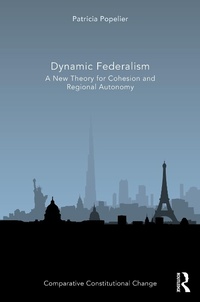
Dynamic Federalism
A New Theory for Cohesion and Regional Autonomy
1st Edition
Published on 9. March 2021
304 pages
978-1-000-35918-3 (ISBN)
Description

This book offers a new theory of federalism.
The work critically discusses traditional federal theories and builds on theories that focus on the dynamics of federalism. It offers a definition of federalism and federal organizations that encompasses both new and old types of multi-tiered system. Unlike traditional federal theory, it is well-suited to research both multinational and mononational systems. It also takes into account the complexity of these systems, with bodies of governance at the local, regional, national, and supranational level. The book is divided into three parts: the first part outlines the contours of dynamic federalism, based on a critical overview of traditional federal theory; the second part develops comprehensive indexes to measure autonomy and cohesion of multi-tiered systems; and the third part focuses on the dynamics of federal organizations, with a special focus on institutional hubs for change.
Dynamic Federalism will be an essential resource for legal, social, economic, and political scholars interested in federalism, regionalism, and de/centralization.
The work critically discusses traditional federal theories and builds on theories that focus on the dynamics of federalism. It offers a definition of federalism and federal organizations that encompasses both new and old types of multi-tiered system. Unlike traditional federal theory, it is well-suited to research both multinational and mononational systems. It also takes into account the complexity of these systems, with bodies of governance at the local, regional, national, and supranational level. The book is divided into three parts: the first part outlines the contours of dynamic federalism, based on a critical overview of traditional federal theory; the second part develops comprehensive indexes to measure autonomy and cohesion of multi-tiered systems; and the third part focuses on the dynamics of federal organizations, with a special focus on institutional hubs for change.
Dynamic Federalism will be an essential resource for legal, social, economic, and political scholars interested in federalism, regionalism, and de/centralization.
Reviews / Votes
"Popelier aims at laying the foundations for a new, dynamic theory of federalism, overcoming some key weaknesses of traditional federal theory, and testing such theory on a series of conditions: universality, specificity, and flexibility... the author's endeavors in trying to overcome the theoretical weaknesses of traditional federal scholarship, doing so from a legal perspective, is certainly fascinating... the book also offers a peculiar opportunity for comparative constitutional law scholarship to reflect on the importance of method and the definition of concepts to advance research."Lidia Bonifati, Diritti Comparati, 27 May 2021
"Dynamic Federalism is one of the rare books that attempt to develop a holistic theory. One that not only describes but also explains and predicts how federal structures come about, remain in place, contribute to stability or fuel fragmentation, and eventually dissolve. Written by a constitutional lawyer and drawing on the Belgian case to measure its various dimensions and indicators, there is much to be learned from several of the book's core postulates both in the theoretical and in the empirical realms."
Sean Mueller (2021): Dynamic federalism: a new theory for cohesion and regional autonomy, Regional & Federal Studies, DOI: 10.1080/13597566.2021.1939691
`...the book is not only greatly informative, but thought-provoking and inspiring. It offers illuminating paths into the worlds of federalism-not all of them yet unknown, but superbly nuanced and analyzed.'
Anna Gamper University of Innsbruck, Austria; doi:10.1093/publius/pjab034
More details
Series
Edition
1. Auflage
Language
English
Place of publication
London
United Kingdom
Publishing group
Taylor & Francis Ltd
Target group
College/higher education
Illustrations
55 Tables, black and white; 1 Line drawings, black and white
ISBN-13
978-1-000-35918-3 (9781000359183)
Copyright in bibliographic data and cover images is held by Nielsen Book Services Limited or by the publishers or by their respective licensors: all rights reserved.
Schweitzer Classification
Other editions
Additional editions

Book
09/2022
1st Edition
Routledge
€65.80
Shipment within 15-20 days

Book
03/2021
1st Edition
Routledge
€206.80
Shipment within 15-20 days
Person
Patricia Popelier is full professor at the law faculty of the University of Antwerp, director of the research group of government and law and copromoter of the interdisciplinary Centre of Excellence GOVTRUST. She is also senior research fellow at the University of Kent, Centre for Federal Studies. She is the vice president of the International Association of Legislation (IAL) and president of the Flemish Interuniversity Center of Legislation (ICW), convenor of the standing research group on subnational constitutions in federal and quasi-federal systems of the International Association of Constitutional Law, and member of the scientific committee of EURAC - Institute for Comparative Federalism (Bolzano); of the scientific committee of the Sofia Legal Science Network (SLSN); and of the scientific committee of the Ossevatorio AIR (Rome).
Content
Introduction
Part I. Theoretical framework
Chapter 1. What is federalism? In search of building blocks for a new federal theory
Chapter 2. Dynamic Federalism: 'Federalism as a Process' Revisited
Part II. Measuring Cohesion and Autonomy
Chapter 3. Preliminary notes on the indicators: representation, and the Belgian case study
Chapter 4. Status
Chapter 5. Powers
Chapter 6. Fiscal arrangements
Part III. Measuring change
Chapter 7. Contours for a theory of change
Chapter 8. Institutional hubs for change
Conclusion: Findings and way forward
Appendix: Showcase - Belgium
Part I. Theoretical framework
Chapter 1. What is federalism? In search of building blocks for a new federal theory
Chapter 2. Dynamic Federalism: 'Federalism as a Process' Revisited
Part II. Measuring Cohesion and Autonomy
Chapter 3. Preliminary notes on the indicators: representation, and the Belgian case study
Chapter 4. Status
Chapter 5. Powers
Chapter 6. Fiscal arrangements
Part III. Measuring change
Chapter 7. Contours for a theory of change
Chapter 8. Institutional hubs for change
Conclusion: Findings and way forward
Appendix: Showcase - Belgium
