

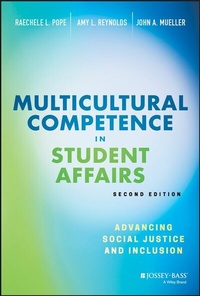
Multicultural Competence in Student Affairs
Description

The long-awaited second edition, Multicultural Competence in Student Affairs: Advancing Social Justice and Inclusion, introduces an updated model of student affairs competence that reflects the professional competencies identified by ACPA and NASPA (2015) and offers a valuable approach to dealing effectively with increasingly complex multicultural issues on campus. To reflect the significance of social justice, the updated model of multicultural awareness, knowledge, and skills now includes multicultural action and advocacy and speaks directly to the need for enhanced perspectives, tools, and strategies to create inclusive and equitable campuses.
This book offers a fresh approach and new strategies for student affairs professionals to enhance their practice; useful guidelines and revised core competencies provide a framework for everyday challenges, best practices that advance the ability of student affairs professionals to create multicultural change on their campuses, and case studies that allow readers to consider and apply essential awareness, knowledge, skills, and action applied to common student affairs situations.
Multicultural Competence in Student Affairs: Advancing Social Justice and Inclusion will allow professionals to:
* Examine the updated and revised dynamic model of student affairs competence
* Learn how multicultural competence translates into effective and efficacious practice
* Understand the inextricable connections between multicultural competence and social justice
* Examine the latest research and practical implications
* Explore the impacts of practices on assessment, advising, ethics, teaching, administration, technology, and more
* Learn tools and strategies for creating multicultural change, equity, and inclusion on campus
Understanding the changes taking place on campus today and developing the competencies to make individual and systems change is essential to the role of student affairs professional. What is needed are new ways of thinking and innovative strategies and approaches to how student affairs professionals interact with students, train campus faculty and staff, and structure their campuses. Multicultural Competence in Student Affairs: Advancing Social Justice and Inclusion provides guidance for the evolving realities of higher education.
More details
Other editions
Additional editions
Persons
RAECHELE L. POPE is an associate dean and associate professor of higher education and student affairs in the Graduate School of Education at the University at Buffalo, State University of New York.
AMY L. REYNOLDS is an associate professor of counseling psychology in the department of Counseling, School, and Educational Psychology at the University at Buffalo, State University of New York.
JOHN A. MUELLER is a professor in the Department of Student Affairs in Higher Education at Indiana University of Pennsylvania.
Content
Foreword xi
Preface xv
About the Authors xxv
Acknowledgments xxix
1 Multicultural Competence and Social Justice in Student Affairs: Parallels and Intersections 1
2 Multicultural Competence, Social Justice, and Inclusion in Student Affairs 23
3 Multicultural Competence in Theory and Translation 63
4 Multicultural Competence in Administration and Leadership 85
5 Multicultural Competence in Helping, Supporting, and Advising 123
6 Multicultural Competence in Assessment, Evaluation, and Research 153
7 Multicultural Competence in Ethics, Law, and Policy 181
8 Multicultural Competence in Teaching and Training 207
9 Multicultural Competence in Technology 235
10 Reflection and Practice through Case Studies 267
Case 1 - Escalating Tensions (Written by Durgham Alyasiri) 272
Case 2 - Being the Only One . . .(Written by Kristian Contreras) 274
Case 3 - Let the Diversity Committee Handle This (Written by Jhane Cummings) 276
Case 4 - Campus Diversity Work: Strategic or Immediate? (Written by Lacretia Johnson Flash) 278
Case 5 - If We Can't See Native Americans on Campus, Are They Really on Campus? (Written by John Garland [Choctaw]) 281
Case 6 - Self-Reflection. Now What? (Written by Henry W. Lewis III) 284
Case 7 - Catch an Illegal Immigrant Day (Written by John Wesley Lowery) 286
Case 8 - HBCU Legacy and I Still Don't Belong (Written by Robert T. Palmer and Jalil Bishop) 288
Case 9 - Who's Training Whom on Social Justice and Inclusion? (Written by Rosemary J. Perez) 290
Case 10 - Civility Is Not My Goal(Written by Robert Reason) 292
Case 11 - Anti-Jewish or Harmless Prank? (Written by Amy L. Reynolds) 295
Case 12 - When a Speaker's Comment Derails Diversity Training (Written by Windi Natsuko Sasaki) 296
Case 13 - The Language of Competence (Written by Cha Ron K. Sattler-Leblanc and Cecilia Grugan) 299
Case 14 - Perils of Technology (Written by John Sauter, Jr.) 302
Case 15 - Mixing International Students and Politics (Written by Hannah Suh) 304
Case 16 - Classroom Hostilities (Written by Sherry Watt, Laila McCloud, Steve Malvaso, and Charles Martin-Stanley) 307
Case 17 - Inclusion Pushback (Written by Matthew J. Ardila-Weigand) 310
11 Conclusion 313
References 331
Name Index 371
Subject Index 381
PREFACE
When we decided to update Multicultural Competence in Student Affairs, we knew it would be an intensive and challenging undertaking. Not just because in many ways writing a second edition of a book is harder than writing the book the first time (which is true), but because so very much has changed in how multicultural issues have been integrated into the field of student affairs. In 2004 the multicultural literature in student affairs was nascent and underdeveloped. In the 15 years since Multicultural Competence in Student Affairs was published, the number of books, articles, training institutes, and conferences dedicated to multicultural issues in student affairs and higher education has just exploded.
Our language, our understanding, and our expectations have all matured and expanded to embrace a continually new and evolving multicultural world. As we began to consider this new edition, we had to reexamine the assumptions, theories, and practices underlying our early work on multicultural competence and incorporate how the ways we teach, conduct research, consult, and engage in advocacy have changed over the years. In doing so, we explored how our own work, as well as the broader field of multiculturalism within higher education, has evolved and become more plentiful, complex, and dynamic. Many constructs, such as social justice, inclusion, equity, critical theory, and intersectionality, to mention a few, were not part of the common student affairs lexicon when our book was published in 2004.
In addition to the changes in our understanding of multicultural competence, it is important to acknowledge the ways in which the student affairs profession has become more competence-oriented. When we first introduced the Dynamic Model of Student Affairs Competence in 2004, there really was no other unifying framework for understanding or advocating for competence within the field. The ACPA/NASPA Professional Competency Areas for Student Affairs did not exist until 2010 and then was updated in 2015. Eaton (2016) highlights the growing visibility of a competency movement within student affairs, which will undoubtedly change how we train and evaluate those within the field. Acknowledging all of these changes has been central to this revised edition so that it accurately reflects the many changes that have occurred in the past 15 years.
We took the time to deeply examine these changes and determine how our work fit within the larger dialogue regarding multicultural and social justice issues. In doing so, we decided that our book needed to be much more than a simple reboot but rather reflect this evolution, which is why we decided to alter the title of our second edition to Multicultural Competence in Student Affairs: Advancing Social Justice and Inclusion to reflect those changes in our thinking and the world around us. We are confident that this second edition will be an additional and important resource for the countless practitioners, administrators, faculty, and students who are committed to creating inclusive, affirming, equitable, and just campuses. Further, we hope to share how our conceptualization of the multicultural awareness, knowledge, skills, and actions necessary to be effective and ethical professionals has evolved and can be used to strengthen our ability to provide meaningful and relevant services to students. While much of the literature on multicultural issues in student affairs concentrates on college students or the services and programs provided to them, this book continues to focus on the awareness, knowledge, skills, and actions of student affairs educators (both practitioners and faculty) to help them in their quest to become more multiculturally competent and social justice-oriented.
While the basic architecture of this book remains the same (i.e., chapters focusing on each competency), there have been some significant changes and additions to this edition that reflect the most contemporary thinking of multicultural and social justice scholars and practitioners within and beyond the field of student affairs and higher education.
The most prominent set of changes in this edition reflect our effort to update and more closely align the Dynamic Model of Student Affairs Competence - the principal conceptual apparatus of the book - with the ACPA/NASPA Professional Competency Areas for Student Affairs Educators (2015). Our intent in doing this is to recognize our profession's commitment to preparing student affairs practitioners with contemporary knowledge and skills identified by our national student affairs organizations as essential to professional success. In each chapter describing the eight competencies of the Revised Dynamic Model of Student Affairs, we have described core and relevant principles from the corresponding ACPA/NASPA competency area. We were deliberate, however, in our decision not to directly structure the book around the 10 competency areas identified in the ACPA/NASPA (2015) document. Instead, we examined the language of the document and the areas that overlapped with the Revised Dynamic Model of Student Affairs Competence that we regard as competencies. For example, we do not view values and history as competencies per se and instead view them as a personal disposition or a specific knowledge area, respectively. However, we could not overlook technology as a distinct competency and, thus, added an entire chapter on that competency area for the very reason that ACPA and NASPA did in the most recent edition of their document. Technology has become ubiquitous in student affairs practice and undergirds much of our administrative and programmatic activities as well as our information, communication, and student development efforts. Less obvious, but still meaningful, was our decision to adopt the language of some of the competency area titles. For example, we now incorporate the terms (and related concepts of) leadership, evaluation, and supporting in the Dynamic Model of Student Affairs Competence.
Another significant change to the Dynamic Model of Student Affairs Competence, and thus this book, is to now regard multicultural competence as a quadripartite, rather than a tripartite, model. In previous conceptualizations, multicultural competence referred to the three domains of awareness, knowledge, and skills. To this we have added multicultural action to more explicitly emphasize principles of social justice and advocacy, such as interrupting institutional oppression and promoting structural change. This is evident in every chapter where action steps, built on requisite awareness, knowledge, and skills, are addressed within each competency.
Finally, we believe that grasping the substance of each of the competencies requires clear examples. Therefore, we have updated opening scenarios and closing exemplars in each chapter to reflect more contemporary realities of student affairs and higher education. Also, we invited a range of scholars, practitioners, and faculty members to contribute a new set of thought-provoking case studies that allow students and trainees to wrestle with challenging situations across a range of competency areas, all within the context of complex multicultural issues.
UNDERLYING ASSUMPTIONS
Just as in the first edition, it is important to be explicit about our assumptions underlying this book and define key terms we use. One of the barriers to developing multicultural campuses is that there continues to be no broadly accepted definition of the term multicultural and no clear vision of what a multicultural campus looks like. Multicultural scholars have often disagreed about the definition of multiculturalism. Some argue for a more inclusive definition of multiculturalism that would include race, gender, sexual orientation, gender expression, social class, and religion (Pederson, 1988; Speight, Myers, Cox, & Highlen, 1991), while others express concerns that broader definitions undermine efforts to expose and combat racism (Carter & Qureshi, 1995; Helms & Richardson, 1997).
There are multicultural scholars who believe that efforts to broaden the definition of multiculturalism are fueled by conscious or unconscious discomfort in openly facing issues of race and racism (Helms & Richardson, 1997). This discomfort is very real and the history and current race relations of the United States have created a reality where "race, racial identity, and racism are central to how we view ourselves, each other, and the relationships and community that we are able to create" (Reynolds, 2001a, p. 104). If we scratch the surface of any significant aspect of higher education, such as curriculum, admissions, violence on campus, or retention, it is almost impossible to ignore how racial dynamics influence solutions and strategies for resolving or addressing those issues. Whether the examination involves a predominantly White institution, a tribal college, or a historically Black college, racial issues affect the experiences of college students and the student affairs professionals who attempt to meet their needs.
We believe that it is important to acknowledge that all of our social identities (race, class, religion, gender, sexual orientation, gender expression, age, and abilities), in both singular and intersectional fashion, influence who we are and how we view the world. Reynolds (2001a) suggests that "because of the complexity of diversity, we all experience life from the perspective of those social identities (from either the dominant or target group point of view) whether we realize it or not" (p. 104). And while many of us focus on primarily one or two...
