

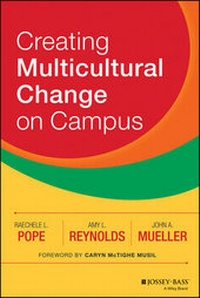
Creating Multicultural Change on Campus
Description

More details
Other editions
Additional editions
Persons
Content
1
MULTICULTURAL COMPETENCE AND MULTICULTURAL CHANGE
CREATING MULTICULTURAL CAMPUSES HAS BECOME an aspirational goal for many colleges and universities today. However, moving beyond aspirations to actual concrete steps can be a rather challenging task. When asked, most campus administrators acknowledge this quest for diversity (Levine & Cureton, 1998), yet few have the awareness, knowledge, or skills to achieve this laudable goal (Pope, Reynolds, & Mueller, 2004). “In light of the reality that colleges and universities are becoming more racially, ethnically, and culturally diverse, extensive knowledge of diversity issues and topics related to multiculturalism are vital for higher education and student affairs professionals” (Flowers, 2004, p. 3). During the past four decades, multicultural initiatives and change efforts have become abundant in higher education. Many institutions have developed specific programs, hired uniquely qualified professionals, and made changes to the curriculum to address multicultural issues; however, many of those efforts have been inconsistent, fragmented, reactive, and based on trial and error rather than relying on well-developed scholarship, assessment data, and leadership within the institution (Kezar & Eckel, 2008; Krishnamurthi, 2003; Pope, 1992; Smith, 2009; Williams, 2013).
Williams (2013), in his extensive research study of senior diversity officers at more than 700 diverse academic institutions, provides a snapshot of the current status of many diversity efforts on college and university campuses. His research focuses on higher education diversity capabilities that he views as vital to the development of a multicultural vision and strategy. His study found that while most campuses embrace general diversity planning strategies in which diversity is part of the campus mission statement or mentioned within some strategic or academic plans, few colleges and universities have created the commitment and infrastructure of more robust, substantial, and concrete campus diversity plans. Additionally, most campuses are not engaged in intensive or extensive accountability efforts to ensure campus-wide investment in the multicultural change effort. Instead, what often happens is that particular individuals or offices are responsible for specific diversity goals. Almost half of all campuses studied by Williams have used diversity training and education programs to educate their employees; however, senior administrators and faculty members rarely participate in such training. Although engaging in campus-wide conversations on diversity is necessary, it is not sufficient without a broader effort toward accountability. Likewise, despite the emphasis on assessment at many colleges and universities (Pope, Reynolds, & Mueller, 2004), few campuses engage in meaningful and rigorous assessments or research studies to ensure that their multicultural change efforts are having the desired effect.
Remember that these multicultural initiatives are part of a longer trajectory toward diversity within higher education. “Contrary to popular belief, the deliberate, conscious effort to achieve greater student diversity on our campuses was not born in the 1960s. In fact, it reaches back to the mid-nineteenth century, when issues of racial, ethnic, and other forms of diversity were no less volatile in American life than they are today” (Rudenstine, 2001, p. 32). Fast-forward to the mid-twentieth century and the same issues of access and equity were still the centerpieces of diversity efforts on campus (Chang, 2005; Smith, 2009). Although legal battles ultimately shaped the outcome of many of these access and equity endeavors, the aftershocks of those fights remain and have evolved into ongoing conversations, sometimes debates, about curriculum, campus climate, student success, and institutional multicultural efforts (Smith, 2009). As the student body became more diverse in recent decades, many college administrators began to address issues of climate, which led to programmatic interventions and the creation of diversity-related offices (e.g., Office of Multicultural Affairs) whose task was to integrate underrepresented students into the overall student body. This dynamic also led to the growth of many student groups or organizations whose purpose was to provide support and educate the broader campus on diversity issues. Yet, even as the student body diversified, the overall culture of higher education often has not changed, frequently leading to high attrition and low satisfaction (Rankin & Reason, 2005). “While our campuses often look more diverse . . . that appearance is misleading and can camouflage the concerns that emerge as one looks deeper into the institution” (Smith, 2009, p. 254). Despite this apparent diversity, many students still sit with their own racial groups and rarely develop deep friendships with members of another race, attend cultural functions with other races, or meet other meaningful multicultural markers (Stearns, Buchmann, & Bonneau, 2009). Instead, many students of color, lesbian, gay, bisexual, and transgender (LGBT) students, and religious minorities continue to report feeling isolated, harassed, singled out, and unwelcome (Rankin & Reason, 2005).
This enduring reality led many campuses to create or expand retention efforts for underrepresented students and the recruitment of diverse faculty in hopes of halting the revolving door. Although many colleges and universities have focused on retention, with limited programmatic efforts and minimal institutional strategic planning focused on multicultural issues, extensive research evidence was generated that helped to build the case for admitting underrepresented students because of the educational value of a diverse student body (e.g., Antonio, Chang, Hakuta, Kenny, Levin, & Milem, 2004; Gurin, Dey, Hurtado, & Gurin, 2002; Hu & Kuh, 2003; Hurtado, Dey, Gurin, & Gurin, 2003; Milem, Chang, & Antonio, 2005; Orfield, 2001). This scholarly direction, which became the crux of the argument supporting affirmative action in college admission cases before the Supreme Court in 2003, moved the conversation away from the notion that campuses should embrace diversity because it was the right thing to do. Instead, the new diversity rationale began to focus on the educational, social, and economic benefits of a culturally diverse student body (Chang, 2005; Chang, Chang, & Ledesma, 2005; Gurin & Nagda, 2006).
History of Diversity Efforts in Higher Education
In her review of the past forty years of diversity efforts in higher education, Smith (2009) identified two important themes: “great change and great unfinished business” (p. 80). From her vantage point, great change included “changing demographics, the increasing calls for inclusiveness in higher education, the expanding accountability mandates, and the growing understanding of the multiplicity of perspectives concerning identity” (p. 132). Marchesani and Jackson (2005) offered a historical analysis of multicultural change efforts that highlighted four common response patterns. First, a crisis-driven social diversity and social justice agenda has often been the fulcrum of change efforts in higher education, leading to unresolved concerns and long-standing problems. Second, many change efforts have focused on increasing underrepresented student groups, with little attention paid to increasing underrepresented faculty and staff members or educating dominant members of the community about their privilege or contribution to the multicultural challenges facing the institution. The third response pattern is that most change efforts target individual behavior change rather than systemic structures that perpetuate monocultural values and practices. This has led to what Miller and Katz (2002) call “diversity in a box,” in which “diversity activities are pre-packaged, one-size-fits-all training exercises strictly relating to differences between people” (p. 28). Finally, the reality is that for many institutions, the individuals personally committed to creating multicultural change often exist at the margins of power within the organization. They attempt to intervene and advocate, but with limited power and influence, their efforts are often short-lived and have limited effect.
Chang (2005) suggested that whereas early diversity efforts focused almost exclusively on race and ethnicity, current discussions and interventions incorporate a very dynamic and growing collection of identities and concerns, which create challenges for many institutions. Many campus leaders are hesitant and unsure of the complexity of all these changes and often are unable to fully substantiate that their diversity efforts have made an actual difference on their campuses. This reality has led to increased calls for assessment and accountability as well as a push for heightened institutional leadership (Aguirre & Martinez, 2002; Harper & Hurtado, 2007; Kezar & Eckel, 2008; Smith & Parker, 2005). This is part of the unfinished business identified as Smith’s second theme: Diversity is no longer enough; rather, “creating the conditions under which diversity thrives will be critical to institutional success” (p. 132). Diversity as an end goal is shortsighted; instead, viewing diversity as a source of excellence within higher education has become the new direction (Williams, 2013).
How Campuses Deal with Multicultural Issues
Understanding how multicultural issues are conceptualized and...
