

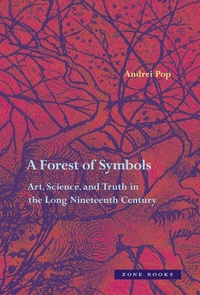
A Forest of Symbols
Description

In this groundbreaking book, Andrei Pop presents a lucid reassessment of those writers and artists in the late nineteenth century whose work merits the adjective "symbolist." For Pop, this term denotes an art that is self-conscious about its modes of making meaning and he argues that these symbolist practices, which sought to provide more direct access to the viewer by constant revision of its material means of meaning-making (brushstrokes on a canvas, words on a page), are crucial to understanding the genesis of modern art. The symbolists saw art not as a social revolution, but a revolution in sense and in how we conceptualize the world. At the same time, the concerns of symbolist painters and poets were shared to a remarkable degree by theoretical scientists of the period, especially by mathematicians and logicians who were dissatisfied with the strict empiricism dominant in their disciplines, and which made shared knowledge seem unattainable. A crisis of sense made art and science look for conceptual foundations underlying the diverging subjective responses and perceptions of individuals.
Unlike other studies of this period, Pop's focus is not on how individual artists may have absorbed bits of scientific theories, but rather on the philosophical questions that were relevant to both domains. The problem of subjectivity in particular, of what in one's experience can and cannot be shared, was crucial to the possibility of collaboration within science and to the communication of artistic innovation. Pop's brilliant close readings of the literary and visual practices of Manet and Mallarmé, of drawings by Ernst Mach, William James and Wittgenstein, of experiments with color by Bracquemond and Van Gogh, and of the philosophical systems of Frege and Russell add up to a startling but coherent picture of the symbolist heritage of modernity and its consequences.
More details
Other editions
Additional editions
Person
Content
- Intro
- Contents
- Preface: Why Symbolism?
- 1 Symbolisms in the Plural
- 2 Crises of Sense: The French Take on Edgar Allan Poe
- 3 Where Do We Come From? Symbolism's Psychologistic Roots
- 4 What Are We? A Symbolist Picture Theory
- 5 Where Are We Going? Consequences of Symbolism
- Conclusion: Beyond Symbolism
- Acknowledgments
- Notes
- Index
