

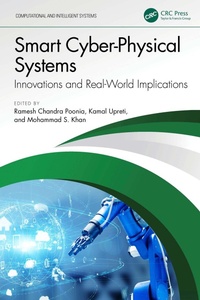
Smart Cyber-Physical Systems
Innovations and Real-World Implications
Published on 16. September 2025
362 pages
978-1-040-41036-3 (ISBN)
Description

Smart cyber-physical systems (SCPS) are revolutionizing the interaction between the physical and digital realms, driving innovation across diverse fields. This book provides an extensive overview of cutting-edge SCPS technologies, highlighting their applications, challenges, and transformative potential. Designed for researchers, professionals, and students, it offers foundational insights and advanced applications in urban planning, healthcare, transportation, finance, and cybersecurity. It also bridges the gap between theory and practice through real-world case studies and in-depth analysis, showcasing how SCPS address critical global challenges.
This book:
Provides a comprehensive introduction to SCPS, their components, and their applications in various domains and explores their role in enabling sustainable smart cities and urban planning
Provides advanced SCPS-based solutions for optimizing supply chain logistics and route planning and real-world applications of SCPS in healthcare, including wearable technology and remote patient monitoring, and financial modeling, comparing investment indices using advanced techniques
Discusses the integration of artificial intelligence and machine learning in autonomous vehicle systems and transportation
Analyzes cybersecurity challenges in cryptocurrency and blockchain ecosystems
Focuses on innovations in energy management, including smart grids and sustainable practices powered by SCPS, and explores adaptive human-machine interaction frameworks for enhanced decision-making
This book serves as a vital resource for understanding the transformative power of SCPS and inspires further research and development in this dynamic and rapidly evolving field.
This book:
Provides a comprehensive introduction to SCPS, their components, and their applications in various domains and explores their role in enabling sustainable smart cities and urban planning
Provides advanced SCPS-based solutions for optimizing supply chain logistics and route planning and real-world applications of SCPS in healthcare, including wearable technology and remote patient monitoring, and financial modeling, comparing investment indices using advanced techniques
Discusses the integration of artificial intelligence and machine learning in autonomous vehicle systems and transportation
Analyzes cybersecurity challenges in cryptocurrency and blockchain ecosystems
Focuses on innovations in energy management, including smart grids and sustainable practices powered by SCPS, and explores adaptive human-machine interaction frameworks for enhanced decision-making
This book serves as a vital resource for understanding the transformative power of SCPS and inspires further research and development in this dynamic and rapidly evolving field.
More details
Series
Language
English
Place of publication
London
United Kingdom
Publishing group
Taylor & Francis Ltd
Target group
College/higher education
Professional and scholarly
Illustrations
42 Tables, black and white; 95 Line drawings, black and white; 10 Halftones, black and white; 105 Illustrations, black and white
File size
12,41 MB
ISBN-13
978-1-040-41036-3 (9781040410363)
Copyright in bibliographic data and cover images is held by Nielsen Book Services Limited or by the publishers or by their respective licensors: all rights reserved.
Schweitzer Classification
Other editions
Additional editions
Ramesh Chandra Poonia | Kamal Upreti | Mohammad S. Khan
Smart Cyber-Physical Systems
Innovations and Real-World Implications
Book
09/2025
1st Edition
CRC Press
€234.00
Shipment within 10-20 days
Persons
Ramesh Chandra Poonia completed a Postdoctoral Fellowship from the Cyber-Physical Systems Laboratory (CPS Lab), Department of ICT and Natural Sciences, Norwegian University of Science and Technology (NTNU), Alesund, Norway. He also completed a Part-Time Postdoctoral Fellowship on the International Collaborative Project of a Prediction Model for Pandemic Disease using Machine Learning at Oakland University, USA, and Imam University, Saudi Arabia. He received his Ph.D. in Computer Science from Apaji Institute of Mathematics & Applied Computer Technology, Banasthali University, Banasthali, India, in July 2013. He has also completed Master of Technology (M.Tech.) in Data Science & Engineering, Work Integrated Learning Programme (WILP) from Birla Institute of Technology and Science, Pilani (BITS Pilani), India. He is a Professor in the Department of Computer Science, CHRIST (Deemed to be University), Bangalore, India. His research interests are sustainable technologies, cyber-physical systems, computational intelligence, and network protocol evaluation. He is Chief Editor of the TARU Journal of Sustainable Technologies and Computing (TJSTC) and Associate Editor of the Sustainable Computing: Informatics and Systems, Elsevier. He also serves on the editorial boards of a few international journals. He is the principal author and co-author of six books and an editor of more than 25 special issues of journals, books, and conference proceedings. He has also authored/co-authored over 75 research publications in peer-reviewed reputed journals, book chapters, and conference proceedings. Moreover, he is a regular reviewer for international journals and conferences. He also serves as Conference Chair of Conference Series, International Conference on Sustainable Computing in Science, Technology and Management (SUSCOM-20XX). He was endorsed with the prestigious "Faculty Appreciation Award 2013" for commendable services. H-index as of July 2022 is 23, according to Google Scholar.
Kamal Upreti is currently working as Associate Professor in the Department of Computer Science, CHRIST (Deemed to be University), Delhi NCR, Ghaziabad, India. He completed his B.Tech (Hons) degree from UPTU, M.Tech (Gold Medalist) and PGDM(Executive) from IMT Ghaziabad, and Ph.D. in the Department of Computer Science & Engineering. He has completed his postdoctorate degree at the National Taipei University of Business, TAIWAN, funded by MHRD. He has published 50+ patents, 32+ magazine issues, and 165+ research papers in various reputed journals and international conferences. His areas of interest include modern physics, data analytics, cyber security, machine learning, healthcare, embedded systems, and cloud computing. He has published more than 45+ authored and edited books in reputed publications. He has years of enriched experience in corporate and teaching fields in engineering colleges. He has worked with HCL, NECHCL, Hindustan Times, Dehradun Institute of Technology, and Delhi Institute of Advanced Studies, with more than 15+ years of enriching experience in research, academics, and corporate fields. He has also worked at NECHCL in Japan, where he had a project called "Hydrastore" funded by a collaboration between HCL and NECHCL Company. He worked on a government project: "Integrated Power Development Scheme (IPDS)," launched by the Ministry of Power, Government of India, to strengthen the sub-transmission and distribution network in the urban areas. Currently, he has completed work in collaboration with GB PANT & AIIMS Delhi, the funded project of the ICMR Scheme on cardiovascular disease prediction strokes using machine learning techniques from 2017 to 2020, which has a fund of 80 lakhs. He got 5 lakhs funding from DST SERB for conducting the International Conference, ICSCPS-2024, 13-14 Sept 2024. Recently, he received a fund of 10 lakhs from AICTE - Inter-Institutional Biomedical Innovations and Entrepreneurship Program (AICTE-IBIP) for 2024-2026. He has attended as a session chairperson at national and international conferences and was a keynote speaker on various platforms such as skill-based training, corporate training, guest faculty, and faculty development programs. He was awarded as the best teacher, researcher, extra academic performer, and gold medalist in the M.Tech program.
Mohammad S. Khan (SM' 19) is Associate Professor of Computing at East Tennessee State University and Director of the Network Science and Analysis Lab (NSAL). He received his M.Sc. and Ph.D. in Computer Science and Computer Engineering from the University of Louisville, Kentucky, USA, in 2011 and 2013, respectively. His primary area of research is in ad hoc networks, wireless sensor networks, network tomography, connected vehicles, vehicular social networks, and cyber-physical systems. He is an associate editor of IEEE Access, IET ITS, IET WSS, Telecommunication Systems, and Neural Computing and Applications. He has been on technical program committees of various international conferences and is a technical reviewer of various international journals in his field. He is a senior member of IEEE.
Kamal Upreti is currently working as Associate Professor in the Department of Computer Science, CHRIST (Deemed to be University), Delhi NCR, Ghaziabad, India. He completed his B.Tech (Hons) degree from UPTU, M.Tech (Gold Medalist) and PGDM(Executive) from IMT Ghaziabad, and Ph.D. in the Department of Computer Science & Engineering. He has completed his postdoctorate degree at the National Taipei University of Business, TAIWAN, funded by MHRD. He has published 50+ patents, 32+ magazine issues, and 165+ research papers in various reputed journals and international conferences. His areas of interest include modern physics, data analytics, cyber security, machine learning, healthcare, embedded systems, and cloud computing. He has published more than 45+ authored and edited books in reputed publications. He has years of enriched experience in corporate and teaching fields in engineering colleges. He has worked with HCL, NECHCL, Hindustan Times, Dehradun Institute of Technology, and Delhi Institute of Advanced Studies, with more than 15+ years of enriching experience in research, academics, and corporate fields. He has also worked at NECHCL in Japan, where he had a project called "Hydrastore" funded by a collaboration between HCL and NECHCL Company. He worked on a government project: "Integrated Power Development Scheme (IPDS)," launched by the Ministry of Power, Government of India, to strengthen the sub-transmission and distribution network in the urban areas. Currently, he has completed work in collaboration with GB PANT & AIIMS Delhi, the funded project of the ICMR Scheme on cardiovascular disease prediction strokes using machine learning techniques from 2017 to 2020, which has a fund of 80 lakhs. He got 5 lakhs funding from DST SERB for conducting the International Conference, ICSCPS-2024, 13-14 Sept 2024. Recently, he received a fund of 10 lakhs from AICTE - Inter-Institutional Biomedical Innovations and Entrepreneurship Program (AICTE-IBIP) for 2024-2026. He has attended as a session chairperson at national and international conferences and was a keynote speaker on various platforms such as skill-based training, corporate training, guest faculty, and faculty development programs. He was awarded as the best teacher, researcher, extra academic performer, and gold medalist in the M.Tech program.
Mohammad S. Khan (SM' 19) is Associate Professor of Computing at East Tennessee State University and Director of the Network Science and Analysis Lab (NSAL). He received his M.Sc. and Ph.D. in Computer Science and Computer Engineering from the University of Louisville, Kentucky, USA, in 2011 and 2013, respectively. His primary area of research is in ad hoc networks, wireless sensor networks, network tomography, connected vehicles, vehicular social networks, and cyber-physical systems. He is an associate editor of IEEE Access, IET ITS, IET WSS, Telecommunication Systems, and Neural Computing and Applications. He has been on technical program committees of various international conferences and is a technical reviewer of various international journals in his field. He is a senior member of IEEE.
Content
1. Exploring Advancements in Space Object Detection through Computer Vision. 2. Smart Cities and The Role of Smart Cyber-Physical Systems Towards Sustainability: Case Studies. 3. Integrating CPS in Digital Payments 5.0: A Study on Security Risks and Evidence-Based Solutions. 4. AI-Driven Smart Cyber-Physical Systems for Optimizing Supply Chain Route Planning and Logistics. 5. Integrating Smart Cyber-Physical Systems into Urban Planning: The Future of Smart Cities. 6. Smart Cyber-Physical Systems in Healthcare: Revolutionizing Modern Medicine in RPM and Health Security. 7. Smart Transportation and Autonomous System Integration. 8. Healthcare and Wearables in Smart Cyber-Physical Systems. 9. Maximizing Investment Potential: A Comparative Study of Nifty 50 and Nifty Midcap 100 Using Advanced Machine Learning based Financial Models. 10. Integrating Collaborative and Machine Learning to Improve Performance in Autonomous Cyber-Physical System. 11. Transforming Autonomous Vehicle Technology: AI and Machine Learning Applications in Cyber-Physical Systems. 12. Real-Time Player Performance Analytics: Leveraging Smart Cyber-Physical Systems and AI in Sports. 13. Navigating the Risks: Cybersecurity Challenges in Cryptocurrency and Blockchain Solutions. 14. Smart Grid and Energy Management in Smart Cyber-Physical Systems (SCPS). 15. Investigating System Vulnerabilities in Digital Environments. 16. Adaptive Multimodal Human-Machine Interaction in Cyber-Physical Systems for Enhanced Decision Making.
