

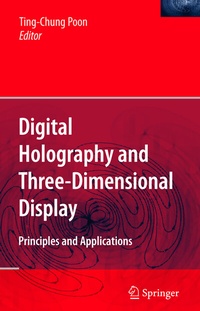
Digital Holography and Three-Dimensional Display
Description

Digital (or electronic) holography and its application to 3-D display is one of the formidable problems of evolving areas of high technology that has been receiving great attention in recent years. Indeed, the "Holy Grail" for 3-D display is the realization of life-size interactive 3-D displays. Obviously, we are not there yet, but advances in 3-D display allow us to make important steps towards the Holy Grail. The theme of this book is to organize a collection of key chapters that covers digital holography and 3-D display techniques so as to provide the reader with the state-of-the-art developments in these important areas around the world.
More details
Other editions
Additional editions
Person
About the editor
Ting-Chung Poon is Professor at Virginia Tech in the Bradley Department of Electrical and Computer Engineering, where he is also Director of the Optical Image Processing Laboratory. His current research interests include acousto-optics, hybrid (optical/electronic/digital) 3-D image processing, optical scanning cryptography, optical scanning holography, 3-D holographic display, and 3-D holographic microscopy. Dr. Poon is the co-author of the textbooks Principles of Applied Optics (McGraw-Hill 1991) and Contemporary Optical Image Processing with MATLAB® (Elsevier 2001). He has served as a panelist for the National Institutes of Health and the National Science Foundation, and as guest editor of, among other publications, Applied Optics, International Journal of Optoelectronics, and Optical Engineering. Dr. Poon currently serves as a topical editor for Applied Optics and is on the editorial board of Optics and Laser Technology and the Journal of Holography and Speckle. Dr. Poon is a Fellow of the OSA and SPIE and is a Senior Member of the IEEE.
