

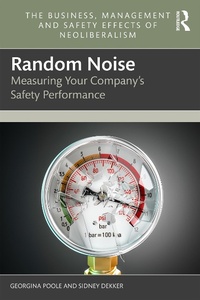
Random Noise
Measuring Your Company's Safety Performance
1st Edition
Published on 10. June 2024
146 pages
978-1-040-03104-9 (ISBN)
Description

In the realm of safety management, this book embarks on a profound exploration of how the political economy was reshaped in the last two decades. Much like privatization, deregulation, and financialization altered the economic landscape, this narrative unveils how safety management has been affected by the intertwined dynamics of asset underinvestment, privatization, self-regulation, workplace flexibilization, and market-driven policies.
This book, the second installment of a thought-provoking trilogy on the consequences of neoliberalism, mirrors the political economy's promotion of the private sector's role in the economy. Just as neoliberalism amplified and accelerated the mechanisms of human-made disasters in complex systems, this narrative lays bare the heightened potential for safety misfortunes when governed by market-driven principles.
As the story unfolds, the book delves into the concept of 'synoptic legibility' in safety management, akin to how the political economy distilled its essence into privatization and deregulation. The authors scrutinize the consequences of translating safety measures into rigid targets, unveiling how this shift can distort the integrity of safety metrics and inadvertently harm individuals. Drawing parallels with historical blunders such as England's window tax, the book contemplates the precarious nature of equating simplified metrics with safety achievements. Much like the political economy's 'acceptable risk' renegotiations, it examines how the pursuit of safety through metrics and surveillance can lead to 'manufactured insecurity,' eroding trust, autonomy, and professionalism.
In Random Noise, Poole and Dekker extend this reach once again, writing for all managers, board members, organization leaders, consultants, practitioners, researchers, lecturers, students, and investigators curious to understand the genuine nature of organizational and safety performance.
This book, the second installment of a thought-provoking trilogy on the consequences of neoliberalism, mirrors the political economy's promotion of the private sector's role in the economy. Just as neoliberalism amplified and accelerated the mechanisms of human-made disasters in complex systems, this narrative lays bare the heightened potential for safety misfortunes when governed by market-driven principles.
As the story unfolds, the book delves into the concept of 'synoptic legibility' in safety management, akin to how the political economy distilled its essence into privatization and deregulation. The authors scrutinize the consequences of translating safety measures into rigid targets, unveiling how this shift can distort the integrity of safety metrics and inadvertently harm individuals. Drawing parallels with historical blunders such as England's window tax, the book contemplates the precarious nature of equating simplified metrics with safety achievements. Much like the political economy's 'acceptable risk' renegotiations, it examines how the pursuit of safety through metrics and surveillance can lead to 'manufactured insecurity,' eroding trust, autonomy, and professionalism.
In Random Noise, Poole and Dekker extend this reach once again, writing for all managers, board members, organization leaders, consultants, practitioners, researchers, lecturers, students, and investigators curious to understand the genuine nature of organizational and safety performance.
Reviews / Votes
"'You don't show your workers the TRIFR in safety meetings? What do you talk about then?'. This was asked of me of a high-level manager once - we talked about discussing controls and operational learning, and now we have Random Noise as text to support why these metrics don't reflect safety in an organisation. I've personally seen the behaviours these metrics can drive, and this book calls these out with practical examples of its negative impacts, whist also presenting real alternatives that businesses can explore."Josh Bryant, General Manager - People, Risk (HSE) and Sustainability, Mitchell Services Limited, Australia
"Georgina and Sidney articulate the significance of adopting a progressive approach towards measuring proactive safety performance, underlining the shift from traditional reactive metrics to a more foresight-driven methodology. The book serves as a pragmatic thought starter for safety professionals, with clear actionable tips to operationalise this much needed industry shift in focus."
Luke Beeston, Director of Risk and Innovation, HSE Global, Australia
"Random Noise: Measuring your company's safety performance by Georgina Poole and Sidney Dekker is a must-read book that explains how injury rates in organizations can be misunderstood or misrepresented. The authors have done extensive research and analysis, and their work provides valuable perspectives on safety performance. This book is highly recommended for anyone who wants to learn more about safety performance and how to improve it effectively."
Brad Green MS, CSP, OHST, CHST, USA
"This book hooks right from the beginning, it clearly shows how our quest for a single tell all metric is not the right way of looking at 'safety'. With great examples and supporting arguments throughout, I am also pleased to see some instruction on how to do safety differently. This is great, with very clear and workable advice."
Jon Schmidt, Human and Organisational Performance Leader, Davey Tree, USA
"This book demonstrates that counting things matters, but you need to count the right things. Take a walk through a shipyard and then a walk through a nuclear power facility, and the differences in attitudes and what matters the most to the cultures vastly differ. Measure those attitudes on top of outcomes, and you're heading to more meaningful performance indicators".
James Newman, Human Performance Improvement Manager, Lawrence Berkeley National Laboratory, USA
More details
Series
Edition
1. Auflage
Language
English
Place of publication
London
United Kingdom
Publishing group
Taylor & Francis Ltd
Target group
College/higher education
Professional and scholarly
Product notice
Reflowable
ISBN-13
978-1-040-03104-9 (9781040031049)
Copyright in bibliographic data and cover images is held by Nielsen Book Services Limited or by the publishers or by their respective licensors: all rights reserved.
Schweitzer Classification
Other editions
Additional editions
Book
06/2024
1st Edition
Routledge
€196.80
Shipment within 10-20 days
Book
06/2024
1st Edition
Routledge
€52.50
Shipment within 10-20 days
Persons
Georgina Poole is a Health and Safety Professional in Brisbane, Australia. She has spent more than 15 years embedded in operational safety roles across a variety of industries, including mining, oil and gas, construction, and aviation. Georgina is well known for her podcast 'Leading Safely' and her passion for human and organizational performance. She recently completed her Graduate Certificate of Safety Leadership at Griffith University, where co-author Sidney Dekker is the Program Director.
Sidney Dekker is a Professor at Griffith University in Brisbane, Australia, where he founded the Safety Science Innovation Lab. He is also Honorary Professor of Psychology at the University of Queensland. Previously, Dekker was Professor at Lund University in Sweden, where he founded the Leonardo da Vinci Laboratory for Complexity and Systems Thinking, and flew as First Officer on Boeing 737s for Sterling and later Cimber Airlines out of Copenhagen. Dekker is a high-profile scholar and is known for his work in the fields of human factors and safety. He is the author of many best-selling titles, such as Just Culture, Safety Differently, The Field Guide to Understanding Human Error, Drift into Failure, The Safety Anarchist, and Foundations of Safety Science.
Sidney Dekker is a Professor at Griffith University in Brisbane, Australia, where he founded the Safety Science Innovation Lab. He is also Honorary Professor of Psychology at the University of Queensland. Previously, Dekker was Professor at Lund University in Sweden, where he founded the Leonardo da Vinci Laboratory for Complexity and Systems Thinking, and flew as First Officer on Boeing 737s for Sterling and later Cimber Airlines out of Copenhagen. Dekker is a high-profile scholar and is known for his work in the fields of human factors and safety. He is the author of many best-selling titles, such as Just Culture, Safety Differently, The Field Guide to Understanding Human Error, Drift into Failure, The Safety Anarchist, and Foundations of Safety Science.
Content
1. The lure of a homogenised quantity; 2. Stop counting what you can count - it doesn't count; 3. How many injuries are enough?; 4. The absence of injuries does not predict what you think it does; 5. But I am only injuring my sub-contractors!; 6. Measuring nothing in 'ultra-safe' industries; 7. Don't talk about safety culture - talk about safety climate!; 8. What if not every injury is preventable?; 9. What should you measure instead?; 10. Now, what should your safety people do?
