

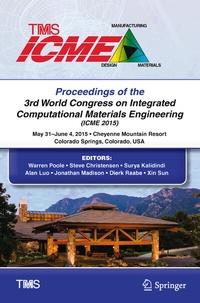
Proceedings of the 3rd World Congress on Integrated Computational Materials Engineering (ICME)
1st Edition
Published on 5. December 2016
XVIII, 373 pages
978-3-319-48170-8 (ISBN)
Description

This book presents a collection of papers presented at the 3rd World Congress on Integrated Computational Materials Engineering (ICME), a specialty conference organized by The Minerals, Metals & Materials Society (TMS). This meeting convened ICME stakeholders to examine topics relevant to the global advancement of ICME as an engineering discipline.
The papers presented in these proceedings are divided into six sections: (1) ICME Applications; (2) ICME Building Blocks; (3) ICME Success Stories and Applications (4) Integration of ICME Building Blocks: Multi-scale Modeling; (5) Modeling, Data and Infrastructure Tools, and (6) Process Optimization. .
These papers are intended to further the global implementation of ICME, broaden the variety of applications to which ICME is applied, and ultimately help industry design and produce new materials more efficiently and effectively.
More details
Other editions
Additional editions
Warren Poole | Steve Christensen | Surya Kalidindi
Proceedings of the 3rd World Congress on Integrated Computational Materials Engineering (ICME)
Book
06/2015
Wiley
€141.13
Article exhausted; check different version
Persons
The Minerals, Metals & Materials Society (TMS) is a member-driven international professional society dedicated to fostering the exchange of learning and ideas across the entire range of materials science and engineering, from minerals processing and primary metals production, to basic research and the advanced applications of materials. Included among its nearly 13,000 professional and student members are metallurgical and materials engineers, scientists, researchers, educators, and administrators from more than 70 countries on six continents. For more information on TMS, visit www.tms.org.
Content
- Cover
- Half Title
- Title Page
- Copyright Page
- Table of Contents
- Preface
- Acknowledgments
- Conference Editors/Organizers
- ICME Applications
- Importance of Controlling Microstructure Heterogeneity When Designing Steel
- ICME for Process Scale-Up: Importance of Vertical and Horizontal Integration of Models
- Finite Element Model for Plymouth Tube Processing Using Internal State Variables
- Ab-Initio Calculation of Solute Effects on Austenite Grain Boundary Properties in Steel
- ICME Towards Improved Understanding of Bainite in 100CR6
- Steel - Ab Initio: Quantum Mechanics Guided Design of New Fe-Based Materials
- Experiments and Modeling of Three-Dimensional Dendritic Morphology of Magnesium Alloy
- Phase Field Simulation of Orowan Strengthening by Coherent Precipitate Plates in a Mg-Nd Alloy
- Application of Multi-Scale Fatigue Models in Lightweight Metal Castings
- Experimental Verification for Solid Fraction Measurement in Semi-Solid Silver Metal Processing in Comparison with Theoretical Thermodynamics Model
- Experimental and Numerical Determination of the Fracture Energy of Pan/Phenolic-Based Carbon/Carbon Composites
- ICME Building Blocks
- From Integrated Computational Materials Engineering to Integrated Computational Structural Engineering
- Predictive Simulation of Diffusion in Ni-Based Alloys Using Pair Interaction Based Kinetic Monte Carlo Method
- Yield Strength Model for Undercooled Aluminium Alloys Based on Calorimetric In-Situ Quenching Experiments
- Load Partitioning Mechanisms in Stainless Steel 440C by Crystal Plasticity Based Micromechanical Modeling Approach
- A Molecular Dynamics Simulation Mechanism with Imprecise Interatomic Potentials
- A Curve Swarm Algorithm for Global Search of State Transition Paths
- Modelling the Microstructure of Polycrystalline Austenite-Martensite Steels
- An Interface to Quantum ESPRESSO
- ICME Success Stories and Applications
- Microstructure Modelling in ICME Settings
- Development of an ICME Approach for Aluminum Alloy Corrosion
- ICME Support for Jumbo Vertical Bloom Continuous Caster
- ICME Applications in Optimizing Welding and Thermal-Forming Processes
- Design of Co-Free Cemented Carbides
- Integration of ICME Building Blocks: Multi-Scale Modeling
- Modeling and Simulation of Directional Solidification of Ni-Based Superalloy Turbine Blades Casting by Liquid Metal Cooling
- From Melt Pool to Strength - Application of ICME Methods for the Development of Rapid Manufacturing Technologies
- Calibrated Localization Relationships for Polycrystalline Aggregates by Using Materials Knowledge System
- Computational Modeling and Experimental Characterization of Martensitic Transformations in NiCoAl for Self-Sensing Materials
- Mesoscale Modeling of 3-d Voids Evolution in Large Ingot during Multi-Hit Deformation
- Modeling, Data and Infrastructure Tools
- Data Infrastructure Developed for PW-8: Nickel Base Superalloy Residual Stress Foundational Engineering Problem
- Application of Machine Learning Techniques for Inverse Prediction in Manufacturing Process Chains
- nanoHUB as a Platform for Implementing ICME Simulations in Research and Education
- A Review of Materials Data Infrastructure Projects
- An Integrated Collaborative Environment for Materials Research
- Analysis of Published Cast Iron Experimental Data
- Process Optimization
- A General Simulation Technology for Forging with Considering the Evolution of Voids, Grains and Cracks
- A Method for Determining the Set Points of the Ladle, Tundish and Caster for Manufacturing a High Strength Steel Slab
- ICME for the Integrated Design of an Automotive Gear Considering Uncertainty
- An Integrated Surrogate Modeling Approach for Materials and Process Design
- Uncertainty Management in the Integrated Realization of Materials and Components
- Exploring the Performance-Property-Structure Solution Space in Friction Stir Welding
- Force Modelling for Temperature Field Determination during High Speed End-Milling of Super Alloys
- Author Index
- Subject Index
