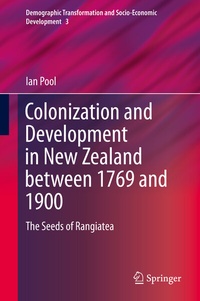
Colonization and Development in New Zealand between 1769 and 1900
Description

This book details the interactions between the Seeds of Rangiatea, New Zealand's Maori people of Polynesian origin, and Europe from 1769 to 1900. It provides a case-study of the way Imperial era contact and colonization negatively affected naturally evolving demographic/epidemiologic transitions and imposed economic conditions that thwarted development by precursor peoples, wherever European expansion occurred. In doing so, it questions the applicability of conventional models for analyses of colonial histories of population/health and of development.
The book focuses on, and synthesizes, the most critical parts of the story, the health and population trends, and the economic and social development of Maori. It adopts demographic methodologies, most typically used in developing countries, which allow the mapping of broad changes in Maori society, particularly their survival as a people.
The book raises general theoretical questions about how populations react to the introduction of diseases to which they have no natural immunity. Another more general theoretical issue is what happens when one society's development processes are superseded by those of some more powerful force, whether an imperial power or a modern-day agency, which has ingrained ideas about objectives and strategies for development. Finally, it explores how health and development interact.
The Maori experience of contact and colonization, lasting from 1769 to circa 1900, narrated here, is an all too familiar story for many other territories and populations, Natives and former colonists. This book provides a case-study with wider ramifications for theory in colonial history, development studies, demography, anthropology and other fields.
More details
Other editions
Additional editions