

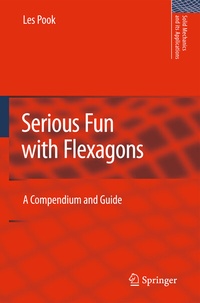
Serious Fun with Flexagons
Description

A flexagon is a motion structure that has the appearance of a ring of hinged polygons. It can be flexed to display different pairs of faces, usually in cyclic order. Flexagons can be appreciated as toys or puzzles, as a recreational mathematics topic, and as the subject of serious mathematical study. Workable paper models of flexagons are easy to make and entertaining to manipulate. The mathematics of flexagons is complex, and how a flexagon works is not immediately obvious on examination of a paper model. Recent geometric analysis, included in the book, has improved theoretical understanding of flexagons, especially relationships between different types.
This profusely illustrated book is arranged in a logical order appropriate for a textbook on the geometry of flexagons. It is written so that it can be enjoyed at both the recreational mathematics level, and at the serious mathematics level. The only prerequisite is some knowledge of elementary geometry, including properties of polygons. A feature of the book is a compendium of over 100 nets for making paper models of some of the more interesting flexagons, chosen to complement the text. These are accurately drawn and reproduced at half full size. Many of the nets have not previously been published. Instructions for assembling and manipulating the flexagons are included.
Reviews / Votes
From the reviews:
"This book comes across as a sort of encyclopedia or a classification of flexagons. . The more serious researcher . will find this book an amazing resource for various kinds of flexagons. . I'm sure this book will remain a reference book of choice in the subject of flexagons for a long time. . If you are looking for . 'Encyclopedia of Flexagons' this flexagon book appears to be the best on the market." (Collin Carbno, The Mathematical Association of America, December, 2009)More details
Other editions
Additional editions
Person
Since my formal retirement in 1998 I have been a Visiting Professor in the Department of Mechanical Engineering at University College London, where I do some part time teaching in the fields of metal fatigue and fracture mechanics. I am a senior official of the European Structural Integrity Society, and have been involved with the organisation of two of their conferences (FCP 2003 and CP 2006), including editing conference proceedings and associated special issues of journals.
