

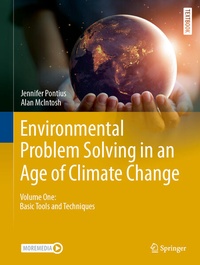
Environmental Problem Solving in an Age of Climate Change
Description

This textbook provides an opportunity for undergraduate students studying the environment to work on addressing real-world environmental problems and practice the disciplinary and professional skills necessary to tackle complex issues. Each of the 12 units that comprise the heart of this workbook-style text focus on a specific environmental challenge directly or indirectly tied to climate change. Students are guided through activities that require them to review relevant environmental content knowledge, practice an array of learning outcome-based skills, evaluate potential solutions, and advocate for action.
An important feature of the book is its problem-based approach, using climate change as a common lens through which to view an array of current environmental challenges. Showing students how they might apply their core knowledge and disciplinary skills to identify possible solutions demonstrates the utility of science to inform decision making and builds student competency in learning outcomes common across environmental academic programs.Designed to provide problem-area options to match student interests (from sea turtle conservation to climate migrants to urban heat islands), instructors can choose among units to best engage students, or work through units sequentially to scaffold instruction while building student capacity. Each unit contains activities that focus on:
(1) Discovery, where students are guided through exploration to build their knowledge of the issue and prepare a formal Problem Statement;
(2) Analysis , where students dig into relevant data and begin to evaluate potential solutions; and
(3) Solutions , where students practice their problem solving, decision making and environmental communication skills.
Environmental Problem Solving in an Age of Climate Change underscores the pervasive nature of climate change as a commonfactor in all environmental issues. The book demonstrates how sustainable solutions require the efforts of many people working on smaller, more tangible issues to tackle the grand challenge that climate change presents.
More details
Other editions
Additional editions
Persons
Jennifer Pontius: Dr. Pontius currently serves as Dean for Curricular Affairs at the Rubenstein School of Environment and Natural Resources and as Director of the Environmental Sciences Program at the University of Vermont. Her scholarship is interdisciplinary, with the goal of scaling field observations and relationships to a landscape-scale using remote sensing and geographic information systems to inform the management of temperate forests. This integration of technical tools with traditional ecological approaches provides the landscape perspective necessary to mitigate the impacts of environmental stressors like climate change with the information necessary to guide activities at local to regional scales.
Alan McIntosh:
After receiving his PhD in limnology at Michigan State University, Professor McIntosh taught at Purdue University and Rutgers University before joining the School of Natural Resources at the University of Vermont. He served as Director of the Vermont Water Resources and Lake Studies Center, and he chaired the Environmental Sciences Program in the school from 1995 until 2013. He taught a number of environmental courses, including the introductory environmental sciences class each semester during that period. His primary research interests have been the fate and effects of toxic contaminants in surface waters.
