

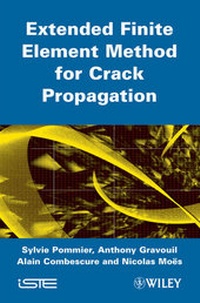
Extended Finite Element Method for Crack Propagation
Description

More details
Other editions
Additional editions
Persons
Sylvie Pommier is Professor at Ecole Normale Supérieure de Cachan and the LMT-Cachan Laboratory in France. Her main research topics include the development of fatigue crack growth rate predictions and methods accounting for load history effects under complex loading conditions (mixed mode loading, non-isothermal fatigue, variable amplitude, corrosion assisted fatigue).
Anthony Gravouil is Professor at INSA and the LaMCoS Laboratory in Lyon, France. His main research topics include the development of efficient and robust numerical methods (X-FEM) for the simulation of crack growth without remeshing, local multi-grid strategy coupled with X-FEM with a 3D representation of "real" cracks by level sets from 3D imaging and the development of space-time multi-scale methods for transient nonlinear dynamics (simulation of crash and impact phenomena).
Alain Combescure is Professor at INSA in Lyon, France. His specialties include buckling, fracture mechanics, dynamics (mainly computational mechanics).
Nicolas Moës is Professor at Ecole Centrale de Nantes in France. His research interests include computational methods in engineering for fracture and impact, and X-FEM.
Content
Acknowledgements xiii
List of Symbols xv
Introduction xvii
Chapter 1. Elementary Concepts of Fracture Mechanics 1
1.1. Introduction 1
1.2. Superposition principle 3
1.3. Modes of crack straining 4
1.4. Singular fields at cracking point 5
1.5. Crack propagation criteria 10
Chapter 2. Representation of Fixed and Moving Discontinuities 21
2.1. Geometric representation of a crack: a scale problem 22
2.2. Crack representation by level sets 29
2.3. Simulation of the geometric propagation of a crack 52
2.4. Prospects of the geometric representation of cracks 66
Chapter 3. Extended Finite Element Method X-FEM 69
3.1. Introduction 69
3.2. Going back to discretization methods 70
3.3. X-FEM discontinuity modeling 79
3.4. Technical and mathematical aspects 94
3.5. Evaluation of the stress intensity factors 98
Chapter 4. Non-linear Problems, Crack Growth by Fatigue 109
4.1. Introduction 109
4.2. Fatigue and non-linear fracture mechanics 114
4.3. eXtended constitutive law 137
4.4. Applications 164
Chapter 5. Applications: Numerical Simulation of Crack Growth 173
5.1. Energy conservation: an essential ingredient 173
5.2. Examples of crack growth by fatigue simulations 182
5.3. Dynamic fracture simulation 192
5.4. Simulation of ductile fracture 207
Conclusions and Open Problems 227
Summary 233
Bibliography 235
Index 253
