

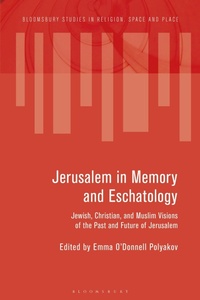
Jerusalem in Memory and Eschatology
Jewish, Christian, and Muslim Visions of the Past and Future of Jerusalem
1st Edition
Published on 12. June 2025
256 pages
978-1-350-50574-2 (ISBN)
Description

Investigating a range of eschatological ideologies, this volume explores the connection
between notions of sacred space and time in Jewish, Christian, and Muslim understandings
of Jerusalem.
The recognition of Jerusalem as a holy city both unites and divides Judaism, Christianity, and
Islam. While these three religious traditions share a reverence for the same ancient city, this
veneration leads more often to tension and violence than to commonality and cooperation.
Each of these religions draws heavily from religious memory and eschatological prophecies,
and sees Jerusalem as a site of past and future upheaval; however, the distinctions in their
visions imbue Jerusalem with meanings that reinforce conflicting and contested ideologies.
Offering multiple analyses of religious interpretations of the city and its sacred sites, this
volume explores these divergent visions of the remembered and anticipated Jerusalem.
between notions of sacred space and time in Jewish, Christian, and Muslim understandings
of Jerusalem.
The recognition of Jerusalem as a holy city both unites and divides Judaism, Christianity, and
Islam. While these three religious traditions share a reverence for the same ancient city, this
veneration leads more often to tension and violence than to commonality and cooperation.
Each of these religions draws heavily from religious memory and eschatological prophecies,
and sees Jerusalem as a site of past and future upheaval; however, the distinctions in their
visions imbue Jerusalem with meanings that reinforce conflicting and contested ideologies.
Offering multiple analyses of religious interpretations of the city and its sacred sites, this
volume explores these divergent visions of the remembered and anticipated Jerusalem.
More details
Series
Edition
1. Auflage
Language
English
Place of publication
London
United Kingdom
Publishing group
Bloomsbury Publishing PLC
Target group
Professional and scholarly
ISBN-13
978-1-350-50574-2 (9781350505742)
Copyright in bibliographic data and cover images is held by Nielsen Book Services Limited or by the publishers or by their respective licensors: all rights reserved.
Schweitzer Classification
Other editions
Additional editions
Emma O'Donnell Polyakov
Jerusalem in Memory and Eschatology
Jewish, Christian, and Muslim Visions of the Past and Future of Jerusalem
Book
07/2025
Bloomsbury Academic
€119.30
Shipment within 15-20 days
Person
Emma O'Donnell Polyakov is a fellow at the Helsinki Collegium for Advanced Studies, Finland and Associate Professor of the Interdisciplinary Study of Religion at Merrimack College, USA. She is also the author of The Nun in the Synagogue: Judeocentric Catholicism in Israel (2020) and Remembering the Future: The Experience of Time in Jewish and Christian Liturgy (2015), and the editor of Antisemitism, Islamophobia, and Interreligious Hermeneutics (2018).
Content
Introduction
"Introduction: Jerusalem in Memory and Eschatology," Emma O'Donnell Polyakov (Merrimack College, USA)
Visions of Time: Memory and Eschatology
1. "'Part of Prophecy': Christian Zionism, Dispensationalism, and Time," Aron Engberg (Lund University, Sweden)
2. "A House of Prayer for all Peoples: A Universal Eschatological Vision for Jerusalem," Alon Goshen-Gottstein (Elijah Interfaith Institute, Jerusalem)
3. "Islamic Visions of Jesus: Revelation, Prophecy, and Eschatology," Antonio Cuciniello (Catholic University of Milan, Italy)
4. "Jerusalem in Memory and Eschatology: A Catholic Perspective," Dirk Ansorge (Jesuit Faculty of Philosophy and Theology Sankt Georgen, Germany)
5. "The Hypertemple in Mind: God's Voice Rebooted in the Temple Scroll," Natalie Bloch (Uppsala University, Sweden)
Visions of Place: Contemporary Conflicts
6. "An Unprecedented Alliance: Evangelical Christians, Jews, and the Rebuilding of the Temple," Yaakov Ariel (University of North Carolina at Chapel Hill, USA)
7. "How the Taboo on Jews Entering the Temple Mount was Broken by Religious Zionist Activists," Motti Inbari (University of North Carolina at Pembroke, USA)
8. "Jerusalem from the Perspective of the ISIS Apocalyptic Propaganda," Bronislav Ostranský (Czech Academy of Sciences, Czechia)
Conclusion
"A Place in Time and a Time in Place: The Spatial and Temporal Nexus in Jewish, Christian, and Muslim Visions of Jerusalem," Emma O'Donnell Polyakov (Merrimack College, USA)
"Introduction: Jerusalem in Memory and Eschatology," Emma O'Donnell Polyakov (Merrimack College, USA)
Visions of Time: Memory and Eschatology
1. "'Part of Prophecy': Christian Zionism, Dispensationalism, and Time," Aron Engberg (Lund University, Sweden)
2. "A House of Prayer for all Peoples: A Universal Eschatological Vision for Jerusalem," Alon Goshen-Gottstein (Elijah Interfaith Institute, Jerusalem)
3. "Islamic Visions of Jesus: Revelation, Prophecy, and Eschatology," Antonio Cuciniello (Catholic University of Milan, Italy)
4. "Jerusalem in Memory and Eschatology: A Catholic Perspective," Dirk Ansorge (Jesuit Faculty of Philosophy and Theology Sankt Georgen, Germany)
5. "The Hypertemple in Mind: God's Voice Rebooted in the Temple Scroll," Natalie Bloch (Uppsala University, Sweden)
Visions of Place: Contemporary Conflicts
6. "An Unprecedented Alliance: Evangelical Christians, Jews, and the Rebuilding of the Temple," Yaakov Ariel (University of North Carolina at Chapel Hill, USA)
7. "How the Taboo on Jews Entering the Temple Mount was Broken by Religious Zionist Activists," Motti Inbari (University of North Carolina at Pembroke, USA)
8. "Jerusalem from the Perspective of the ISIS Apocalyptic Propaganda," Bronislav Ostranský (Czech Academy of Sciences, Czechia)
Conclusion
"A Place in Time and a Time in Place: The Spatial and Temporal Nexus in Jewish, Christian, and Muslim Visions of Jerusalem," Emma O'Donnell Polyakov (Merrimack College, USA)
