

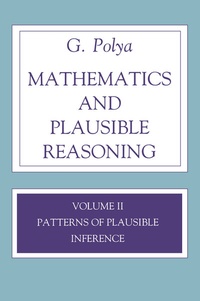
Mathematics and Plausible Reasoning, Volume 2
Logic, Symbolic and mathematical
1st Edition
Published on 25. August 2021
240 pages
978-1-4008-2372-7 (ISBN)
Description

A guide to the practical art of plausible reasoning, this book has relevance in every field of intellectual activity. Professor Polya, a world-famous mathematician from Stanford University, uses mathematics to show how hunches and guesses play an important part in even the most rigorously deductive science. He explains how solutions to problems can be guessed at; good guessing is often more important than rigorous deduction in finding correct solutions. Vol. II, on Patterns of Plausible Inference, attempts to develop a logic of plausibility. What makes some evidence stronger and some weaker? How does one seek evidence that will make a suspected truth more probable? These questions involve philosophy and psychology as well as mathematics.
More details
Other editions
Additional editions
Book
08/1990
Princeton University Press
€52.80
Shipment within 10-20 days
Book
10/1954
Princeton University Press
€47.04
Article exhausted; check different version
Book
01/1954
Princeton University Press
€33.43
Article exhausted; check different version
Person
G. Polya (1887-1985) was Professor of Mathematics at Stanford University.
Content
- Cover Page
- Half-title Page
- Title Page
- Copyright Page
- Preface
- Hints to the Reader
- Contents
- Chapter XII. Some Conspicuous Patterns
- 1. Verification of a consequence
- 2. Successive verification of several consequences
- 3. Verification of an improbable consequence
- 4. Inference from analogy
- 5. Deepening the analogy
- 6. Shaded analogical inference
- Examples and Comments on Chapter XII
- Chapter XIII. Further Patterns and First Links
- 1. Examining a consequence
- 2. Examining a possible ground
- 3. Examining a conflicting conjecture
- 4. Logical terms
- 5. Logical links between patterns of plausible inference
- 6. Shaded inference
- 7. A table
- 8. Combination of simple patterns
- 9. On inference from analogy
- 10. Qualified inference
- 11. On successive verifications
- 12. On rival conjectures
- 13. On judicial proof
- Examples and Comments on Chapter XIII
- Chapter XIV. Chance, The Ever-Present Rival Conjecture
- 1. Random mass phenomena
- 2. The concept of probability
- 3. Using the bag and the balls
- 4. The calculus of probability. Statistical hypotheses
- 5. Straightforward prediction of frequencies
- 6. Explanation of phenomena
- 7. Judging statistical hypotheses
- 8. Choosing between statistical hypotheses
- 9. Judging non-statistical conjectures
- 10. Judging mathematical conjectures
- Examples and Comments on Chapter XIV
- Chapter XV. The Calculus of Probability and the Logic of Plausible Reasoning
- 1. Rules of plausible reasoning?
- 2. An aspect of demonstrative reasoning
- 3. A corresponding aspect of plausible reasoning
- 4. An aspect of the calculus of probability. Difficulties
- 5. An aspect of the calculus of probability. An attempt.
- 6. Examining a consequence
- 7. Examining a possible ground
- 8. Examining a conflicting conjecture
- 9. Examining several consequences in succession
- 10. On circumstantial evidence
- Examples and Comments on Chapter XV
- Chapter XVI. Plausible Reasoning in Invention and Instruction
- 1. Object of the present chapter
- 2. The story of a little discovery
- 3. The process of solution
- 4. Deus ex machina
- 5. Heuristic justification
- 6. The story of another discovery
- 7. Some typical indications
- 8. Induction in invention
- 9. A few words to the teacher
- Examples and Comments on Chapter XVI
- Solutions to Problems
- Bibliography
- Appendix
- I. Heuristic Reasoning in the Theory of Numbers
- II. Additional Comments, Problems, and Solutions
