

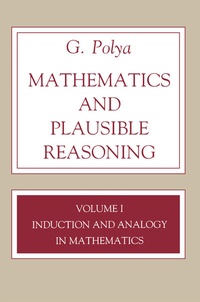
Mathematics and Plausible Reasoning, Volume 1
Induction and Analogy in Mathematics
1st Edition
Published on 11. February 2021
296 pages
978-0-691-21830-4 (ISBN)
Description

A guide to the practical art of plausible reasoning, this book has relevance in every field of intellectual activity. Professor Polya, a world-famous mathematician from Stanford University, uses mathematics to show how hunches and guesses play an important part in even the most rigorously deductive science. He explains how solutions to problems can be guessed at; good guessing is often more important than rigorous deduction in finding correct solutions. Vol. I, on Induction and Analogy in Mathematics, covers a wide variety of mathematical problems, revealing the trains of thought that lead to solutions, pointing out false bypaths, discussing techniques of searching for proofs. Problems and examples challenge curiosity, judgment, and power of invention.
More details
Other editions
Additional editions
Book
08/1990
Princeton University Press
€60.00
Shipment within 10-20 days

Book
10/1954
Princeton University Press
€52.00
Article exhausted; check different version
Book
01/1954
Princeton University Press
€49.52
Article exhausted; check different version
Person
G. Polya (1887-1985) was Professor of Mathematics at Stanford University.
Content
- Cover Page
- Half-title page
- Title page
- Copyright page
- Preface
- Hints to the Reader
- Contents
- Chapter I: Induction
- 1. Experience and belief
- 2. Suggestive contacts
- 3. Supporting contacts
- 4. The inductive attitude
- Examples and Comments on Chapter I.
- Chapter II: Generalization, Specialization, Analogy
- 1. Generalization, Specialization, Analogy, and Induction
- 2. Generalization
- 3. Specialization
- 4. Analogy
- 5. Generalization, Specialization, and Analogy
- 6. Discovery by analogy
- 7. Analogy and induction
- Examples and Comments on Chapter II
- Chapter III: Induction in Solid Geometry
- 1. Polyhedra
- 2. First supporting contacts
- 3. More supporting contacts
- 4. A severe test
- 5. Verifications and verifications
- 6. A very different case
- 7. Analogy
- 8. The partition of space
- 9. Modifying the problem
- 10. Generalization, specialization, analogy
- 11. An analogous problem
- 12. An array of analogous problems
- 13. Many problems may be easier than just one
- 14. A conjecture
- 15. Prediction and verification
- 16. Again and better
- 17. Induction suggests deduction
- the particular case suggests the general proof
- 18. More conjectures
- Examples and Comments on Chapter III
- Chapter IV: Induction in the Theory of Numbers
- 1. Right triangles in integers
- 2. Sums of squares
- 3. On the sum of four odd squares
- 4. Examining an example
- 5. Tabulating the observations
- 6. What is the rule?
- 7. On the nature of inductive discovery
- 8. On the nature of inductive evidence
- Examples and Comments on Chapter IV
- Chapter V: Miscellaneous Examples of Induction
- 1. Expansions
- 2. Approximations
- 3. Limits
- 4. Trying to disprove it
- 5. Trying to prove it
- 6. The role of the inductive phase
- Examples and Comments on Chapter V
- Chapter VI: A More General Statement
- 1. Euler
- 2. Euler's memoir
- 3. Transition to a more general viewpoint
- 4. Schematic outline of Euler's memoir
- Examples and Comments
- Chapter VII: Mathematical Induction
- 1. The inductive phase
- 2. The demonstrative phase
- 3. Examining transitions
- 4. The technique of mathematical induction
- Examples and Comments on Chapter VII
- Chapter VIII: Maxima and Minima
- 1. Patterns
- 2. Examples
- 3. The pattern of the tangent level line
- 4. Examples
- 5. The pattern of partial variation
- 6. The theorem of the arithmetic and geometric means and its first consequences
- Examples and Comments on Chapter VIII
- Chapter IX: Physical Mathematics
- 1. Optical interpretation
- 2. Mechanical interpretation
- 3. Reinterpretation
- 4. Jean Bernoulli's discovery of the Brachistochrone
- 5. Archimedes' discovery of the integral calculus
- Examples and Comments on Chapter IX
- Chapter X: The Isoperimetric Problem
- 1. Descartes' inductive reasons
- 2. Latent reasons
- 3. Physical reasons
- 4. Lord Rayleigh's inductive reasons
- 5. Deriving consequences
- 6. Verifying consequences
- 7. Very close
- 8. Three forms of the Isoperimetric Theorem
- 9. Applications and questions
- Examples and Comments on Chapter X
- Chapter XI: Further Kinds of Plausible Reasons
- 1. Conjectures and conjectures
- 2. Judging by a related case
- 3. Judging by the general case
- 4. Preferring the simpler conjecture
- 5. Background
- 6. Inexhaustible
- 7. Usual heuristic assumptions
- Examples and Comments on Chapter XI
- Final Remark
- Solutions to Problems
- Bibliography
