

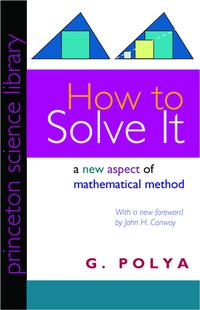
How to Solve It
A New Aspect of Mathematical Method
1st Edition
Published on 18. November 2019
288 pages
978-1-4008-2867-8 (ISBN)
Description

The bestselling book that has helped millions of readers solve any problem
A must-have guide by eminent mathematician G. Polya, How to Solve It shows anyone in any field how to think straight. In lucid and appealing prose, Polya reveals how the mathematical method of demonstrating a proof or finding an unknown can help you attack any problem that can be reasoned out-from building a bridge to winning a game of anagrams. How to Solve It includes a heuristic dictionary with dozens of entries on how to make problems more manageable-from analogy and induction to the heuristic method of starting with a goal and working backward to something you already know.
This disarmingly elementary book explains how to harness curiosity in the classroom, bring the inventive faculties of students into play, and experience the triumph of discovery. But it's not just for the classroom. Generations of readers from all walks of life have relished Polya's brilliantly deft instructions on stripping away irrelevancies and going straight to the heart of a problem.
A must-have guide by eminent mathematician G. Polya, How to Solve It shows anyone in any field how to think straight. In lucid and appealing prose, Polya reveals how the mathematical method of demonstrating a proof or finding an unknown can help you attack any problem that can be reasoned out-from building a bridge to winning a game of anagrams. How to Solve It includes a heuristic dictionary with dozens of entries on how to make problems more manageable-from analogy and induction to the heuristic method of starting with a goal and working backward to something you already know.
This disarmingly elementary book explains how to harness curiosity in the classroom, bring the inventive faculties of students into play, and experience the triumph of discovery. But it's not just for the classroom. Generations of readers from all walks of life have relished Polya's brilliantly deft instructions on stripping away irrelevancies and going straight to the heart of a problem.
More details
Other editions
Additional editions
Book
10/2014
Princeton University Press
€22.50
Shipment within 10-20 days
Book
01/1985
Princeton University Press
€39.56
Article exhausted; check different version
Persons
G. Polya (1887-1985) was one of the most influential mathematicians of the twentieth century. His basic research contributions span complex analysis, mathematical physics, probability theory, geometry, and combinatorics. He was a teacher par excellence who maintained a strong interest in pedagogical matters throughout his long career. Even after his retirement from Stanford University in 1953, he continued to lead an active mathematical life. He taught his final course, on combinatorics, at the age of ninety. John H. Conway (1937-2020) was professor emeritus of mathematics at Princeton University. He was awarded the London Mathematical Society's Polya Prize in 1987. He was interested in many branches of mathematics and invented a successor to Polya's notation for crystallographic groups.
Content
- Cover
- Title
- Copyright
- Contents
- From the Preface to the First Printing
- From the Preface to the Seventh Printing
- Preface to the Second Edition
- How to Solve It" list
- Foreword
- Introduction
- PART I. IN THE CLASSROOM
- Purpose
- 1. Helping the student
- 2. Questions, recommendations, mental operations
- 3· Generality
- 4· Common sense
- 5· Teacher and student. Imitation and practice
- Main divisions, main questions
- 6. Four phases
- 7· Understanding the problem
- 8. Example
- 9. Devising a plan
- 10. Example
- 11. Carrying out the plan
- 12. Example
- 13· Looking back
- 14· Example
- 15· Various approaches
- 16. The teacher's method of questioning
- 17· Good questions and bad questions
- More examples
- 18. A problem of construction
- 19. A problem to prove
- 20. A rate problem
- PART II. HOW TO SOLVE IT
- A dialogue
- PART III. SHORT DICTIONARY OF HEURISTIC
- Analogy
- Auxiliary elements
- Auxiliary problem
- Bolzano
- Bright idea
- Can you check the result?
- Can you derive the result differently?
- Can you use the result?
- Carrying out
- Condition
- Contradictory┼
- Corollary
- Could you derive something useful from the data?
- Could you restate the problem?┼
- Decomposing and recombining
- Definition
- Descartes
- Determination, hope, success
- Diagnosis
- Did you use all the data?
- Do you know a related problem?
- Draw a figure┼
- Examine your guess
- Figures
- Generalization
- Have you seen it before?
- Here is a problem related to yours and solved before
- Heuristic
- Heuristic reasoning
- If you cannot solve the proposed problem
- Induction and mathematical induction
- Inventor's paradox
- Is it possible to satisfy the condition?
- Leibnitz
- Lemma
- Look at the unknown
- Modern heuristic
- Notation
- Pappus
- Pedantry and mastery
- Practical problems
- Problems to find, problems to prove
- Progress and achievement
- Puzzles
- Reductio ad absurdum and indirect proof
- Redundant┼
- Routine problem
- Rules of discovery
- Rules of style
- Rules of teaching
- Separate the various parts of the condition
- Setting up equations
- Signs of progress
- Specialization
- Subconscious work
- Symmetry
- Terms, old and new
- Test by dimension
- The future mathematician
- The intelligent problem-solver
- The intelligent reader
- The traditional mathematics professor
- Variation of the problem
- What is the unknown?
- Why proofs?
- Wisdom of proverbs
- Working backwards
- PART IV. PROBLEMS, HINTS, SOLUTIONS
- Problems
- Hints
- Solutions
