

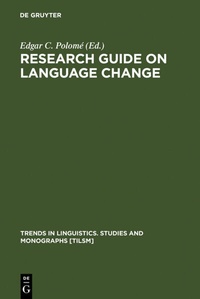
Research Guide on Language Change
1st Edition
Published on 15. June 2011
IX, 564 pages
978-3-11-087537-9 (ISBN)
Description

No detailed description available for "Research Guide on Language Change".
More details
Series
Edition
Reprint 2011
Language
English
Place of publication
Berlin/Boston
Germany
Publishing group
de Gruyter Mouton
Target group
Professional and scholarly
US School Grade: College Graduate Student
Illustrations
Num. figs.
Num. figs.
File size
18,41 MB
ISBN-13
978-3-11-087537-9 (9783110875379)
Schweitzer Classification
Other editions
Additional editions
Edgar C. Polomé
Research Guide on Language Change
Book
12/1990
1st Edition
De Gruyter Mouton
€250.00
Shipment within 7-9 days
Edgar C. Polomé
Research Guide on Language Change
Book
01/1990
1st Edition
De Gruyter Mouton
€339.00
Article exhausted; check different version
Content
- Intro
- I. Introduction
- Language change and the Saussurean dichotomy: Diachrony versus synchrony
- Linguistic reconstruction: The scope of historical and comparative linguistics
- II. Aspects of Language Change
- Synchronic manifestations of linguistic change
- Evidence of language change
- The context of language change
- Methods to Study Language Change
- Philology: Analysis of written records
- The chronology of phonological change
- Linguistic paleontology: Migration theory, prehistory, and archeology correlated with linguistic data
- Linguistic geography and language change
- Psycholinguistics: A research review
- Lexicostatistics
- Theoretical Models of Change
- The Neogrammarian hypothesis
- A structural view of sound-change
- The transformational-generative model
- Other Approaches
- Dialect geography
- Social stratification of language
- Contact and interference
- III. Types of Language Change
- Phonological Change
- Phonetic, phonemic, and phonotactic change
- Evidence
- Structuralist interpretation
- Synchronic rules and diachronic "laws": The Saussurean dichotomy reaffirmed
- Morphophonology
- Morphological change
- Syntactic change
- Lexical Change
- Onomasiological change: Sachen-change reflected by Wörter
- Semantic change
- Borrowing
- Etymology
- Change of Languages
- Language families and subgroupings, tree model and wave theory, and reconstruction of protolanguages
- The development of standard language (koine) and dialect: Language split and dialect merger
- Contact linguistics: Research on linguistic areas, strata, and interference in Europe
- Creolization and language change
- Bi- and multilingualism: Code-switching, interference and hybrids
- Subject Index
- Language Index
- Author Index
