

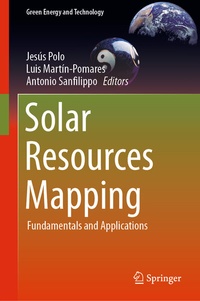
Solar Resources Mapping
Fundamentals and Applications
1st Edition
Published on 22. January 2019
XVIII, 367 pages
978-3-319-97484-2 (ISBN)
Description

This book presents methods for optimising the spatial and network configuration of solar radiation measuring stations. Various physical and mathematical models are demonstrated, which together with high quality measurements, provide the essential tools to generate and validate solar resource estimates to improve the mapping of solar resources.
Each chapter deals with a specific topic, showing its methodology, and providing examples of how to apply these techniques with reference to current projects around the world. These topics include:
· Radiometric measurement campaigns;· Equipment calibration, installation, operation, and maintenance;· Data quality assurance and assessment;· Solar radiation modelling from satellite images and numerical models;· Downscaling and kriging interpolation of solar radiation;· Simulation of electric solar power plant generation;· Solar radiation forecasting;· Applications of solar energy; and· Socio-economic benefits of solar energy.
The contributors present the statistical and physical models needed to derive solar radiation from satellite images and numerical models, emphasising the importance of measuring solar radiation accurately. They also show the classical models used to generate synthetic data, clear sky models and ancillary air quality and meteorological data from different input sources.
Solar Resources Mapping provides industry professionals with methodologies and tools to build solar irradiance maps for different applications. The book will also benefit students and researchers as it serves as a main technical reference, presenting the basic terminology and fundamentals for solar resource mapping that include methods for assessing measurement uncertainty.
Each chapter deals with a specific topic, showing its methodology, and providing examples of how to apply these techniques with reference to current projects around the world. These topics include:
· Radiometric measurement campaigns;· Equipment calibration, installation, operation, and maintenance;· Data quality assurance and assessment;· Solar radiation modelling from satellite images and numerical models;· Downscaling and kriging interpolation of solar radiation;· Simulation of electric solar power plant generation;· Solar radiation forecasting;· Applications of solar energy; and· Socio-economic benefits of solar energy.
The contributors present the statistical and physical models needed to derive solar radiation from satellite images and numerical models, emphasising the importance of measuring solar radiation accurately. They also show the classical models used to generate synthetic data, clear sky models and ancillary air quality and meteorological data from different input sources.
Solar Resources Mapping provides industry professionals with methodologies and tools to build solar irradiance maps for different applications. The book will also benefit students and researchers as it serves as a main technical reference, presenting the basic terminology and fundamentals for solar resource mapping that include methods for assessing measurement uncertainty.
More details
Series
Language
English
Place of publication
Cham
Switzerland
Publishing group
Springer International Publishing
Target group
Professional and scholarly
Product notice
Reflowable
Illustrations
XVIII, 367 p.
File size
13,62 MB
ISBN-13
978-3-319-97484-2 (9783319974842)
DOI
10.1007/978-3-319-97484-2
Schweitzer Classification
Other editions
Additional editions
Jesús Polo | Luis Martín-Pomares | Antonio Sanfilippo
Solar Resources Mapping
Fundamentals and Applications
Book
01/2019
Springer
€128.39
Shipment within 10-15 days
Persons
Dr.
Antonio Sanfilippo
is Chief Scientist at the Qatar Environment & Energy Research Institute (QEERI), where he leads the Smart Grid Portfolio - a research initiative focused on grid integration, solar resource mapping and forecasting, and demand-side management - and a grant on "PV Adoption in the GCC" funded by the Qatar National Research Fund. Prior to joining QEERI, he was Chief Scientist at the Pacific Northwest National Laboratory in the US (PNNL), a laboratory of the US Department of Energy (DOE), where he was awarded the Laboratory Director's Award for Exceptional Scientific Achievement in 2008. While at PNNL, he led research projects for the Department of Homeland Security, the National Institutes of Health, DOE, and the National Science Foundation, and directed a four-year advanced research program at PNNL on predictive analytics focused on security, energy and environment applications. Dr. Sanfilippo has also held positions as Research Director in the private sector,Senior Consultant at the European Commission, Research Supervisor and Group Manager at SHARP Laboratories of Europe, and Research Associate at the University of Edinburgh and the University of Cambridge in the UK. He holds master degrees from Columbia University (US) and a PhD from the University of Edinburgh (UK).
Jesús Polo , Researcher at CIEMAT. PhD in Physics from the University of Madrid (Spain). An expert on solar radiation modelling and estimation from meteorological satellite observations. Over ten years working in R&D projects on solar resource assessment and solar radiation knowledge at the earth surface. Main activities are solar radiation modelling, solar radiation derived from geostationary satellites, solar radiation mapping, solar radiation attenuation (analysis of atmospheric aerosol loading and its impact on solar radiation at ground). An expert on solar resource assessment within the task 36 and 46 of the Solar Heating and Cooling(International Energy Agency). Collaborator as an expert in the COST WIRE action ES1002 on Forecasting wind and solar resources.
Dr. Luis Pomares a BSc in in Computer Science Engineering by the University of Almeria, and a PhD in Phys-ics from the Complutense University. He has more than 12 years of experience in solar resources. In 2004 he began his professional career working at Plataforma Solar de Almeria (PSA) developing the data acquisition system and all the software for the BSRN station of the PSA. From 2005 until February 2009 he did his PhD studies at CIEMAT, Spain's National Laboratory for Energy Research, in solar energy forecasting. He has been for more than a year the managing director of a spin-off company from CIEMAT, Ir-SOLaV. At present, he is working in QEERI. He is doing different solar resources assessment and prediction tasks which cover all the phases needed by CSP and PV projects. He is an expert in solar radiation estimation fromsatellite, creation of solar energy maps, analysis of ground measured data and solar energy forecasting.
Jesús Polo , Researcher at CIEMAT. PhD in Physics from the University of Madrid (Spain). An expert on solar radiation modelling and estimation from meteorological satellite observations. Over ten years working in R&D projects on solar resource assessment and solar radiation knowledge at the earth surface. Main activities are solar radiation modelling, solar radiation derived from geostationary satellites, solar radiation mapping, solar radiation attenuation (analysis of atmospheric aerosol loading and its impact on solar radiation at ground). An expert on solar resource assessment within the task 36 and 46 of the Solar Heating and Cooling(International Energy Agency). Collaborator as an expert in the COST WIRE action ES1002 on Forecasting wind and solar resources.
Dr. Luis Pomares a BSc in in Computer Science Engineering by the University of Almeria, and a PhD in Phys-ics from the Complutense University. He has more than 12 years of experience in solar resources. In 2004 he began his professional career working at Plataforma Solar de Almeria (PSA) developing the data acquisition system and all the software for the BSRN station of the PSA. From 2005 until February 2009 he did his PhD studies at CIEMAT, Spain's National Laboratory for Energy Research, in solar energy forecasting. He has been for more than a year the managing director of a spin-off company from CIEMAT, Ir-SOLaV. At present, he is working in QEERI. He is doing different solar resources assessment and prediction tasks which cover all the phases needed by CSP and PV projects. He is an expert in solar radiation estimation fromsatellite, creation of solar energy maps, analysis of ground measured data and solar energy forecasting.
Content
Part I: Fundamentals of Measurements.- Part II: Fundamentals of Solar Radiation Modelling and Forecasting.- Part III: Fundamentals of Solar Radiation Mapping.- Part IV: Applications.
