

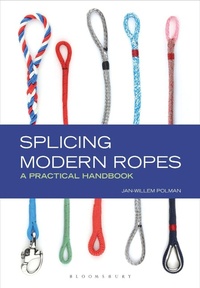
Splicing Modern Ropes
A Practical Handbook
1st Edition
Published on 5. May 2016
176 pages
978-1-4729-2492-6 (ISBN)
Description

The time when every vessel going to sea made use of 3-strand rope has gone. Splicing that type of rope and cord is relatively straightforward. Nowadays the most common type of rope used on board yachts, dinghies, motorboats, working boats and ferries is braided rope. Few people have the knowledge to splice it, or even where to start.
Splicing Modern Ropes is the first guide to this essential skill. It explains why splices are better - and stronger - than knots or shackles for joining or shortening rope, and how to go about it. With this skill, yachtsmen can customise their ropes, optimise their deck layout, taper their sheets for ease of handling, and splice an extra cover on their ropes to give better grip, avoid chafe and make them last longer.
Using clear, step-by-step photography and detailed instructions, this book will guide readers through all the stages required to make strong, reliable splices.
Splicing Modern Ropes is the first guide to this essential skill. It explains why splices are better - and stronger - than knots or shackles for joining or shortening rope, and how to go about it. With this skill, yachtsmen can customise their ropes, optimise their deck layout, taper their sheets for ease of handling, and splice an extra cover on their ropes to give better grip, avoid chafe and make them last longer.
Using clear, step-by-step photography and detailed instructions, this book will guide readers through all the stages required to make strong, reliable splices.
More details
Edition
1. Auflage
Language
English
Place of publication
London
United Kingdom
Publishing group
Bloomsbury Publishing PLC
Target group
Professional and scholarly
Illustrations
Over 450 colour photos
ISBN-13
978-1-4729-2492-6 (9781472924926)
Copyright in bibliographic data and cover images is held by Nielsen Book Services Limited or by the publishers or by their respective licensors: all rights reserved.
Schweitzer Classification
Other editions
Additional editions
Book
05/2016
Adlard Coles Nautical
€44.76
Article exhausted; check different version
Person
Jan-Willem Polman is a line specialist and tool retailer. He has written several books for the leisure boater as well as magazine articles for the yachting press.
Content
- Cover
- Half-title
- Title
- Copyright
- Contents
- Introduction
- 1. Synthetic fibres
- Developments
- Technical features
- Breaking load
- Safe working load
- Stretch
- Creep
- Synthetic fibres used for ropes
- Polyester
- Polyamide
- Polypropylene
- UHMWPE (Dyneema, Spectra)
- LCP (Vectran)
- PBO (Zylon)
- Aramid (Kevlar, Technora)
- 2. Construction of ropes
- Twisted ropes
- Single braid ropes
- Double braid ropes
- Braided cover with a core of twisted strands or parallel fibres
- Additional types of rope construction
- 3. Which type of rope?
- Sheets and halyards
- Materials
- Control lines and running backstays
- Diameter and breaking load
- Length
- Mooring lines
- Diameter
- Length
- Ropes combined with clutches
- Maintenance and troubleshooting
- Inspection
- Friction and wear
- Rope does not hold in clutches
- Twisted ropes
- Cleaning ropes
- 4. Before you start
- Splicing tools
- Splicing technique and core materials
- The size of the eye
- How to remove a core from the cover
- 'Tapering' the ends of a rope
- 'Milking' the cover
- Long bury splicing
- 5. Eye splice in plaited or twisted ropes
- Three-strand rope
- Eight-strand rope
- 6. Eye splice in polyester ropes
- Double braid rope
- Stainless steel thimble
- Rope with a laid core
- Rope with parallel fibres in the core
- 7. Eye splice in Dyneema ropes
- Single braid rope
- Basic method
- Method for hollow braid with a grip fibre
- Lock splice
- Double braid rope
- Without using the cover
- Using the cover
- Double layer cover
- 8. Dyneema shackles
- Soft shackles
- Type 1
- Type 2
- Integral
- Soft shackle knot
- 9. Weight savings and tapering
- Tapering a doubled braid Dyneema rope
- Joining two single braid ropes
- Joining steel wire with double braid polyester
- Joining a single braid Dyneema rope with double braid polyester
- 10. Thickening and strengthening
- Splicing or sewing in an extra cover
- Splicing in an extra cover
- Sewing in an extra cover
- Splicing in an extra core
- 11. Continuous loops
- Double braid polyester
- For equal thickness, spliced without the core
- For strength, spliced with the core
- Single braid Dyneema ('loop')
- Basic loop
- Loop with cover
- Double braid Dyneema
- 12. Whippings
- Double stitched whipping for braided ropes
- Common whipping
- Whipping for a three-strand laid rope
- 13. Reeving of new halyards
- Reeving eye ('Flemish eye')
- Reeving loop with whipping
- 14. Splicing tools
- Using a soft needle
- How to make a soft needle
- Appendices
- 1 Features of synthetic fibres: a comparison
- 2 Diameters and breaking loads of ropes
- Guidelines for diameters of sheets and halyards
- Guidelines for diameters of mooring lines
- Acknowledgements
- About the author
- Bibliography
- Index
