

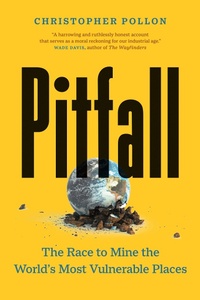
Pitfall
The Race to Mine the World's Most Vulnerable Places
Published on 10. October 2023
249 pages
978-1-77164-913-1 (ISBN)
Description

A harrowing journey through the past, present, and future of mining, this expertly-researched account ends on a vision for how industry can better serve the needs of humanity.
A race is on to exploit the last bonanzas of gold, silver, and industrial metals left on Earth. These metals are not only essential for all material comfort and need, but for the transition to clean energy: in the coming decades, billions of tons of copper, nickel, silver, and other metals will be required to build electric vehicles, solar and wind installations, and green infrastructure. We need more metals than ever before, yet the qualities and quantities are diminishing, making the extraction process more polluting to land, air and water. And most of these metals will be mined from the global south, where social conflict will only grow, led by Indigenous peoples demanding a greater say in how their wealth is used.
The stakes couldn't be higher: How can we mine the metals we need without replicating the environmental and human rights abuses of the past?
Pitfall is the compelling story of the quest to exploit the metals our civilization needs?and at what cost to local people and their environments. Beginning with the first waves of big, foreign-owned mines in the 1960s, investigative journalist Christopher Pollon shows how transnational companies rose to dominate copper, precious metals, and lithium in Latin America, made inroads into war-torn countries in Africa, and exploited nickel, industrial metals, and rare earth metals across Asia and Oceania.
If we cannot change our course, Pollon argues, we are condemned to mine deeper and darker places, including the depths of the ocean, sacrifice zones, and near-earth asteroids. This disturbing vision of the future also includes robotic mines without workers and social license?unless we act now.
Published in Partnership with the David Suzuki Institute.
More details
Other editions
Additional editions
Book
10/2023
Greystone Books,Canada
€28.50
Shipment within 3-4 weeks
Person
Christopher Pollon is an independent journalist who reports on the politics of natural resources, focusing on mining, oceans, and energy. His work has appeared in dozens of publications, including National Geographic, VICE, the Walrus, the Tyee, and the Globe and Mail. He is also the author of The Peace in Peril: The Real Cost of the Site C Dam. He lives in Vancouver, BC.
Content
- Intro
- Title Page
- Contents
- Map: Key Locations
- Introduction: The City With a Heart of Gold
- I. Founding Sacrifice Zones
- 1. The Richest Island on Earth: An American Foray Into New Guinea
- 2. Nice People Behaving Badly: Guatemala and the Canadian Mining Juggernaut
- 3. The Plunder of Inner Mongolia: What It Takes to Be a Rare Earth Superpower
- II. Business As Usual
- 4. Chasing White Gold: How Bolivia Tried (and Failed) to Mine on Its Own Terms
- 5. High and Dry in the Andes: Mining in a Water-Scarce World
- 6. A New Scramble for Africa: Adventures in Last-Frontier Cowboy Capitalism
- III. Where Do We Go From Here?
- 7. Tailings and Trade-Offs: What "Resource Independence" Really Looks Like
- 8. Ever Deeper, Ever Darker: The New Frontiers of Conflict
- 9. Feeding the Monster: Consumption and the Bumpy Road to Accountability
- Afterword: "That's Batshit Crazy"-a Case for Leaving Gold in the Ground
- Acknowledgments
- Notes
- Selected Bibliography
- Index
- Copyright
