

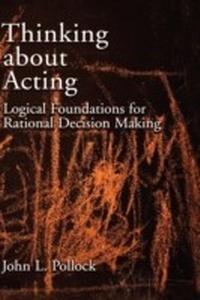
Thinking about Acting
Logical Foundations for Rational Decision Making
1st Edition
Published on 27. July 2006
280 pages
978-0-19-983886-8 (ISBN)
Description

John Pollock aims to construct a theory of rational decision making for real agents--not ideal agents. Real agents have limited cognitive powers, but traditional theories of rationality have applied only to idealized agents that lack such constraints. Pollock argues that theories of ideal rationality are largely irrelevant to the decision making of real agents. Thinking about Acting aims to provide a theory of "real rationality."
More details
Other editions
Additional editions
Book
08/2006
Oxford University Press Inc
€140.00
Shipment within 15-20 days
Person
John L. Pollock is Regents' Professor of Philosophy and Research Professor of Cognitive Science, University of Arizona, Tucson.
Content
- Intro
- Contents
- Chapter 1: Rational Choice and Classical Decision Theory
- 1. Rational Cognition
- 2. Ideal Rationality and Real Rationality
- 3. Human Rationality and Generic Rationality
- 4. Decision Making
- 5. Classical Decision Theory and the Optimality Prescription
- Part I: Values
- Chapter 2: Evaluative Cognition and the Evaluative Database
- 1. The Doxastic/ Conative Loop
- 2. Preference Rankings
- 3. Analog Representations of Values
- 4. Conclusions
- Chapter 3: Evaluative Induction
- 1. The Need for Evaluative Induction
- 2. Human Conative States
- 3. Evaluative Induction
- 4. Evaluative Induction as a Q&I Module
- 5. Conclusions
- Chapter 4: Some Observations about Evaluative Cognition
- 1. Liking Activities
- 2. Evaluating the Human Cognitive Architecture
- 3. State Liking
- 4. Conclusions
- Chapter 5: The Database Calculation
- 1. The Database Calculation
- 2. Justifying the Database Calculation
- 3. Feature-Based Evaluative Cognition
- Part II: Probabilities
- Chapter 6: Subjective Probabilities
- 1. Two Kinds of Probabilities
- 2. Subjective Probabilities and Degrees of Belief
- 3. Belief Simpliciter
- 4. Subjective Expected Utility Theory
- 5. Rational Decision Making
- 6. Do Subjective Probabilities Exist
- 7. Deriving the Optimality Prescription from Rationality Constraints
- 8. Subjective Probabilities from Epistemology
- 9. A Return to Objective Probabilities
- Chapter 7: Objective Probabilities
- 1. Physical Probabilities and Relative Frequencies
- 2. Empirical Theories
- 3. Nomic Probability
- 4. Mixed Physical/Epistemic Probabilities
- 5. Conclusions
- Chapter 8: Causal Probabilities
- 1. Causal Decision Theory
- 2. Probabilistic Causation
- 3. Skyrms and Lewis
- 4. Defining Causal Probability
- 5. Conditional Causal Probability
- 6. C-PROB[sub(A)] and K-PROB[sub(A)]
- 7. Computing Causal Probabilities
- 8. Computing Conditional Causal Probabilities
- 9. Simplifying the Computation Defeasibly
- 10. Conclusions
- Part III: Decisions
- Chapter 9: Rational Choice and Action Omnipotence
- 1. Actions and the Optimality Prescription
- 2. Action Omnipotence
- 3. Restricting the Scope of the Optimality Prescription
- 4. Expected Utility
- 5. Conditional Policies and Expected Utilities
- 6. Two Problems
- 7. Computing Expected-Utilities
- 8. Conclusions
- Chapter 10: Plans and Decisions
- 1. Against Optimality
- 2. The Logical Structure of Practical Deliberation
- 3. Groups of Actions
- 4. Actions and Plans
- 5. Choosing between Plans
- 6. AI Planning Theory: The Real World versus Toy Problems
- 7. When Is a Plan a Good One?
- 8. Locally Global Planning
- 9. Conclusions
- Chapter 11: Plans and Their Expected Utilities
- 1. Linear Plans
- 2. Linear Policies
- 3. Nonlinear Plans
- 4. Conditional Plans
- 5. An Example
- 6. Conclusions
- Chapter 12: Locally Global Planning
- 1. The Theory
- 2. Incremental Decision-Theoretic Planning
- 3. Goal-Directed Planning
- 4. Presumptively Additive Expected Utilities
- 5. Finding and Repairing Decision-Theoretic Interference
- 6. Conclusions
- Appendix: The Theory of Nomic Probability
- 1. Introduction
- 2. Computational Principles
- 3. The Statistical Syllogism
- 4. Direct Inference and Definite Probabilities
- 5. Indefinite Probabilities and Probability Distributions
- 6. Induction
- 7. Conclusions
- Bibliography
- Index
- A
- B
- C
- D
- E
- F
- G
- H
- I
- J
- K
- L
- M
- N
- O
- P
- Q
- R
- S
- T
- U
- V
- W
- Y
