

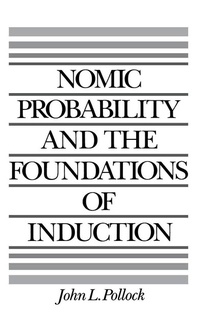
Nomic Probability and the Foundations of Induction
Published on 22. February 1990
363 pages
978-0-19-534521-6 (ISBN)
Description

In this book Pollock deals with the subject of probabilistic reasoning, making general philosophical sense of objective probabilities and exploring their relationship to the problem of induction. He argues that probability is fundamental not only to physical science, but to induction, epistemology, the philosophy of science and much of the reasoning relevant to artificial intelligence. Pollock's main claim is that the fundamental notion of probability is nomic--that is, it involves the notion of natural law, valid across possible worlds. The various epistemic and statistical conceptions of probability, he demonstrates, are derived from this nomic notion. He goes on to provide a theory of statistical induction, an account of computational principles allowing some probabilities to be derived from others, an account of acceptance rules, and a theory of direct inference.
More details
Other editions
Additional editions
John L. Pollock
Nomic Probability and the Foundations of Induction
Book
04/1990
Oxford University Press Inc
€291.50
Shipment within 15-20 days
Content
- Intro
- Contents
- PART I: THE GENERAL THEORY
- 1. Physical Probability
- 1. Introduction
- 2. The Laplacian Theory
- 3. Logical Probability
- 4. Frequency Theories
- 5. Hypothetical Frequency Theories
- 6. Empirical Theories
- 7. Propensities
- 8. Nomic Probability and Nomic Generalizations
- 2. Computational Principles
- 1. Introduction
- 2. The Logical Framework
- 3. Nomic Generalizations
- 4. Probabilities as Proportions
- 5. The Boolean Theory of Proportions
- 6. The Elementary Theory of Nomic Probability
- 7. The Non-Boolean Theory of Proportions
- 8. Non-Boolean Principles of Nomic Probability
- 9. Exotic Principles
- 10. Summary
- 3. Acceptance Rules
- 1. Introduction
- 2. An Acceptance Rule
- 3. The Epistemological Framework
- 4. Generalized Acceptance Rules
- 5. Derived Acceptance Rules
- 6. The Material Statistical Syllogism
- 7. Summary
- 4. Direct Inference and Definite Probabilities
- 1. Introduction
- 2. Classical Direct Inference
- 3. Nonclassical Direct Inference
- 4. The Reduction of Classical Direct Inference to Nonclassical Direct Inference
- 5. Foundations for Direct Inference
- 6. Nonclassical Direct Inference for Frequencies
- 7. Summary
- 5. Induction
- 1. Introduction
- 2. A Generalized Acceptance Rule
- 3. The Statistical Induction Argument
- 4. Enumerative Induction
- 5. Material Induction
- 6. Concluding Remarks
- 7. Summary
- 6. Recapitulation
- 1. The Analysis of Nomic Probability
- 2. Main Consequences of the Theory
- 3. Prospects: Other Forms of Induction
- 4. The Problem of Projectibility
- PART II: ADVANCED TOPICS
- 7. Exotic Computational Principles
- 1. Introduction
- 2. The Exotic Theory of Proportions
- 3. The Derivation of (PFREQ)
- 4. The Principle of Agreement
- 5. Summary
- 8. Advanced Topics: Defeasible Reasoning
- 1. Introduction
- 2. Reasons
- 3. Warrant
- 4. Nonmonotonic Logic
- 5. Summary
- 9. Advanced Topics: Acceptance Rules
- 1. Introduction
- 2. The Gambler's Fallacy
- 3. The Paradox of the Preface
- 4. Defeasible Defeaters
- 5. Domination Defeaters
- 6. Summary
- 10. Advanced Topics: Direct Inference
- 1. Propensities
- 2. Joint Subset Defeaters
- 3. Domination Defeaters
- 4. Summary
- 11. Advanced Topics: Induction
- 1. Projectibility
- 2. Subsamples
- 3. Fair Sample Defeaters for Statistical Induction
- 4. Fair Sample Defeaters for Enumerative Induction
- 5. Diversity of the Sample
- 6. The Paradox of the Ravens
- 7. Summary
- Bibliography
- Index
- A
- B
- C
- D
- E
- F
- G
- H
- I
- J
- K
- L
- M
- N
- O
- P
- Q
- R
- S
- T
- U
- V
- W
- Appendix: Main Principles
