

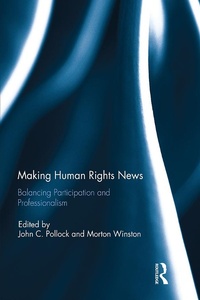
Making Human Rights News
Balancing Participation and Professionalism
1st Edition
Published on 18. October 2018
152 pages
978-1-351-71116-6 (ISBN)
Description

Making Human Rights News: Balancing Participation and Professionalism explores the impact of new digital technology and activism on the production of human rights messages. It is the first collection of studies to combine multidisciplinary approaches, "citizen witness" challenges to journalism ethics, and expert assessments of the "liberating role" of the Internet, addressing the following questions:
1. What can scholars from a wide range of disciplines - including communication studies, journalism, sociology, political science, and international relations/studies - add to traditional legal and political human rights discussions, exploring the impact of innovative digital information technologies on the gathering and dissemination of human rights news?
2. What questions about journalism ethics and professionalism arise as growing numbers of untrained "citizen witnesses" use modern mobile technology to document claims of human rights abuses?
3. What are the limits of the "liberating role" of the Internet in challenging traditional sources of authority and credibility, such as professional journalists and human rights professionals?
4. How do greater Internet access and human rights activism interact with variations in press freedom and government censorship worldwide to promote respect for different categories of human rights, such as women's rights and rights to health?
This book was originally published as a special issue of the Journal of Human Rights.
1. What can scholars from a wide range of disciplines - including communication studies, journalism, sociology, political science, and international relations/studies - add to traditional legal and political human rights discussions, exploring the impact of innovative digital information technologies on the gathering and dissemination of human rights news?
2. What questions about journalism ethics and professionalism arise as growing numbers of untrained "citizen witnesses" use modern mobile technology to document claims of human rights abuses?
3. What are the limits of the "liberating role" of the Internet in challenging traditional sources of authority and credibility, such as professional journalists and human rights professionals?
4. How do greater Internet access and human rights activism interact with variations in press freedom and government censorship worldwide to promote respect for different categories of human rights, such as women's rights and rights to health?
This book was originally published as a special issue of the Journal of Human Rights.
More details
Edition
1. Auflage
Language
English
Place of publication
London
United Kingdom
Publishing group
Taylor & Francis Ltd
Target group
College/higher education
ISBN-13
978-1-351-71116-6 (9781351711166)
Copyright in bibliographic data and cover images is held by Nielsen Book Services Limited or by the publishers or by their respective licensors: all rights reserved.
Schweitzer Classification
Other editions
Additional editions
Book
05/2019
1st Edition
Routledge
€48.50
Article exhausted; check different version
Book
08/2018
1st Edition
Routledge
€68.70
Shipment within 10-20 days
Book
07/2017
1st Edition
Routledge
€207.00
Shipment within 10-20 days
Persons
John C. Pollock (PhD, Stanford) is Professor of Communication Studies at The College of New Jersey. His most recent books include Tilted Mirrors: Media Alignment with Political and Social Change (2007), Media and Social Inequality: Innovations in Community Structure Research (2013), and Journalism and Human Rights: How Demographics Drive Media Coverage (2015). With special interests in media sociology and political communication, he conducts research on health communication and human rights.
Morton E. Winston (PhD, Illinois) is Professor of Philosophy at The College of New Jersey. His areas of specialization include human rights theory and practice, global ethics, and the philosophy of technology. His most recent books are On Chomsky (2001) and Society, Ethics, and Technology (2013). He served as Chairman of Amnesty International USA's National Board of Directors and was the Distinguished Chair of Human Rights and International Relations at the Danish Institute of Human Rights.
Morton E. Winston (PhD, Illinois) is Professor of Philosophy at The College of New Jersey. His areas of specialization include human rights theory and practice, global ethics, and the philosophy of technology. His most recent books are On Chomsky (2001) and Society, Ethics, and Technology (2013). He served as Chairman of Amnesty International USA's National Board of Directors and was the Distinguished Chair of Human Rights and International Relations at the Danish Institute of Human Rights.
Content
Introduction: Human Rights in the News: Balancing New Media Participation with the Authority of Journalism and Human Rights Professionals. 1. A New Era of Human Rights News? Contrasting Two Paradigms of Human Rights News Making 2. Source Credibility as 'Information Subsidy': Strategies for Successful NGO Journalism at Mexican Human Rights NGOs 3. The Rise of Eyewitness Video and Its Implications for Human Rights: Conceptual and Methodological Approaches 4. Non Profit Product Placement: Human Rights Advocacy in Film and Television 5. Promoting the People's Surrogate: The Case for Press Freedom as a Distinct Human Right 6. News about Her: The Effects of Media Freedom and Internet Access on Women's Rights 7. Beyond Naming and Shaming: New Modalities of Information Politics in Human Rights
