
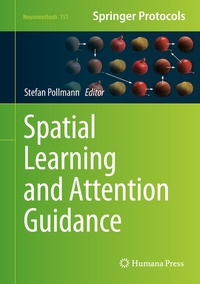
Spatial Learning and Attention Guidance
Description
Alles über E-Books | Antworten auf Fragen rund um E-Books, Kopierschutz und Dateiformate finden Sie in unserem Info- & Hilfebereich.
This volume looks at the latest research techniques to study the interaction of visual spatial learning and attention guidance with behavioral, psychophysiological, and imaging methods. Part One (behavioral methods) focuses on different paradigms of visual search like visual foraging and contextual cueing, and also methods like feature distribution analysis and search in virtual reality. Part Two (psychophysiological methods) integrates innovative uses of classical potential changes like the CDA and N2pc, with multivariate analysis methods and multi-method designs. Part Three (functional imaging) covers lesion-behavior mapping, retinotopic and grid cell mapping methods for human fMRI, as well as functional registration by hyperalignment and simultaneous eye-tracking and fMRI. In
Neuromethods
series style, chapters include the kind of detail and key advice from the specialists needed to get successful results in your laboratory.
Cutting-edge and comprehensive,
Spatial Learning and Attention Guidance
is a valuable resource for all researchers and scientists who are interested in learning more about the relationship between attention and memory.
More details
Other editions
Additional editions

Content
System requirements
File format: PDF
Copy protection: Watermark-DRM (Digital Rights Management)
System requirements:
- Computer (Windows; MacOS X; Linux): Use the free software Adobe Reader, Adobe Digital Editions, or any other PDF viewer of your choice (see eBook Help).
- Tablet/Smartphone (Android; iOS): Install the free app Adobe Digital Editions or another reading app for eBooks, e.g., PocketBook (see eBook Help).
- E-reader: Bookeen, Kobo, Pocketbook, Sony, Tolino and many more (only limited: Kindle).
The file format PDF always displays a book page identically on any hardware. This makes PDF suitable for complex layouts such as those used in textbooks and reference books (images, tables, columns, footnotes). Unfortunately, on the small screens of e-readers or smartphones, PDFs are rather annoying, requiring too much scrolling.
This eBook uses Watermark-DRM, a „soft” copy protection. This means that there are no technical restrictions to prevent illegal distribution. However, there is a personalised watermark embedded in the eBook that can be used to identify the purchaser of the eBook in the event of misuse and to provide evidence for legal purposes.
For more information, see our eBook Help page.