

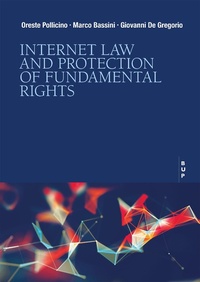
Internet Law and Protection of Fundamental Rights
Published on 1. January 2023
256 pages
978-88-31322-72-0 (ISBN)
Description

The protection of fundamental rights is increasingly relevant in the digital age. The massive spread of digital and algorithmic technologies raises inherently constitutional questions. Rights and freedoms are exposed both to the opportunities and challenges of digital technologies, thus leading to different constitutional responses. This book offers an overview of the most important challenges posed by the rise of cyberspace from a legal standpoint. After some preliminary chapters on the Internet landscape, it focuses on how the advent of digital technologies has impacted content and data, thus exploring the effects in terms of protection of freedom of expression, the right to privacy and data protection. By addressing these topics, this book aims to provide readers with a background to understand the constitutional issues raised by digital technologies.
More details
Other editions
Additional editions
Oreste Pollicino | Marco Bassini | Giovanni De Gregorio
Internet Law and Protection of Fundamental Rights
Book
02/2023
Bocconi University Press
€59.90
Shipment within 3-4 weeks
Content
- Description
- Biographia
- Title Page
- Copyright
- Table of Contents
- Introduction
- Part I - The Internet Landscape
- 1. The Law of the Internet
- 1.1 Introduction
- 1.2 The regulatory conundrum
- 1.3 Cyberanarchy
- 1.4 Against cyberanarchy
- 1.5 From the "law of the horse" to "code is law"
- 1.6 From the regulatory dilemma to the rise of Internet bills of rights
- 1.7 The constitutional dimension of the Internet
- 1.8 Conclusions
- 2. Internet and Jurisdiction
- 2.1 Introduction
- 2.2 Cyberspace and jurisdiction
- 2.3 Beyond US courts
- 2.4 Jurisdiction and cyberspace in Europe
- 2.5 Conclusions
- 3. Internet Access and Net Neutrality
- 3.1 Introduction
- 3.2 The right to Internet access
- 3.3 The right to Internet access between international and national law
- 3.3.1 National initiatives on Internet access regulation
- 3.4 The right to Internet access: Do we really need it?
- 3.5 Net neutrality
- 3.6 Conclusions
- Part II - Freedom of Expression
- 4. Freedom of Expression and the Internet
- 4.1 Introduction
- 4.2 The origins of freedom of expression
- 4.3 Freedom of expression across the ocean
- 4.4 Freedom of expression in action
- 4.4.1 The US Supreme Court
- 4.4.2 The European Court of Human Rights
- 4.4.3 The European Court of Justice
- 4.5 Conclusions
- 5. Internet Service Provider Liability
- 5.1 Introduction
- 5.2 The rise and consolidation of the "safe harbor" doctrine
- 5.2.1 The US system: Section 230 CDA
- 5.2.2 Secondary liability: Another road?
- 5.3 The legal regime of online intermediaries within the EU: The e-Commerce Directive
- 5.4 European courts and online intermediaries
- 5.4.1 Case law from the European Court of Justice
- 5.4.2 Case law from the European Court of Human Rights
- 5.4.3 National case law: The example of Italy
- 5.5 Data protection and liability of online intermediaries
- 5.6 Toward a new regulatory framework: The DSA proposal
- 5.7 Conclusions
- 6. Hate Speech and Disinformation
- 6.1 Introduction
- 6.2 Hate speech across the Atlantic
- 6.2.1 Hate speech in the US First Amendment case law
- 6.2.2 Hate speech in the case law of the ECtHR
- 6.2.3 Tackling hate speech at the EU level
- 6.2.4 Tackling terrorist content in the EU: The TERREG Regulation
- 6.3 Online disinformation
- 6.3.1 Defining disinformation
- 6.3.2 EU policies against disinformation
- 6.4 A comparative overview of domestic legislations
- 6.4.1 Germany
- 6.4.2 Italy
- 6.4.3 France
- 6.4.4 The cases of Russia, Singapore and Malaysia
- 6.5 Conclusions
- 7. Copyright in the Digital Age
- 7.1 Introduction
- 7.2 The birth of a "pan-European" Internet copyright law: InfoSoc Directive
- 7.2.1 The rights over works and other subject matter: Content, limitations and exceptions
- 7.2.2 The notion of "communication to the public" and the intervention of the ECJ
- 7.3 The new DSM Copyright Directive
- 7.3.1 The new rules on limitations and exceptions
- 7.3.2 Online content-sharing service providers and the "value gap" provision of art. 17
- 7.3.3 The case of Poland v. Parliament and Council on the annulment of art. 17
- 7.4 Copyright and freedom of expression in the case law of the European courts
- 7.5 The administrative enforcement of copyright: The examples of Italy and France
- 7.6 Conclusions
- 8. Audiovisual Media Services
- 8.1 Introduction
- 8.2 From broadcasting to audiovisual media services
- 8.3 The AVMSD Refit and the new notion of video-sharing platform services
- 8.4 The "country-of-origin" principle and the rules on jurisdiction
- 8.5 The rules on content
- 8.5.1 The rules on audiovisual commercial communication
- 8.5.2 The regulation on harmful content: Notably, the protection of minors and the prohibition of hate speech and terrorist content
- 8.5.3 Other rules for the pursuit of public interests
- 8.6 Promotion and prominence of European works on non-linear services
- 8.7 The rules on video-sharing platform services: Focus on article 28b
- 8.8 Conclusions
- Part III - Privacy and Data Protection
- 9. The Right to Privacy and Data Protection
- 9.1 Introduction
- 9.2 The right to privacy and to data protection
- 9.2.1 The right to privacy and the right to data protection: A legal definition
- 9.3 The judicial consolidation of the right to privacy
- 9.4 The evolution of privacy and data protection in Europe
- 9.4.1 The evolution of privacy and data protection under the case law of the ECtHR
- 9.5 The right to privacy and data protection in the Union
- 9.5.1 The right to privacy and data protection in the Union under the lenses of the ECJ
- 9.6 Conclusions
- 10. The General Data Protection Regulation
- 10.1 Introduction
- 10.2 Material and territorial scope
- 10.2.1 Data controller
- 10.2.2 Data processor
- 10.2.3 Territorial scope
- 10.3 General principles
- 10.4 Legal bases
- 10.4.1 Consent
- 10.4.2 Other legal bases
- 10.5 Data subjects' rights
- 10.5.1 Right of access
- 10.5.2 Right to rectification
- 10.5.3 Right to erasure
- 10.5.4 Right to restriction of processing
- 10.5.5 Right to data portability
- 10.5.6 Right to object
- 10.5.7 Automated individual decision-making, including profiling
- 10.6 Obligations under the GDPR
- 10.6.1 Records of processing activities
- 10.6.2 Security measures related to processing
- 10.6.3 Data breach
- 10.6.4 Data protection impact assessment and prior consultation
- 10.6.5 Appointment of a data protection officer
- 10.7 Transfer of personal data
- 10.8 Authorities and sanctions
- 10.9 Conclusions
- 11. Privacy, Identity and the Right to Be Forgotten
- 11.1 Introduction
- 11.2 Privacy and digital identity
- 11.3 The right to be forgotten (or the right to erasure)
- 11.3.1 The traditional definition of the right to be forgotten
- 11.3.2 The right to be forgotten on the Internet
- 11.4 Google Spain (C-131/12) and the framing of the right to be forgotten in the digital age
- 11.4.1 Facts of the case and Advocate General opinion
- 11.4.2 To erase or not to erase? The ECJ reasoning
- 11.5 The aftermath of Google Spain
- 11.5.1 Article 17 of the General Data Protection Regulation
- 11.5.2 The territorial scope of the right to erasure
- 11.6 Conclusions
- 12. Transfer of Personal Data
- 12.1 Introduction
- 12.2 Personal data transfers according to the GDPR
- 12.2.1 Adequacy decisions
- 12.2.2 Appropriate safeguards
- 12.2.3 Derogations
- 12.3 The Schrems saga
- 12.3.1 Schrems I
- 12.3.2 Schrems II
- 12.4 Recent developments
- 12.5 Conclusions
- 13. Data Retention and Law Enforcement
- 13.1 Introduction
- 13.2 First challenges to data retention
- 13.3 Data retention after Digital Rights Ireland
- 13.4 Law Enforcement Directive
- 13.4.1 Material scope
- 13.4.2 Principles of data processing
- 13.4.3 Logging
- 13.4.4 Transfers of personal data to third countries or international organizations
- 13.5 Conclusions
- References
