

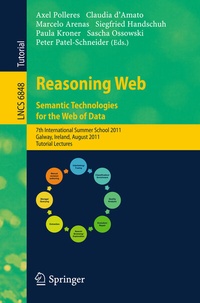
Reasoning Web. Semantic Technologies for the Web of Data
Description

The Semantic Web aims at enriching the existing Web with meta-data and processing methods so as to provide web-based systems with advanced capabilities, in particular with context awareness and decision support. The objective of this book is to provide a coherent introduction to semantic web methods and research issues with a particular emphasis on reasoning.
The 7th reasoning web Summer School, held in August 2011, focused on the central topic of applications of reasoning for the emerging "Web of Data". The 12 chapters in the present book provide excellent educational material as well as a number of references for further reading. The book not only addresses students working in the area, but also those seeking an entry point to various topics related to reasoning over Web data.
Reviews / Votes
From the reviews:
"This book contains lecture notes from the 7th Reasoning Web Summer School of 2011 held in Galway, Ireland, with the theme 'Web of Data.' Twelve sets of lecture notes are given in the volume, each a separate chapter. . Much to my surprise and delight, a complete video record of the lectures is also available. There are 117 videos captured in the lecture hall. The book and these videos together are an excellent resource for self-study." (Anthony J. Duben, ACM Computing Reviews, December, 2012)
More details
Other editions
Additional editions
Content
Introduction to Linked Data and its Lifecycle on the Web.- Foundations of Description Logics.- Using SPARQL with RDFS and OWL Entailment.- Database foundations for scalable RDF processing.-Scalable OWL 2 Reasoning for Linked Data.- Rules and Logic Programming for the Web.- OWL and Rules.- Modeling the Web of Data.- Trust management methodologies for the Web.- Application and Evaluation of Inductive Reasoning Methods for the Semantic Web and Software Analysis.- Probabilistic-Logical Web Data Integration.- An Introduction to Constraint Programming and Combinatorial Optimisation.
Foundations of Description Logics.- Using SPARQL with RDFS and OWL Entailment.- Database foundations for scalable RDF processing.- Scalable OWL 2 Reasoning for Linked Data.- Rules and Logic Programming for the Web.- OWL and Rules.- Modeling the Web of Data.- Trust management methodologies for the Web.- Application and Evaluation of Inductive Reasoning Methods for the Semantic Web and Software Analysis.- Probabilistic-Logical Web Data Integration.- An Introduction to Constraint Programming and Combinatorial Optimisation.