

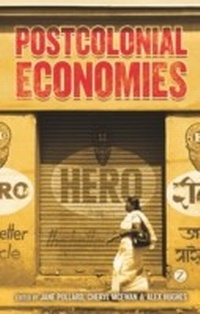
Postcolonial Economies
1st Edition
Published on 12. May 2011
248 pages
978-1-78032-134-9 (ISBN)
Description

Postcolonial approaches to understanding economies are of increasing academic and political significance as questions about the nature of globalisation, transnational flows of capital and workers and the making and re-making of territorial borders assume centre stage in debates about contemporary economies and policy.
Despite the growing academic and political urgency in understanding how 'other' cultures encounter 'the west', economics-oriented approaches within social sciences have been slow to engage with the ideas and challenges posed by postcolonial critiques. In turn, postcolonial approaches have been criticised for their simplistic treatment of 'the economic' and for not engaging with existing economic analyses of poverty and wealth creation.
Utilising examples drawn from India to Latin America, and bringing together scholars from a range of disciplines, including Geography, Economics, Development Studies, History and Women's Studies, Postcolonial Economies breaks new ground in providing a space for nascent debates about postcolonialism and its treatment of 'the economic'.
Despite the growing academic and political urgency in understanding how 'other' cultures encounter 'the west', economics-oriented approaches within social sciences have been slow to engage with the ideas and challenges posed by postcolonial critiques. In turn, postcolonial approaches have been criticised for their simplistic treatment of 'the economic' and for not engaging with existing economic analyses of poverty and wealth creation.
Utilising examples drawn from India to Latin America, and bringing together scholars from a range of disciplines, including Geography, Economics, Development Studies, History and Women's Studies, Postcolonial Economies breaks new ground in providing a space for nascent debates about postcolonialism and its treatment of 'the economic'.
Reviews / Votes
This book signals that postcolonialism has lost none of its potential to provoke and surprise; setting fresh agendas. * James D Sidaway, University of Amsterdam * This innovative collection rises to the theoretical and methodological challenge of bringing together into constructive dialogue the often antagonistic literatures on postcolonialism and (political) economy. * Jo Sharp, University of Glasgow * This collection presents an exciting mix of scholars attuned to the productivity of postcolonial thinking who are listening, watching, moving around and toward economies in new ways. * Katherine Gibson, Centre for Citizenship and Public Policy University of Western Sydney *More details
Edition
1. Auflage
Language
English
Place of publication
United Kingdom
Publishing group
Bloomsbury Publishing PLC
Target group
College/higher education
Professional and scholarly
ISBN-13
978-1-78032-134-9 (9781780321349)
Copyright in bibliographic data and cover images is held by Nielsen Book Services Limited or by the publishers or by their respective licensors: all rights reserved.
Schweitzer Classification
Other editions
Additional editions
Book
05/2011
Zed Books Ltd
€117.80
Shipment within 3-4 weeks
Persons
Jane Pollard has published articles in journals such as Antipode, Area, the Journal of Economic Geography, Environment and Planning A, Geoforum, International Journal of Urban and Regional Research, Transactions of the Institute of British Geographers and Urban Studies. She sits on the Editorial Boards of the Journal of Economic Geography, Geography Compass and Growth and Change.
Cheryl McEwan is the author of Gender, Geography and Empire (2000) and Postcolonialism and Development (2008), and is co-editor of Postcolonial Geographies (2002). She is currently Editor (Development Section) of Geography Compass and sits of the Editorial Board of the RGS-IBG/Blackwell Book Series.
Alex Hughes is Senior Lecturer in Economic Geography at Newcastle University in the UK. She is co-editor (with Suzanne Reimer) of Geographies of Commodity Chains (2004).
Cheryl McEwan is the author of Gender, Geography and Empire (2000) and Postcolonialism and Development (2008), and is co-editor of Postcolonial Geographies (2002). She is currently Editor (Development Section) of Geography Compass and sits of the Editorial Board of the RGS-IBG/Blackwell Book Series.
Alex Hughes is Senior Lecturer in Economic Geography at Newcastle University in the UK. She is co-editor (with Suzanne Reimer) of Geographies of Commodity Chains (2004).
Content
Introduction: Postcolonial Economic Lives - The Editors
Part I: Theorising the Economic
1. Can Political Economy be Postcolonial? A Note - Dipesh Chakrabarty
2. Postcolonial Theory and Economics: Orthodox and Heterodox - Eiman O. Zein-Elabdin
3. Acts of Theory and Violence : Can the Worlds of Economic Geographies be Left in Tact? - Roger Lee
4. Economic Geographies as Situated Knowledges - Wendy Larner
Part II: Postcolonial Understandings of the Economic
5. Cultural Econo-Mixes of the Bazaar - Nitasha Kaul, Centre for the Study of Democracy, University of Westminster, London
6. Bridging the Legal Abyss: Hawala and the Waqf? - Hilary Lim
7. Postcolonial Geographies of Latin American Migration to London: Towards a Materialist Perspective - Cathy McIlwaine
Part III: Postcolonial Economies: Policy and Practice
8. Development and Postcolonial Takes on Biopolitics and Economy - Christine Sylvester
9. Postcolonial Economies of Development Volunteering - Pat Noxolo
10. Conclusion - The Editors
Part I: Theorising the Economic
1. Can Political Economy be Postcolonial? A Note - Dipesh Chakrabarty
2. Postcolonial Theory and Economics: Orthodox and Heterodox - Eiman O. Zein-Elabdin
3. Acts of Theory and Violence : Can the Worlds of Economic Geographies be Left in Tact? - Roger Lee
4. Economic Geographies as Situated Knowledges - Wendy Larner
Part II: Postcolonial Understandings of the Economic
5. Cultural Econo-Mixes of the Bazaar - Nitasha Kaul, Centre for the Study of Democracy, University of Westminster, London
6. Bridging the Legal Abyss: Hawala and the Waqf? - Hilary Lim
7. Postcolonial Geographies of Latin American Migration to London: Towards a Materialist Perspective - Cathy McIlwaine
Part III: Postcolonial Economies: Policy and Practice
8. Development and Postcolonial Takes on Biopolitics and Economy - Christine Sylvester
9. Postcolonial Economies of Development Volunteering - Pat Noxolo
10. Conclusion - The Editors
