

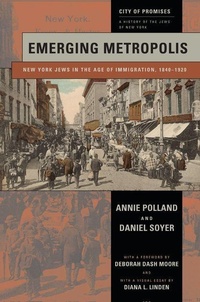
Emerging Metropolis
New York Jews in the Age of Immigration, 1840-1920
1st Edition
Published on 1. September 2013
277 pages
978-0-8147-3832-0 (ISBN)
Description

Describes New York's transformation into a Jewish city
Emerging Metropolis tells the story of New York's emergence as the greatest Jewish city of all time. It explores the Central European and East European Jews' encounter with New York City, tracing immigrants' economic, social, religious, political, and cultural adaptation between 1840 and 1920. This meticulously researched volume shows how Jews wove their ambitions and aspirations-for freedom, security, and material prosperity-into the very fabric and physical landscape of the city.
Emerging Metropolis tells the story of New York's emergence as the greatest Jewish city of all time. It explores the Central European and East European Jews' encounter with New York City, tracing immigrants' economic, social, religious, political, and cultural adaptation between 1840 and 1920. This meticulously researched volume shows how Jews wove their ambitions and aspirations-for freedom, security, and material prosperity-into the very fabric and physical landscape of the city.
Reviews / Votes
"Finally a history of the Jews of New York. Emerging Metropolis demonstrates, with prodigious research and lucid prose, that New York played a crucial role in shaping the Jews, and that the Jews left an indelible stamp on America's great metropolis, New York. Soyer and Polland tell a complicated story that looks both into the inner lives of New York's Jews--in all their complexity--and at the same time surveys the impact of the many other New Yorkers among whom the Jews lived. In doing so the authors show how this city created a Jewish experience that was truly sui generis while it simultaneously shaped modern Jewry around the world." - Hasia R. Diner,Director, Goldstein-Goren Center of American Jewish History, New York University "Polland and Soyer write a compelling history of both New York and Jewish immigration that will appeal to people who are familiar with New York history and/or Jewish history but also a good starting point for people who are new to either New York history or Jewish history in the United States. Quotes and stories, as well as pictures, make this volume lively, original and a useful source for teaching." - Julia Trumpold (Yearbook of German-American Studies) "Chronicling New York Jewish life during the era of mass migration, Emerging Metropolis provides a riveting account of the complex matrix of social organizations, economic activities, political movements, and cultural productions created by immigrant Jews. Polland and Soyer bring the citys spaces to life as they describe the invention of a multifaceted Jewish community that took shape within and helped to shape New Yorks diverse and polyglot urban culture." - Beth S. Wenger,Director, Jewish Studies Program, University of PennsylvaniaMore details
Series
Language
English
Place of publication
New York
United States
Target group
Professional and scholarly
File size
6,40 MB
ISBN-13
978-0-8147-3832-0 (9780814738320)
Copyright in bibliographic data and cover images is held by Nielsen Book Services Limited or by the publishers or by their respective licensors: all rights reserved.
Schweitzer Classification
Other editions
Additional editions
Book
01/2015
New York University Press
€36.50
Shipment within 10-20 days
Book
09/2013
New York University Press
€49.70
Article exhausted; check different version
Persons
Annie Polland (Author)
Annie Polland is Executive Director of the American Jewish Historical Society. She was previously Executive Vice President for Programs and Education at the Lower East Side Tenement Museum, where she authored, Landmark of the Spirit: The Eldridge Street Synagogue.
Daniel Soyer (Author)
Daniel Soyer is professor of history at Fordham University. He is the author of Jewish Immigrant Associations and American Identity in New York, 1880-1939, and editor of several other books.
Annie Polland is Executive Director of the American Jewish Historical Society. She was previously Executive Vice President for Programs and Education at the Lower East Side Tenement Museum, where she authored, Landmark of the Spirit: The Eldridge Street Synagogue.
Daniel Soyer (Author)
Daniel Soyer is professor of history at Fordham University. He is the author of Jewish Immigrant Associations and American Identity in New York, 1880-1939, and editor of several other books.
Content
- Cover
- Contents
- Foreword
- General Editor's Acknowledgments
- Authors' Acknowledgments
- Introduction: The Emerging Jewish Metropolis
- 1 Neighborhood Networks
- 2 "Radical Reform": Union through Charity
- 3 Moorish Manhattan
- 4 Immigrant Citadels: Tenements, Shops, Stores, and Streets
- 5 Capital of the Jewish World
- 6 Jews at the Polls: The Rise of the Jewish Style in New York Politics
- 7 Jews and New York Culture
- Conclusion: The Jewish Metropolis at the End of the Immigrant Era
- Visual Essay: An Introduction to the Visual and Material Culture of New York City Jews, 1840-1920
- Notes
- Bibliography
- Index
- A
- B
- C
- D
- E
- F
- G
- H
- I
- J
- K
- L
- M
- N
- O
- P
- Q
- R
- S
- T
- U
- V
- W
- Y
- Z
- About the Authors
