

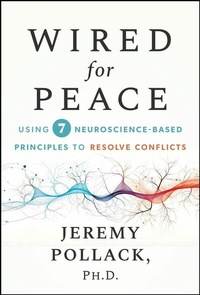
Wired for Peace
Description

A deep dive and exploration into the critical role of the nervous system in conflict resolution and peacebuilding
Drawing from neuroscience, social neuropsychology, predictive-processing theory, and decades of applied conflict resolution practice, Wired for Peace: Using 7 Neuroscience-Based Principles to Resolve Conflicts presents a transformational model for understanding why conflict escalates and how sustainable peace is created. Moving beyond traditional communication-skills or mediation-only approaches, this book shows that lasting conflict resolution begins with the autonomic nervous system and the brain's threat-prediction mechanisms. The book illuminates the internal neural architecture that determines how individuals perceive danger, construct narratives, react to stress, and attempt either protection or connection. Authored by Dr. Jeremy Pollack, an organizational psychologist, conflict resolution expert, and founder of Pollack Peacebuilding Systems, the work examines:
- How the autonomic nervous system, predictive processing, and neuroplasticity shape threat perception, emotional reactivity, and conflict escalation.
- Why conventional modalities such as facilitated dialogue, communication training, leadership coaching, or mediation often fail unless underlying neural dysregulation is addressed.
- How internal conflict, interpersonal conflict, group conflict, and organizational conflict share the same evolutionary and neurobiological foundations.
- The real organizational costs of dysregulated systems, including culture erosion, burnout, turnover, chronic mistrust, and impaired decision-making.
- A complete, research-grounded, multi-chapter framework for building more resilient individuals, teams, organizations, and communities through the science of safety, prediction, and connection.
Wired for Peace is essential reading for anyone who is experiencing persistent conflict in their lives and looking to get to the root of the problem, as well as community and organizational leaders, conflict resolution practitioners, and coaches to add tools to their conflict management toolbox.
More details
Other editions
Additional editions
Person
JEREMY POLLACK, PHD, is a social-organizational psychologist and CEO of Pollack Peacebuilding Systems, the largest workplace conflict resolution consulting firm in North America. A former research fellow at Stanford University's Center for International Conflict & Negotiation and research associate at UCLA's Center for Behavior, Evolution, and Culture, he coaches executives at Fortune 100 companies and contributes regularly to Forbes.com, Fast Company, and Industry Week. He is also author of the Conflict Resolution Playbook and co-author of Peaceful Leadership.
Content
Preface xi
Introduction xix
Principle 1 Solutions and Stress Don't Mix; Always De-escalate First 1
Principle 2 Learn to Look at Conflict as an Opportunity 41
Principle 3 Certainty Is an Illusion; Remain Curious 77
Principle 4 Peace Starts in Small Ways 109
Principle 5 Resolution Requires Care, Transformation Requires Trust 143
Principle 6 We're Built to Collaborate 169
Principle 7 New Solutions Lie Outside the Structure 189
Conclusion 211
Notes 213
Acknowledgments 215
About the Author 217
Index 219
