

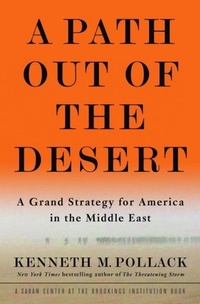
A Path Out of the Desert
A Grand Strategy for America in the Middle East
Published on 15. July 2008
592 pages
978-1-58836-762-4 (ISBN)
Description

"A persuasive but painful solution for dealing with the mess in the Middle East.” -Kirkus
The greatest danger to America's peace and prosperity, notes leading Middle East policy analyst Kenneth M. Pollack, lies in the political repression, economic stagnation, and cultural conflict running rampant in Arab and Muslim nations. By inflaming political unrest and empowering terrorists, these forces pose a direct threat to America's economy and national security. The impulse for America might be to turn its back on the Middle East in frustration over the George W. Bush administration's mishandling of the Iraq War and other engagements with Arab and Muslim countries. But such a move, Pollack asserts, will only exacerbate problems. He counters with the idea that we must continue to make the Middle East a priority in our policy, but in a humbler, more humane, more realistic, and more cohesive way.
Pollack argues that Washington's greatest sin in its relations with the Middle East has been its persistent unwillingness to make the sustained and patient effort needed to help the people of the Middle East overcome the crippling societal problems facing their governments and societies. As a result, the United States has never had a workable comprehensive policy in the region, just a skein of half-measures intended either to avoid entanglement or to contain the influence of the Soviet Union.
Beyond identifying the stagnation of civic life in Arab and Muslim states and the cumulative effect of our misguided policies, Pollack offers a long-term strategy to ameliorate the political, economic, and social problems that underlie the region's many crises. Through his suggested policies, America can engage directly with the governments of the Middle East and indirectly with its people by means of cultural exchange, commerce, and other "soft” approaches. He carefully examines each of the region's most contested areas, including Iraq, Iran, Syria, and Lebanon, as well as the Israeli-Palestinian peace process, and explains how the United States can address each through mutually reinforcing policies.
At a time when the nation will be facing critical decisions about our continued presence in Iraq and Afghanistan, A Path Out of the Desert is guaranteed to stimulate debate about America's humanitarian, diplomatic, and military involvement in the Middle East.
The greatest danger to America's peace and prosperity, notes leading Middle East policy analyst Kenneth M. Pollack, lies in the political repression, economic stagnation, and cultural conflict running rampant in Arab and Muslim nations. By inflaming political unrest and empowering terrorists, these forces pose a direct threat to America's economy and national security. The impulse for America might be to turn its back on the Middle East in frustration over the George W. Bush administration's mishandling of the Iraq War and other engagements with Arab and Muslim countries. But such a move, Pollack asserts, will only exacerbate problems. He counters with the idea that we must continue to make the Middle East a priority in our policy, but in a humbler, more humane, more realistic, and more cohesive way.
Pollack argues that Washington's greatest sin in its relations with the Middle East has been its persistent unwillingness to make the sustained and patient effort needed to help the people of the Middle East overcome the crippling societal problems facing their governments and societies. As a result, the United States has never had a workable comprehensive policy in the region, just a skein of half-measures intended either to avoid entanglement or to contain the influence of the Soviet Union.
Beyond identifying the stagnation of civic life in Arab and Muslim states and the cumulative effect of our misguided policies, Pollack offers a long-term strategy to ameliorate the political, economic, and social problems that underlie the region's many crises. Through his suggested policies, America can engage directly with the governments of the Middle East and indirectly with its people by means of cultural exchange, commerce, and other "soft” approaches. He carefully examines each of the region's most contested areas, including Iraq, Iran, Syria, and Lebanon, as well as the Israeli-Palestinian peace process, and explains how the United States can address each through mutually reinforcing policies.
At a time when the nation will be facing critical decisions about our continued presence in Iraq and Afghanistan, A Path Out of the Desert is guaranteed to stimulate debate about America's humanitarian, diplomatic, and military involvement in the Middle East.
More details
Other editions
Additional editions
Book
08/2009
Random House Trade Paperbacks
€38.40
Article exhausted; check different version

Kenneth M. Pollack
A Path Out of the Desert
Book
08/2008
Random House (NY)
€47.60
Article exhausted; check different version
Person
Kenneth M. Pollack is the director of research at the Saban Center for Middle East Policy at the Brookings Institution. From 1995 to 1996 and from 1999 to 2001, he served as director for Persian Gulf affairs at the National Security Council, where he was the principal working-level official responsible for implementation of U.S. policy toward Iraq, Iran, and the states of the Arabian Peninsula. Prior to his time in the Clinton administration, he spent seven years in the CIA as a Persian Gulf military analyst. He is the author of The Threatening Storm, The Persian Puzzle, Arabs at War, and Things Fall Apart. He lives in Washington, D.C.
Content
- Intro
- Title Page
- Contents
- Dedication
- Foreword
- Preface
- The Middle East
- What I Hope You Will Get from This Book
- Cards on the Table
- Introduction
- The Necessity of a Grand Strategy for the Middle East
- Map
- Part One
- CHAPTER 1
- The Economic Impact of Major Oil Shocks
- The Importance of Middle Eastern and Particularly Saudi Oil Production
- The Perils of Petroleum
- What Does and Does Not Matter About Middle Eastern Oil
- CHAPTER 2
- The Moral Debt
- National Self-Determination
- Democracy
- The Arab-Israeli Conflict
- Other Strategic Considerations
- The Counterargument
- What America's Interest in Israel Means and Does Not Mean
- CHAPTER 3
- Helping Hands
- Geography
- The Limits of American Interest in the Arab States
- CHAPTER 4
- Nonproliferation
- Dogs That Aren't Barking
- A Final Word About America's Interests in the Middle East
- Part Two
- CHAPTER 5
- Demographics
- Unemployment
- Failure to Compete
- The Oil Curse
- Education
- A Culture Under Siege
- CHAPTER 6
- The Persistence of Autocracy
- The Ripple Effect of Bad Governance
- Stultifying Legal Systems
- A Whole That Is Worse Than the Sum of Its Parts
- Part Three
- CHAPTER 7
- The Rise of Political Islam
- CHAPTER 8
- A History of Violence
- The Roots of Instability
- A Darker Future?
- The Prerevolutionary Middle East
- How Long Can They Tread Water?
- A Foolish Game
- CHAPTER 9
- Terrorism and Terrorism
- The Revolutionary Angle
- The Roots of Terrorism
- Anger and Despair
- The Friendly Sea
- Anti-Americanism
- Alternative Explanations for Terrorist Attacks on the United States
- Draining the Swamp
- Part Four
- CHAPTER 10
- The Reforms
- Is All of This Really Necessary?
- Getting Past the Legacy of the Bush Administration
- Is Democracy Possible in the Middle East?
- Give the People What They Want
- CHAPTER 11
- Tilting at Windmills?
- The Islamist Dilemma
- The Problem of New Democracies
- The Most Important Question
- CHAPTER 12
- CHAPTER 13
- Counterterrorism and Reform
- Understanding the Trade-off Trap
- Getting Out of the Trade-offs Trap
- Making Smart Trade-offs When We Have To
- Part Five
- CHAPTER 14
- To Stay or to Leave?
- Reconciling the Options with the Grand Strategy
- CHAPTER 15
- The Iranian Nuclear Program
- Prospects for Regime Change
- Hold Out an Olive Branch
- Beware the Military Option
- Fall Back on Containment
- CHAPTER 16
- Why Peace Matters
- A Modest Agenda
- CHAPTER 17
- Lebanon
- Syria
- Libya
- Sudan
- New Security Architectures
- Part Six
- CHAPTER 18
- Bad History, Part 1
- Bad History, Part 2
- A Worse Middle East or a Better One?
- Conclusion
- Acknowledgments
- Notes
- About the Author
- Also by Kenneth M. Pollack
- Copyright
