

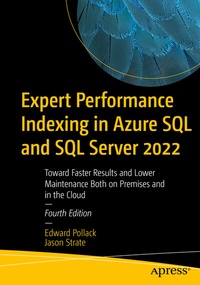
Expert Performance Indexing in Azure SQL and SQL Server 2022
Toward Faster Results and Lower Maintenance Both on Premises and in the Cloud
4th Edition
Published on 21. February 2023
XXI, 638 pages
978-1-4842-9215-0 (ISBN)
Description

Take a deep dive into perhaps the single most important facet of query performance-indexes-and how to best use them. Newly updated for SQL Server 2022 and Azure SQL, this fourth edition includes new guidance and features related to columnstore indexes, improved and consolidated content on Query Store, deeper content around Intelligent Query Processing, and other updates to help you optimize query execution and make performance improvements to even the most challenging workloads.
The book begins with explanations of the types of indexes and how they are stored in a database. Moving further into the book, you will learn how statistics are critical for optimal index usage and how the Index Advisor can assist in reviewing and optimizing index health. This book helps you build a clear understanding of how indexes work, how to implement and use them, and the many options available to tame even the most large and complex workloads.
What You Will Learn
Who This Book Is For
Azure SQL and SQL Server administrators and developers who are ready to improve the performance of their database environment by thoughtfully building indexes to speed up queries that matter the most and make a difference to the business
The book begins with explanations of the types of indexes and how they are stored in a database. Moving further into the book, you will learn how statistics are critical for optimal index usage and how the Index Advisor can assist in reviewing and optimizing index health. This book helps you build a clear understanding of how indexes work, how to implement and use them, and the many options available to tame even the most large and complex workloads.
What You Will Learn
- Properly index row store, columnstore, and memory-optimized tables
- Make use of Intelligent Query Processing for faster query results
- Review statistics to understand indexing choices made by the optimizer
- Apply indexing strategies such as covering indexes, included columns, and index intersections
- Recognize and remove unnecessary indexes
- Design effective indexes for full-text, spatial, and XML data types
Who This Book Is For
Azure SQL and SQL Server administrators and developers who are ready to improve the performance of their database environment by thoughtfully building indexes to speed up queries that matter the most and make a difference to the business
More details
Other editions
Additional editions
Edward Pollack | Jason Strate
Expert Performance Indexing in Azure SQL and SQL Server 2022
Toward Faster Results and Lower Maintenance Both on Premises and in the Cloud
Book
02/2023
4th Edition
APress
€69.54
Shipment within 15-20 days
Persons
Edward Pollack
has over 20 years of experience in database and systems administration, architecture, and development, becoming an advocate for designing efficient data structures that can withstand the test of time. He has spoken at many events, such as SQL Saturdays, PASS Data Community Summit, Dativerse, and at many user groups and is the organizer of SQL Saturday Albany. Ed has authored many articles, as well as the following Apress books:
Dynamic SQL: Applications, Performance, and Securit
y
in Microsoft SQL Server
Analytics Optimization with Columnstore Indexes in Microsoft SQL Server: Optimizing OLAP Workloads
;
and a chapter in
Expert T-SQL Window Functions in SQL Server
. His first patent was issued in 2021, focused on the compression of geographical data for use by analytic systems.
In his free time, Ed enjoys video games, sci-fi and fantasy, traveling, and baking. He lives in the sometimes-frozen icescape of Albany, NY, with his wife Theresa and sons Nolan and Oliver, and a mountain of (his) video game plushies that help break the fall when tripping on (their) toys.
Jason Strate is a database architect and administrator with more than 15 years of experience. He has been a recipient of Microsoft's Most Valuable Professional designation for SQL Server since July 2009. His experience includes design and implementation of both OLTP and OLAP solutions, as well as assessment and implementation of SQL Server environments for best practices, performance, and high availability solutions. He is a SQL Server MCITP and participated in the development of Microsoft Certification exams for SQL Server 2008.
Jason is actively involved with his local PASS chapter (SQL Server User Group) and serves as its director of program development. He worked with the board to organize the PASSMN SQL Summit 2009 for the local community. He enjoys helping others in the SQL Server community and does this by presenting at technical conferences and user group meetings. Most recently, he has presented at the SSWUG Virtual Conferences, TechFuse, numerous SQL Saturdays, and at PASSMN user group meetings.
Jason is a contributing author for the Microsoft whitepaper on "Empowering Enterprise Solutions with SQL Server 2008 Enterprise Edition." He is an active blogger with a focus on SQL Server and related technologies.
In his free time, Ed enjoys video games, sci-fi and fantasy, traveling, and baking. He lives in the sometimes-frozen icescape of Albany, NY, with his wife Theresa and sons Nolan and Oliver, and a mountain of (his) video game plushies that help break the fall when tripping on (their) toys.
Jason Strate is a database architect and administrator with more than 15 years of experience. He has been a recipient of Microsoft's Most Valuable Professional designation for SQL Server since July 2009. His experience includes design and implementation of both OLTP and OLAP solutions, as well as assessment and implementation of SQL Server environments for best practices, performance, and high availability solutions. He is a SQL Server MCITP and participated in the development of Microsoft Certification exams for SQL Server 2008.
Jason is actively involved with his local PASS chapter (SQL Server User Group) and serves as its director of program development. He worked with the board to organize the PASSMN SQL Summit 2009 for the local community. He enjoys helping others in the SQL Server community and does this by presenting at technical conferences and user group meetings. Most recently, he has presented at the SSWUG Virtual Conferences, TechFuse, numerous SQL Saturdays, and at PASSMN user group meetings.
Jason is a contributing author for the Microsoft whitepaper on "Empowering Enterprise Solutions with SQL Server 2008 Enterprise Edition." He is an active blogger with a focus on SQL Server and related technologies.
Content
1. Index Fundamentals.- 2. Index Storage Fundamentals.- 3. Examining Index Contents.- 4. Fragmentation.- 5. Index Metadata and Statistics.- 6. XML Indexes.- 7. Spatial Indexing.- 8. Indexing Memory-Optimized Tables.- 9. Full-Text Indexing.- 10. Indexing Myths and Best Practices.- 11. Index Maintenance.- 12. Indexing Tools.- 13. Indexing Strategies.- 14. Query Strategies.- 15. Monitoring Indexes.- 16. Index Analysis.- 17. Indexing Methodology.
