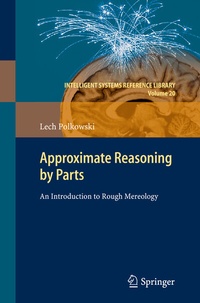
Approximate Reasoning by Parts
Description

The monograph offers a view on Rough Mereology, a tool for reasoning under uncertainty, which goes back to Mereology, formulated in terms of parts by Lesniewski, and borrows from Fuzzy Set Theory and Rough Set Theory ideas of the containment to a degree. The result is a theory based on the notion of a part to a degree.
One can invoke here a formula Rough: Rough Mereology : Mereology = Fuzzy Set Theory : Set Theory. As with Mereology, Rough Mereology finds important applications in problems of Spatial Reasoning, illustrated in this monograph with examples from Behavioral Robotics. Due to its involvement with concepts, Rough Mereology offers new approaches to Granular Computing, Classifier and Decision Synthesis, Logics for Information Systems, and are--formulation of well--known ideas of Neural Networks and Many Agent Systems. All these approaches are discussed in this monograph.
To make the exposition self--contained, underlying notions of Set Theory, Topology, and Deductive and Reductive Reasoning with emphasis on Rough and Fuzzy Set Theories along with a thorough exposition of Mereology both in Lesniewski and Whitehead--Leonard--Goodman--Clarke versions are discussed at length.
It is hoped that the monograph offers researchers in various areas of Artificial Intelligence a new tool to deal with analysis of relations among concepts.
More details
Other editions
Additional editions