

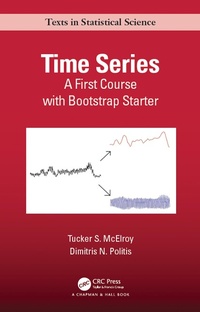
Time Series
A First Course with Bootstrap Starter
1st Edition
Published on 9. December 2019
300 pages
978-1-4398-7652-7 (ISBN)
Description

Time Series: A First Course with Bootstrap Starter provides an introductory course on time series analysis that satisfies the triptych of (i) mathematical completeness, (ii) computational illustration and implementation, and (iii) conciseness and accessibility to upper-level undergraduate and M.S. students. Basic theoretical results are presented in a mathematically convincing way, and the methods of data analysis are developed through examples and exercises parsed in R. A student with a basic course in mathematical statistics will learn both how to analyze time series and how to interpret the results.
The book provides the foundation of time series methods, including linear filters and a geometric approach to prediction. The important paradigm of ARMA models is studied in-depth, as well as frequency domain methods. Entropy and other information theoretic notions are introduced, with applications to time series modeling. The second half of the book focuses on statistical inference, the fitting of time series models, as well as computational facets of forecasting. Many time series of interest are nonlinear in which case classical inference methods can fail, but bootstrap methods may come to the rescue. Distinctive features of the book are the emphasis on geometric notions and the frequency domain, the discussion of entropy maximization, and a thorough treatment of recent computer-intensive methods for time series such as subsampling and the bootstrap. There are more than 600 exercises, half of which involve R coding and/or data analysis. Supplements include a website with 12 key data sets and all R code for the book's examples, as well as the solutions to exercises.
The book provides the foundation of time series methods, including linear filters and a geometric approach to prediction. The important paradigm of ARMA models is studied in-depth, as well as frequency domain methods. Entropy and other information theoretic notions are introduced, with applications to time series modeling. The second half of the book focuses on statistical inference, the fitting of time series models, as well as computational facets of forecasting. Many time series of interest are nonlinear in which case classical inference methods can fail, but bootstrap methods may come to the rescue. Distinctive features of the book are the emphasis on geometric notions and the frequency domain, the discussion of entropy maximization, and a thorough treatment of recent computer-intensive methods for time series such as subsampling and the bootstrap. There are more than 600 exercises, half of which involve R coding and/or data analysis. Supplements include a website with 12 key data sets and all R code for the book's examples, as well as the solutions to exercises.
Reviews / Votes
"The authors should be congratulated for providing many concise and compact proofs for various technical assertions in time series. (There are many seemingly inconspicuous but intriguing technical details in time series!) The authors' strength and perhaps also their preference in frequency domain methods are well-reflected in the treatments in Chapters 6, 7 and 9, and also some parts of Chapters 10 and 11. Chapter 12 introduces several of the most popular bootstrap methods for time series, including AR-sieve bootstrap, block bootstrap and frequency domain bootstrap. In terms of the mathematical level, the book is for students with a solid mathematical background. The style of the presentation would also better suit courses offered in statistics, mathematics or engineering programmes for which spectral analysis is pertinent."~International Statistical Review
"The first eight chapters of this book mainly focus on understanding the structure of time series. From the ninth chapter onwards, they discuss statistical inference based on time series data...Since the book includes a large number of exercises, teachers of a course on time series may find this book useful. Overall, researchers working in the area of time series may also find this book a useful reference. Finally, applied researchers involved with time series data may also find this book helpful." ~ISCB News
"This new monograph by McElroy (US Census Bureau) and Politis (Univ. of California, San Diego) is a timely publication, whereas the more well-known time series monographs were published long ago (in the 1980s and 1990s).. this volume stands out as an ideal source for readers exploring time series analysis both theoretically and empirically...Some unique topics are introduced, for example, information entropy in time series, time-series-specific statistical inference, and dependent data bootstrapping. The latter represents an important recent advancement in time series analysis."
~CHOICE
More details
Series
Edition
1. Auflage
Language
English
Place of publication
London
United Kingdom
Publishing group
Taylor & Francis Ltd
Target group
College/higher education
ISBN-13
978-1-4398-7652-7 (9781439876527)
Copyright in bibliographic data and cover images is held by Nielsen Book Services Limited or by the publishers or by their respective licensors: all rights reserved.
Schweitzer Classification
Other editions
New editions
E-Book
02/2026
2nd Edition
Chapman and Hall
€94.99
Available for download
Additional editions
Book
06/2021
1st Edition
Chapman & Hall/CRC
€69.70
Shipment within 10-20 days
Book
12/2019
1st Edition
Chapman & Hall/CRC
€122.50
Shipment within 15-20 days
Persons
Tucker S. McElroy is Senior Time Series Mathematical Statistician at the U.S. Census Bureau, where he has contributed to developing time series research and software for the last 15 years. He has published more than 80 papers and is a recipient of the Arthur S. Flemming award (2011).
Dimitris N. Politis is Distinguished Professor of Mathematics at the University of California at San Diego, where he is also serving as Associate Director of the Halicioglu Data Science Institute. He has co-authored two research monographs and more than 100 journal papers. He is a recipient of the Tjalling C. Koopmans Econometric Theory Prize (2009-2011) and is Co-Editor of the Journal of Time Series Analysis.
Dimitris N. Politis is Distinguished Professor of Mathematics at the University of California at San Diego, where he is also serving as Associate Director of the Halicioglu Data Science Institute. He has co-authored two research monographs and more than 100 journal papers. He is a recipient of the Tjalling C. Koopmans Econometric Theory Prize (2009-2011) and is Co-Editor of the Journal of Time Series Analysis.
Content
1. Introduction, 2. The Probabilistic Structure of Time Series, 3. Trends, Seasonality, and Filtering, 4. The Geometry of Random Variables, 5. ARMA Models with White Noise Residuals, 6. Time Series in the Frequency Domain, 7. The Spectral Representation, 8. Information and Entropy, 9. Statistical Estimation, 10. Fitting Time Series Models, 11. Nonlinear Time Series Analysis, 12. The Bootstrap, A. Probability, B. Mathematical Statistics, C. Asymptotics, D. Fourier Series, E. Stieltjes Integration
