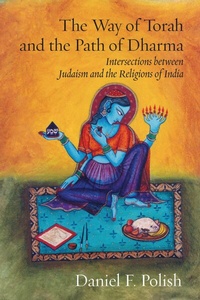
The Way of Torah and the Path of Dharma
Description

Written with deep knowledge of Indian religions (Hinduism, Jainism, Buddhism, and Sikhism) and of Judaism, as both textual traditions and lived practices, and with an understanding of his American audience, The Way of Torah and the Path of Dharma provides an essential introduction to the world's leading non-Abrahamic religions. It serves as well as a model of bridging the world of religious scholarship with the world of ordinary religious practitioners.
When Rabbi Polish embarked on the study of Indian religion at the beginning of his career, India was exotic, and Christianity was at the center of the American Jewish interfaith experience. Now, between globalization on the one hand, and a generation of Indian immigrants coming of age, Indian religion is of growing interest and concern. Rabbi Polish moves the discussion beyond the ways that practices such as Yoga and meditation have been westernized and commoditized, and points to what Jews share with a billion religious practitioners in the U.S. and beyond.
In The Way of Torah and the Path of Dharma, Rabbi Daniel Polish takes Jewish readers on a tour of Indian religious practices and beliefs. He shows commonalities and differences and then, challengingly, asks us how what Jews learn about Indian religion might affect how they think about their Judaism and what followers of Eastern religious traditions can learn from Judaism about their faith.
Advance Praise
"The book is a whirlwind religious tourist visit to the diversity of Indian religions: Sikh, Jain, Buddhist, and Hindu led by an experienced congregational rabbi with much experience in interfaith dialogue and in teaching world religions. Polish seeks a deeper understanding of the Jewish tradition by discussing specific points of Indian religions in tandem with Judaism: the book of Ecclesiastes compared to the teachings of the Buddha; Chanukah and Purim compared to Diwali and Holi; and Jain reverence for life compared to Jewish law. He sets these parallels within discussions of religious evolution, mythology, and henotheism. Polish provides a pleasurable book to be read on the plane to India for those journeying to find their own points of intersection."
-Rabbi Dr. Alan Brill, author of Rabbi on the Ganges: A Jewish Hindu-Encounter and Judaism and World Religions
About the Author
Rabbi Daniel Polish has been a congregational rabbi for many years, most recently serving as spiritual leader of Congregation Shir Chadash of the Hudson River Valley in Lagrangeville, New York. Born in Ithaca, New York, he received his B.A. in Philosophy from Northwestern University, was ordained at Hebrew Union College, and earned his Ph.D. in History of Religion from Harvard University, writing his dissertation on "The Flood Myth in the Traditions of Israel and India."
Throughout the years he has been involved in interfaith dialogue at the highest levels on behalf of the Jewish community. He was part of a team of prominent scholars of religion that met with Muslim religious leaders throughout South Asia for the purpose of promoting interfaith understanding. He has served as chair of the International Jewish Commission for Interreligious Consultation (IJCIC), the official interlocutor of the Jewish community with the Vatican and other international religious bodies.
Rabbi Polish is the author of several previous books: Bringing the Psalms to Life, Keeping Faith with the Psalms, and Talking About God: Exploring the Meaning of Religious Life with Kierkegaard, Buber, Tillich and Heschel. He serves on the editorial board of The Journal of Reform Judaism and of Current Dialogue, published by the World Council of Churches.
All prices
More details
Other editions
Additional editions