

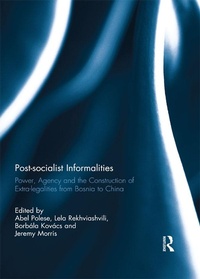
Post-socialist Informalities
Power, Agency and the Construction of Extra-legalities from Bosnia to China
1st Edition
Published on 19. October 2018
280 pages
978-1-351-58519-4 (ISBN)
Description

This book is a comprehensive collection of key scholarship on informality from the whole post-socialist region. From Bosnia to Central Asia, passing through Russia and Azerbaijan, the contributions to this volume illustrate the multi-faceted and complex nature of informality, while demonstrating the growing scholarly and policy debates that have developed around the understanding of informality.
In contrast to approaches which tend to classify informality as 'bad' or 'transitional' - meaning that modernity will make it disappear - this edited volume concentrates on dynamics and mechanisms to understand and explain informality, while also debating its relationship with the market and society.
The authors seek to explain informality beyond a mere monetaristic/economistic approach, rediscovering its interconnection with social phenomena to propose a more holistic interpretation of the meaning of informality and its influence in various spheres of life.
They do this by exploring the evolving role of informal practices in the post-socialist region, and by focusing on informality as a social organisation determinant but also looking at the way it reshapes emergent social resistance against symbolic and real political order(s).
This book was originally published as two special issues, of Caucasus Survey and the Journal of Contemporary Central and Eastern Europe.
In contrast to approaches which tend to classify informality as 'bad' or 'transitional' - meaning that modernity will make it disappear - this edited volume concentrates on dynamics and mechanisms to understand and explain informality, while also debating its relationship with the market and society.
The authors seek to explain informality beyond a mere monetaristic/economistic approach, rediscovering its interconnection with social phenomena to propose a more holistic interpretation of the meaning of informality and its influence in various spheres of life.
They do this by exploring the evolving role of informal practices in the post-socialist region, and by focusing on informality as a social organisation determinant but also looking at the way it reshapes emergent social resistance against symbolic and real political order(s).
This book was originally published as two special issues, of Caucasus Survey and the Journal of Contemporary Central and Eastern Europe.
More details
Edition
1. Auflage
Language
English
Place of publication
London
United Kingdom
Publishing group
Taylor & Francis Ltd
Target group
College/higher education
ISBN-13
978-1-351-58519-4 (9781351585194)
Copyright in bibliographic data and cover images is held by Nielsen Book Services Limited or by the publishers or by their respective licensors: all rights reserved.
Schweitzer Classification
Other editions
Additional editions
Abel Polese | Lela Rekhviashvili | Borbala Kovacs
Post-socialist Informalities
Power, Agency and the Construction of Extra-legalities from Bosnia to China
Book
05/2019
1st Edition
Routledge
€68.60
Shipment within 15-20 days
Abel Polese | Lela Rekhviashvili | Borbala Kovacs
Post-socialist Informalities
Power, Agency and the Construction of Extra-legalities from Bosnia to China
Book
10/2017
1st Edition
Routledge
€205.00
Shipment within 10-20 days
Persons
Abel Polese works on governance and informality with focus on Eastern Europe, the Caucasus, Central and Southeast Asia. He is affiliated to Dublin City University's Institute for International Conflict Resolution and Reconstruction and Tallinn University of Technology's Tallinn Law School and Tallinn University's RASI.
Lela Rekhviashvili works on informal economic practices, political economy of development, and mobility studies. She is based at the Leibniz Institute for Regional Geography, Germany.
Borbala Kovacs is based in the Department of Political Science at Central European University, Hungary.
Jeremy Morris is an ethnographer of post-socialism, and the author and editor of numerous books. He is based at the University of Aarhus, Denmark.
Lela Rekhviashvili works on informal economic practices, political economy of development, and mobility studies. She is based at the Leibniz Institute for Regional Geography, Germany.
Borbala Kovacs is based in the Department of Political Science at Central European University, Hungary.
Jeremy Morris is an ethnographer of post-socialism, and the author and editor of numerous books. He is based at the University of Aarhus, Denmark.
Content
Part I: "States" of informality in post-socialist Europe 1. "States" of informality in post-socialist Europe (and beyond) Abel Polese, Jeremy Morris and Borbala Kovacs 2. Informality currencies: a tale of Misha, his brigada and informal practices among Uzbek labour migrants in Russia Rustamjon Urinboyev and Abel Polese 3. End to informality? Examining the impact of institutional reforms on informal institutions in post-Euromaidan Ukraine Huseyn Aliyev 4. Informality as an interpretive filter: translating ubleha in local community development in Bosnia Karla Koutkova 5. Socio-economic deficits and informal domestic childcare services in Romania: the policy drivers of the commodification of care from a micro-level perspective Borbala Kovacs 6. Counterbalancing marketization informally: Georgia's new-institutionalist reform and its discontents Lela Rekhviashvili 7. Regional security governance in the former Soviet space? Researching institutions, actors and practices Alessandra Russo 8. The art of not seeing like a state. On the ideology of "informality" Rune Steenberg 9. Accomplishing public secrecy: non-monetary informal practices and their concealment at the emergency department Marius Wamsiedel 10. Evaluating the multifarious motives for acquiring goods and services from the informal sector in Central and Eastern Europe Colin C. Williams and Ioana A. Horodnic Part II: Informality and power in the South Caucasus 11. Introduction: Informality and power in the South Caucasus Abel Polese and Lela Rekhviashvili 12. Post-Soviet small businesses in Azerbaijan: the legacies of the Soviet second economy Leyla Sayfutdinova 13. Liberalism and shadow interventionism in post-revolutionary Georgia (2003-2012) Lela Rekhviashvili and Abel Polese 14. Informality as illegality in Georgia's anti-mafia campaign Gavin Slade 15. A critical assessment of informal practices as resistance: the case of birzha in Georgia Costanza Curro 16. Trajectories of illegality and informality in conflict protraction: the Abkhaz-Georgian case Giulia Prelz Oltramonti
