
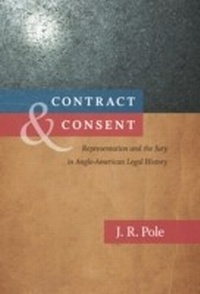
Contract and Consent
Description
Alles über E-Books | Antworten auf Fragen rund um E-Books, Kopierschutz und Dateiformate finden Sie in unserem Info- & Hilfebereich.
In Contract and Consent, the renowned legal historian J. R. Pole posits that legal history has become highly specialized, while mainstream political and social historians frequently ignore cases that figure prominently in the legal literature. Pole makes a start at remedying the situation with a series of essays that reintegrate legal with political and social history. A central theme of the essays is the link between Anglo-American common law and contract law and American political and constitutional principles. Pole also emphasizes the political functions of legal institutions in English and American history, going so far as to suggest that we need to divest ourselves of any notion of the separation of powers. Instead, we need to acknowledge the historical role of courts, juries, and the common law as agencies of political representation and as promulgators of law and policy.
Other essays show the implications of independence for American law, and how American political scientists converted the concept of sovereignty from its authoritarian claims in the eighteenth century into a product of the political process in the nineteenth and twentieth centuries. Although the American colonies made their own versions of the common law,there was no simple division between "English" and "American" law. But it was of fundamental importance that an entitled, landed aristocracy was never imported into or allowed to take root in America, with the result that American law was much simpler than its English counterpart, with the latter's accretion of esoteric language and procedures.
Having established the basis of Anglo-American legal history in contract and common law in part one, in the second half of the volume Pole explores various constitutional and legal themes, from bicameralism in Britain and America and the role of the Constitution in the making of American nationality to the performance of representative institutions in the century following the American Revolution.
All prices
More details
Other editions
Additional editions
Person
J. R. Pole is Rhodes Professor Emeritus of American History and Institutions at St. Catherine's College, University of Oxford.
Content
- front
- ch00
- ch01
- ch02
- ch03
- ch04
- ch05
- ch06
- ch07
- ch08
- ch09
- ch10
- ch11
- index

System requirements
File format: ePUB
Copy protection: Adobe-DRM (Digital Rights Management)
System requirements:
- Computer (Windows; MacOS X; Linux): Install the free reader Adobe Digital Editions prior to download (see eBook Help).
- Tablet/smartphone (Android; iOS): Install the free app Adobe Digital Editions or the app PocketBook before downloading (see eBook Help).
- E-reader: Bookeen, Kobo, Pocketbook, Sony, Tolino and many more (not Kindle).
The file format ePub works well for novels and non-fiction books – i.e., „flowing” text without complex layout. On an e-reader or smartphone, line and page breaks automatically adjust to fit the small displays.
This eBook uses Adobe-DRM, a „hard” copy protection. If the necessary requirements are not met, unfortunately you will not be able to open the eBook. You will therefore need to prepare your reading hardware before downloading.
Please note: We strongly recommend that you authorise using your personal Adobe ID after installation of any reading software.
For more information, see our ebook Help page.
File format: PDF
Copy-Protection: Adobe-DRM (Digital Rights Management)
System requirements:
- Computer (Windows; MacOS X; Linux): Install the free reader Adobe Digital Editions prior to download (see eBook Help).
- Tablet/smartphone (Android; iOS): Install the free app Adobe Digital Editions or the app PocketBook before downloading (see eBook Help).
- E-reader: Bookeen, Kobo, Pocketbook, Sony, Tolino and many more (only limited: Kindle).
The file format PDF always displays a book page identically on any hardware. This makes PDF suitable for complex layouts such as those used in textbooks and reference books (images, tables, columns, footnotes). Unfortunately, on the small screens of e-readers or smartphones, PDFs are rather annoying, requiring too much scrolling.
This eBook uses Adobe-DRM, a „hard” copy protection. If the necessary requirements are not met, unfortunately you will not be able to open the eBook. You will therefore need to prepare your reading hardware before downloading.
Please note: We strongly recommend that you authorise using your personal Adobe ID after installation of any reading software.
For more information, see our eBook Help page.
File format: ePUB
Copy protection: without DRM (Digital Rights Management)
System requirements:
- Computer (Windows; MacOS X; Linux): Use a reader that can handle the file format ePUB, such as Adobe Digital Editions or FBReader – both free (see eBook Help).
- Tablet/Smartphone (Android; iOS): Install the free app Adobe Digital Editions or the app PocketBook (see eBook Help).
- E-reader: Bookeen, Kobo, Pocketbook, Sony, Tolino and many more (not Kindle).
The file format ePUB works well for novels and non-fiction books – i.e., 'flowing' text without complex layout. On an e-reader or smartphone, line and page breaks automatically adjust to fit the small displays.
This eBook does not use copy protection or Digital Rights Management
For more information, see our eBook Help page.
