

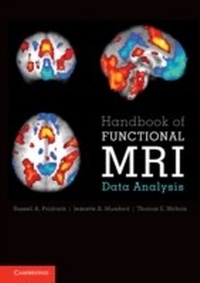
Handbook of Functional MRI Data Analysis
1st Edition
Published on 18. December 2011
978-1-139-11878-1 (ISBN)
Description

Functional magnetic resonance imaging (fMRI) has become the most popular method for imaging brain function. Handbook of Functional MRI Data Analysis provides a comprehensive and practical introduction to the methods used for fMRI data analysis. Using minimal jargon, this book explains the concepts behind processing fMRI data, focusing on the techniques that are most commonly used in the field. This book provides background about the methods employed by common data analysis packages including FSL, SPM and AFNI. Some of the newest cutting-edge techniques, including pattern classification analysis, connectivity modeling and resting state network analysis, are also discussed. Readers of this book, whether newcomers to the field or experienced researchers, will obtain a deep and effective knowledge of how to employ fMRI analysis to ask scientific questions and become more sophisticated users of fMRI analysis software.
Reviews / Votes
'Wow! Very often in neuroimaging a title has little relationship to what follows. That is clearly not the case with the Handbook of Functional MRI Data Analysis by Poldrack, Mumford, and Nichols. This relatively slender volume is all that a handbook should be: it is crafted by true experts in the field, it is structured so that a newcomer can understand a method's strengths and weaknesses, but it also contains meaty information useful to experts. The book touches on all of the major analytical approaches current in the field and, while I don't agree with every choice the authors make, their advice is always well-conceived. This will be a standard reference on every neuroimager's shelf.' Steven Petersen, Washington University, St Louis 'This book, by some of the best in the field, will no doubt be the go-to book found in every imaging lab and recommendedfor all trainees. Poldrack, Mumford, and Nichols cover the most basic to sophisticated imaging analyses in a wonderfully accessible way.' B. J. Casey, Sackler Institute, Weill Cornell Medical College 'This is a great and timely book. The authors start with the basic concepts of fMRI and image analysis, develop the standard processings and statistical models, and finally explain in a simple and didactic style more advanced topics such as connectivity and machine learning techniques. This textbook provides a comprehensive, and yet very clear, introduction to all of the important aspects of fMRI data analysis. It is extremely readable, and I would strongly recommend anyone new to the field of neuroimaging to read this from cover to cover. Psychologists and medics will find it accessible, and not mathematically daunting, while engineers and other methods researchers will find the breadth of imaging-related issues a very valuable background.' Steve Smith, FMRIB Analysis Group, Oxford 'The book is a must in any research laboratory or clinical environment using fMRI, and it is the perfect reading for studnets or researchers, whether they want to develop fMRI data analysis methods or understand and apply these methods. I believe this book will be a best-seller in our field and a reference for many years because it ideally fills the gap between introductory and advanced research textbooks.' Jean-Baptiste Poline, Neurospin, Institut d'Imagerie Biomedicale, CEA, FranceMore details
Language
English
Place of publication
Cambridge
United Kingdom
Publishing group
Cambridge University Press
Target group
Professional and scholarly
Illustrations
5 Tables, unspecified; 51 Plates, unspecified; 51 Plates, color; 18 Halftones, unspecified; 18 Halftones, black and white; 27 Line drawings, black and white
File size
5,57 MB
ISBN-13
978-1-139-11878-1 (9781139118781)
Copyright in bibliographic data and cover images is held by Nielsen Book Services Limited or by the publishers or by their respective licensors: all rights reserved.
Schweitzer Classification
Other editions
Additional editions
Russell A. Poldrack | Jeanette A. Mumford | Thomas E. Nichols
Handbook of Functional MRI Data Analysis
Book
02/2024
Cambridge University Press
€64.60
Shipment within 15-20 days
Russell A. Poldrack | Jeanette A. Mumford | Thomas E. Nichols
Handbook of Functional MRI Data Analysis
Book
08/2011
Cambridge University Press
€86.65
No shipping information available
Persons
Dr Russell A. Poldrack is the Director of the Imaging Research Center and Professor of Psychology and Neurobiology at the University of Texas, Austin. He has published more than 100 articles in the field of cognitive neuroscience, in journals including Science, Nature, Neuron, Nature Neuroscience and PNAS. He is well known for his writings on how neuroimaging can be used to make inferences about psychological function, as well as for his research using fMRI and other imaging techniques to understand the brain systems that support learning and memory, decision making and executive function. Dr Jeanette A. Mumford is a Research Assistant Professor in the Department of Psychology at the University of Texas, Austin. Trained in biostatistics, her research has focused on the development and characterisation of new methods for statistical modeling and analysis of fMRI data. Her work has examined the impact of different group modeling strategies and developed new tools for modeling network structure in resting-state fMRI data. She is the developer of the fmriPower software package, which provides power analysis tools for fMRI data. Dr Thomas E. Nichols is the Head of Neuroimaging Statistics at the University of Warwick, United Kingdom. He has been working in functional neuroimaging since 1992, when he joined the University of Pittsburgh's PET Facility as programmer and statistician. He is known for his work on inference in brain imaging, using both parametric and nonparametric methods, and he is an active contributor to the FSL and SPM software packages. In 2009 he received the Wiley Young Investigator Award from the Organization for Human Brain Mapping in recognition for his contributions to statistical modeling and inference of neuroimaging data.
Content
1. Introduction; 2. Image processing; 3. Preprocessing; 4. Normalization; 5. Statistical modeling; 6. Statistical modeling: group analysis; 7. Statistical inference; 8. Connectivity; 9. Visualization; 10. Machine learning; Appendix A. GLM intro/review; Appendix B. Data organization and management; Appendix C. Image formats.
