

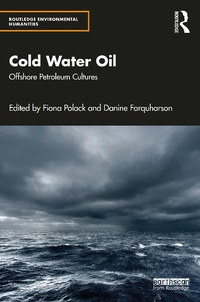
Cold Water Oil
Offshore Petroleum Cultures
1st Edition
Published on 19. December 2021
292 pages
978-1-000-51662-3 (ISBN)
Description

Cold Water Oil: Offshore Petroleum Cultures is a collection of essays examining how societies conceive of fossil fuel extraction in the inhospitable but fragile waters of the North Atlantic and Arctic oceans.
What happens offshore matters. Currently, over a quarter of the world's oil and gas is produced from beneath the seas. The offshore petroleum industry is thus a crucial point of origin for global carbon emissions, and other environmental harms. Cold Water Oil: Offshore Petroleum Cultures illuminates ignored histories, influential contemporary narratives, and emerging energy and environmental futures. The volume centres on North Atlantic and Arctic regions; the continuing but often strongly contested pursuit of oil and gas in frigid, tumultuous, and environmentally sensitive seas enforces the lengths to which corporations and governments will go to maintain the centrality of fossil fuels. The book's contributors focus on the cultural, social, and ecological implications of oil and gas extraction in the oceanic territories of Canada, Norway, the UK, Russia, the US, and the Inupiat of Alaska at a time of profound global uncertainty. In conversation with the energy and environmental humanities, and critical ocean studies, Cold Water Oil considers a region central to debates about climate change and the planet's future.
Cold Water Oil engages students and researchers interested in climate change, energy humanities, critical ocean studies, and North Atlantic and Arctic issues.
What happens offshore matters. Currently, over a quarter of the world's oil and gas is produced from beneath the seas. The offshore petroleum industry is thus a crucial point of origin for global carbon emissions, and other environmental harms. Cold Water Oil: Offshore Petroleum Cultures illuminates ignored histories, influential contemporary narratives, and emerging energy and environmental futures. The volume centres on North Atlantic and Arctic regions; the continuing but often strongly contested pursuit of oil and gas in frigid, tumultuous, and environmentally sensitive seas enforces the lengths to which corporations and governments will go to maintain the centrality of fossil fuels. The book's contributors focus on the cultural, social, and ecological implications of oil and gas extraction in the oceanic territories of Canada, Norway, the UK, Russia, the US, and the Inupiat of Alaska at a time of profound global uncertainty. In conversation with the energy and environmental humanities, and critical ocean studies, Cold Water Oil considers a region central to debates about climate change and the planet's future.
Cold Water Oil engages students and researchers interested in climate change, energy humanities, critical ocean studies, and North Atlantic and Arctic issues.
Reviews / Votes
"The oceans are one of the world's most important sites of oil extraction. Yet far too little attention has been paid to the histories and narratives produced by offshore extraction. Danine Farquharson and Fiona Polack's marvelously curated collection of essays offers readers the first extended exploration of the lives formed around and shaped by the encounter of sea and oil. Cold Water Oil is an instant classic. From its field-defining introduction to its wonderful concluding essay, which offers a whale's view of extraction, this book shows us what environmental and energy studies miss when they fail to critically explore what lies under the surface. A thrilling read for anyone interested in the complex cultures of energy."Imre Szeman, author of On Petrocultures: Globalization, Culture, and Energy and Climate Critic for the Green Party of Canada
"Cold Water Oil illuminates the often-hidden realities of offshore oil development. Far from sight, out to sea and deep beneath the ocean, countries around the North Atlantic are scraping the bottom of the barrel for short-term economic gain. Here Polack and Farquharson gathered an interdisciplinary group of contributors to weave a fuller understanding of offshore oil extraction and its distressing impacts. Together they present case studies from Canada, Norway, the UK, Russia, and the US that draw insights from across ecology, politics, culture, and history. Cold Water Oil is a gripping and despairing-yet-hopeful volume. It confronts the most pressing dilemmas of our time while inspiring a more equitable energy future. It is a timely antidote to the 'clean oil' greenwashing used by governments and industry to convince us we have no other choice."
Angela Carter, Associate Professor, Department of Political Science & Balsillie School of International Affairs, University of Waterloo, Canada, and author of Fossilized: Environmental Policy in Canada's Petro-Provinces
"Energy humanities finally takes to the sea in this important new collection of essays focused on offshore petroleum extraction. The authors disrupt the silencing of marine environments that accompanies the mare nullius logic of frontier extractivism. Cold Water Oil instead reconnects and reterritorializes these environments, placing more-than-human relations and energopolitical entanglements front and center in its accounts of the offshore as the frontlines of struggle over energy transition today. The volume brings the offshore back home, challenging us to expand our critical imagination to sound the watery depths and coasts of petromodernity."
Dominic Boyer, author of Energopolitics, 2021-22 Berggruen Fellow 2021-22, and Professor, Rice University, USA
More details
Series
Edition
1. Auflage
Language
English
Place of publication
London
United Kingdom
Publishing group
Taylor & Francis Ltd
Target group
College/higher education
Illustrations
3 Tables, black and white; 2 Line drawings, black and white; 12 Halftones, black and white; 14 Illustrations, black and white
ISBN-13
978-1-000-51662-3 (9781000516623)
Copyright in bibliographic data and cover images is held by Nielsen Book Services Limited or by the publishers or by their respective licensors: all rights reserved.
Schweitzer Classification
Other editions
Additional editions
Book
12/2021
1st Edition
Routledge
€206.70
Shipment within 15-20 days
Book
12/2021
1st Edition
Routledge
€60.40
Shipment within 15-20 days
Persons
Fiona Polack is Associate Professor in the Department of English at Memorial University of Newfoundland and Labrador, and Academic Editor at Memorial University Press. She researches and publishes in the fields of energy and environmental humanities, island studies, and settler colonial studies. She currently leads the Social Sciences and Humanities Research Council of Canada Insight project "Oil Rigs and Islands" (2020-25), which examines contemporary cultural figurations of place-making in the offshore world, and collaborates with Danine Farquharson on other energy humanities projects. Fiona Polack is co-author of After Oil (2016), with the Petrocultures Research Group. Her edited collection Tracing Ochre: Changing Perspectives on the Beothuk was published in 2018.
Danine Farquharson is Associate Professor of English at Memorial University. Her early research focused on masculinity and violence in contemporary Irish literature and film. More recently, her interests are in energy humanities, specifically collaborating with Fiona Polack. Together, they examine how the North Atlantic offshore oil and gas industry is imagined in a wide range of high and popular contexts - everything from oil company websites, to visual art, to literary fiction. She is the co-editor of Shadows of the Gunmen: Violence and Culture in Modern Ireland and the co-founder with Julia Wright of Dalhousie University of SSHORE: Social Science and Humanities Ocean Research and Education.
Danine Farquharson is Associate Professor of English at Memorial University. Her early research focused on masculinity and violence in contemporary Irish literature and film. More recently, her interests are in energy humanities, specifically collaborating with Fiona Polack. Together, they examine how the North Atlantic offshore oil and gas industry is imagined in a wide range of high and popular contexts - everything from oil company websites, to visual art, to literary fiction. She is the co-editor of Shadows of the Gunmen: Violence and Culture in Modern Ireland and the co-founder with Julia Wright of Dalhousie University of SSHORE: Social Science and Humanities Ocean Research and Education.
Content
1. Heading Offshore: Introducing Cold Water Oil, Fiona Polack and Danine Farquharson 2. "We Are Torn About Our Future:" Big Oil and Inupiaq Community Health in Arctic Alaska, Chie Sakakibara and Rosemary Ahtuangaruak 3. Encountering the Nonhuman in North Atlantic Oil Catastrophes, Fiona Polack 4. Dynamic Positioning: North Sea Petroculture's Backwash, Graeme Macdonald 5.The Call of Cthoilu: The Weird Subject of Cold Water Oil, Jason Haslam 6. Contested and Emergent Futures: Film and Energy Regimes of the Newfoundland Offshore, Rachel Webb Jekanowski 7. Dispatches from Two Cold Water Oil Cultures: Norway and Newfoundland and Labrador, Brigt Dale and Danine Farquharson 8. Art and the Offshore, Sue Jane Taylor 9. Time for Oil: Competing Petrotemporalities in Norway's Lofoten/Vesteralen/Senja Archipelago, Berit Kristoffersen, Gavin Bridge, and Philip Steinberg 10. From Land to Polar Sea: Russia's Ill-Starred Quest for a New Petroleum Province in the Arctic Offshore, Nina Poussenkova 11. Svalbard and Oil: Dangerous games in the Arctic?, Helge Ryggvik 12. Raw, Dense, and Loud: A Whale's Perspective on Cold Water Energy, Amy Donovan
