

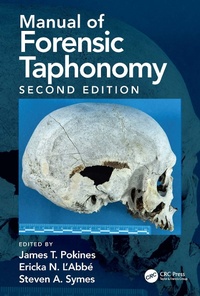
Manual of Forensic Taphonomy
2nd Edition
Published on 30. December 2021
768 pages
978-1-000-48070-2 (ISBN)
Description

The main goals in any forensic skeletal analysis are to answer who is the person represented (individualization), how that person died (trauma/pathology) and when that person died (the postmortem interval or PMI). The analyses necessary to generate the biological profile include the determination of human, nonhuman or nonosseous origin, the minimum number of individuals represented, age at death, sex, stature, ancestry, perimortem trauma, antemortem trauma, osseous pathology, odontology, and taphonomic effects-the postmortem modifications to a set of remains.
The Manual of Forensic Taphonomy, Second Edition covers the fundamental principles of these postmortem changes encountered during case analysis. Taphonomic processes can be highly destructive and subtract information from bones regarding their utility in determining other aspects of the biological profile, but they also can add information regarding the entire postmortem history of the remains and the relative timing of those effects. The taphonomic analyses outlined provide guidance on how to separate natural agencies from human-caused trauma. These analyses are also performed in conjunction with the field processing of recovery scenes and the interpretation of the site formation and their postdepositional history.
The individual chapters categorize these alterations to skeletal remains, illustrate and explain their significance, and demonstrate differential diagnosis among them. Such observations may then be combined into higher-order patterns to aid forensic investigators in determining what happened to those remains in the interval from death to analysis, including the environment(s) in which the remains were deposited, including buried, terrestrial surface, marine, freshwater, or cultural contexts.
Features
Provides nearly 300 full-color illustrations of both common and rare taphonomic effects to bones, derived from actual forensic cases
* Presents new research including experimentation on recovery rates during surface search, timing of marine alterations, trophy skulls, taphonomic laboratory and field methods, laws regarding the relative timing of taphonomic effects, reptile taphonomy, human decomposition, and microscopic alterations by invertebrates to bones
* Explains and illustrates common taphonomic effects and clarifies standard terminology for uniformity and usage within in the field
While the book is primarily focused upon large vertebrate and specifically human skeletal remains, it effectively synthesizes data from human, ethological, geological/paleontological, paleoanthropological, archaeological artifactual, and zooarchaeological studies. Since these taphonomic processes affect other vertebrates in similar manners, The Manual of Forensic Taphonomy, Second Edition will be invaluable to a broad set of forensic and investigative disciplines.
The Manual of Forensic Taphonomy, Second Edition covers the fundamental principles of these postmortem changes encountered during case analysis. Taphonomic processes can be highly destructive and subtract information from bones regarding their utility in determining other aspects of the biological profile, but they also can add information regarding the entire postmortem history of the remains and the relative timing of those effects. The taphonomic analyses outlined provide guidance on how to separate natural agencies from human-caused trauma. These analyses are also performed in conjunction with the field processing of recovery scenes and the interpretation of the site formation and their postdepositional history.
The individual chapters categorize these alterations to skeletal remains, illustrate and explain their significance, and demonstrate differential diagnosis among them. Such observations may then be combined into higher-order patterns to aid forensic investigators in determining what happened to those remains in the interval from death to analysis, including the environment(s) in which the remains were deposited, including buried, terrestrial surface, marine, freshwater, or cultural contexts.
Features
Provides nearly 300 full-color illustrations of both common and rare taphonomic effects to bones, derived from actual forensic cases
* Presents new research including experimentation on recovery rates during surface search, timing of marine alterations, trophy skulls, taphonomic laboratory and field methods, laws regarding the relative timing of taphonomic effects, reptile taphonomy, human decomposition, and microscopic alterations by invertebrates to bones
* Explains and illustrates common taphonomic effects and clarifies standard terminology for uniformity and usage within in the field
While the book is primarily focused upon large vertebrate and specifically human skeletal remains, it effectively synthesizes data from human, ethological, geological/paleontological, paleoanthropological, archaeological artifactual, and zooarchaeological studies. Since these taphonomic processes affect other vertebrates in similar manners, The Manual of Forensic Taphonomy, Second Edition will be invaluable to a broad set of forensic and investigative disciplines.
More details
Edition
2nd edition
Language
English
Place of publication
London
United Kingdom
Publishing group
Taylor & Francis Ltd
Target group
Professional and scholarly
Product notice
Reflowable
Illustrations
59 Tables, color; 30 Line drawings, color; 263 Halftones, color; 293 Illustrations, color
ISBN-13
978-1-000-48070-2 (9781000480702)
Copyright in bibliographic data and cover images is held by Nielsen Book Services Limited or by the publishers or by their respective licensors: all rights reserved.
Schweitzer Classification
Other editions
Additional editions
James T. Pokines | Ericka N. L'Abbe | Steven A. Symes
Manual of Forensic Taphonomy
Book
12/2021
2nd Edition
CRC Press
€166.20
Shipment within 15-20 days
James T. Pokines | Ericka N. L'Abbe | Steven A. Symes
Manual of Forensic Taphonomy
Book
12/2021
2nd Edition
CRC Press
€261.80
Shipment within 15-20 days
Book
12/2021
CRC Press
Unfortunately, price unknown
Available (delivery time upon request)
Persons
James T. Pokines, Ph.D., D.-.A.B.F.A., is an Associate Professor in the Forensic Anthropology Program, Department of Anatomy and Neurobiology, Boston University School of Medicine. He is also the Forensic Anthropologist for the Office of the Chief Medical Examiner, Boston, Commonwealth of Massachusetts, and analyzes all unknown bone cases in that state. His prior experience includes twelve years as a Forensic Anthropologist and Manager at the Central Identification Laboratory, Hawaii, recovering and analyzing the remains of missing servicemembers from past conflicts. His field experience includes excavations in 18 countries, including modern forensic scenes in multiple countries, Tiwanaku sites in Bolivia, a Classical site in Egypt, modern scavenger dens in Kenya, and Paleolithic sites in Spain, France, and Jordan. He has ongoing research in the latter country, including the natural faunal trap site Wadi Zarqa Ma'in 1 and multiple Paleolithic sites in the Azraq basin, His taphonomic interests include scavenger gnawing and dispersal, subaerial weathering, and other environmental effects to bone, and he also researches zooarchaeology, paleoecology, and Paleolithic archaeology. He received his B.A. degree in Anthropology and Archaeology at Cornell University and his M.A. and Ph.D. degrees in Anthropology from the University of Chicago and is a former Vice President of the American Board of Forensic Anthropology and a current Fellow of the American Academy of Forensic Sciences.
Steven A. Symes, Ph.D., D.-A.B.F.A., is currently the Forensic Anthropologist for the Office of the Chief Medical Examiner in Jackson, Mississippi. He is Professor Emeritus of Forensic Anthropology at Mercyhurst University in Pennsylvania, and is an Adjunct Professor in the Department of Anatomy at the University of Pretoria, South Africa. He is a diplomate of the American Board of Forensic Anthropology and is a Fellow of the American Academy of Forensic Sciences. He is best known for his expertise in interpreting trauma to bone and a leading authority on saw and knife mark analysis. With over 30 years of experience, he has assisted federal, state, local, and non-US authorities in the identification, analysis, and documentation of those suspected to be victims of trauma. Dr. Symes has been qualified as an expert for both the prosecution and defense, testifying specifically on forensic tool mark and fracture pattern interpretation in bone, as well as blunt force, ballistic, burned and healing trauma in bone. Because of his specialty in criminal dismemberment and mutilation, he has worked a number of serial homicides, and has provided analysis of cut marks in nearly 200 dismemberment cases and approximately 400 knife wound cases.
Ericka Noelle L'Abbe, Ph.D., D.-A.B.F.A., is a Professor of Biological Anthropology and the Director of the Forensic Anthropology Research Centre (FARC) in the Department of Anatomy at the University of Pretoria, South Africa. She is Board-certified with the American Board of Forensic Anthropology and is a Fellow of the American Academy of Forensic Sciences. She teaches undergraduate and postgraduate students in biological anthropology, human osteology, human evolution and research methodology. She has published numerous papers and book chapters in forensic anthropology, with more recent focuses on facial approximations, teaching human evolution, and the development of medical implants for South Africans. As Director of the FARC, she which is involved in a variety of activities including the analysis of human remains, both forensic and archaeological in nature, field and laboratory training, research, and repatriation. FARC also applies knowledge and research in biological anthropology for application in medicine and health sciences education. She has written 350 technical reports on unknown skeletal remains for forensic pathologists and the South African Police Service (SAPS). She currently manages an Erasmus+ Capacity Building Grant in Higher Education which aims to build the first digital repository of skeletal remains in Africa, known as Bakeng se Afrika project, for the purposes of research and education.
Steven A. Symes, Ph.D., D.-A.B.F.A., is currently the Forensic Anthropologist for the Office of the Chief Medical Examiner in Jackson, Mississippi. He is Professor Emeritus of Forensic Anthropology at Mercyhurst University in Pennsylvania, and is an Adjunct Professor in the Department of Anatomy at the University of Pretoria, South Africa. He is a diplomate of the American Board of Forensic Anthropology and is a Fellow of the American Academy of Forensic Sciences. He is best known for his expertise in interpreting trauma to bone and a leading authority on saw and knife mark analysis. With over 30 years of experience, he has assisted federal, state, local, and non-US authorities in the identification, analysis, and documentation of those suspected to be victims of trauma. Dr. Symes has been qualified as an expert for both the prosecution and defense, testifying specifically on forensic tool mark and fracture pattern interpretation in bone, as well as blunt force, ballistic, burned and healing trauma in bone. Because of his specialty in criminal dismemberment and mutilation, he has worked a number of serial homicides, and has provided analysis of cut marks in nearly 200 dismemberment cases and approximately 400 knife wound cases.
Ericka Noelle L'Abbe, Ph.D., D.-A.B.F.A., is a Professor of Biological Anthropology and the Director of the Forensic Anthropology Research Centre (FARC) in the Department of Anatomy at the University of Pretoria, South Africa. She is Board-certified with the American Board of Forensic Anthropology and is a Fellow of the American Academy of Forensic Sciences. She teaches undergraduate and postgraduate students in biological anthropology, human osteology, human evolution and research methodology. She has published numerous papers and book chapters in forensic anthropology, with more recent focuses on facial approximations, teaching human evolution, and the development of medical implants for South Africans. As Director of the FARC, she which is involved in a variety of activities including the analysis of human remains, both forensic and archaeological in nature, field and laboratory training, research, and repatriation. FARC also applies knowledge and research in biological anthropology for application in medicine and health sciences education. She has written 350 technical reports on unknown skeletal remains for forensic pathologists and the South African Police Service (SAPS). She currently manages an Erasmus+ Capacity Building Grant in Higher Education which aims to build the first digital repository of skeletal remains in Africa, known as Bakeng se Afrika project, for the purposes of research and education.
Content
1. Introduction: The Importance and Use of Forensic Taphonomic Data 2. Microscopic Destruction of Bone 3. Soft Tissue Decomposition in Terrestrial Ecosystems 4. Bone Density and Bone Attrition 5. Effects of Burial Environment on Osseous Remains 6. Fluvial Taphonomy 7. Marine Environmental Alterations to Bone 8. Contemporary Cultural Alterations to Bone: Anatomical, Ritual, and Trophy 9. Faunal Dispersal, Reconcentration, and Gnawing Damage to Bone in Terrestrial Environments 10. Deposition and Dispersal of Human Remains as a Result of Criminal Acts: Homo sapiens sapiens as a Taphonomic Agent 11. Subaerial Weathering and Other Terrestrial Surface Taphonomic Processes 12. Identifying the Origin of Taphonomic Bone Staining and Color Changes in Forensic Contexts 13. Taphonomy and the Timing of Bone Fractures in Trauma Analysis 14. Thermal Alteration to Bone 15. DNA Survivability in Skeletal Remains 16. Avian Taphonomy 17. Effects of Recovery Methods 18. Invertebrate Modification of Bone 19. Reptile Taphonomy 20. Laws of Taphonomic Relative Timing 21. Laboratory and Field Methods in Forensic Taphonomy
