

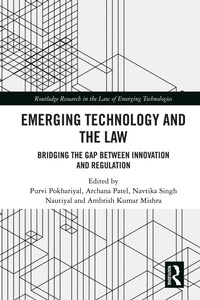
Emerging Technology and the Law
Bridging the Gap Between Innovation and Regulation
1st Edition
Published on 21. April 2026
192 pages
978-1-040-56894-1 (ISBN)
Description

This book explores the multifaceted implications of technological innovation on legal systems, addressing how emerging technologies enhance, challenge, and necessitate reform in legal practice and governance, with a focus on artificial intelligence, big data, and blockchain.
Technological advancements have profoundly reshaped every facet of human life, including the realm of law and governance. From automating legal research and drafting to revolutionizing court proceedings through e-court automation, AI-driven systems are transforming the legal landscape. These advancements bring unprecedented efficiency but also pose critical legal, ethical, and technical challenges. By delving into applications such as predictive justice, document mining, online dispute resolution, and AI governance, this book provides insights into the opportunities and complexities of integrating technology into law; and addresses key topics such as automating legal decision-making, safeguarding data privacy, and the ethical use of AI in the justice system. Through in-depth analysis and case studies, this book bridges the gap between technological innovation and regulatory systems, ensuring that the future of law incorporates robust mechanisms to meet emerging challenges.
The book will be of interest to researchers in the field of the law of emerging technologies, regulation, governance, artificial intelligence, and data science.
Technological advancements have profoundly reshaped every facet of human life, including the realm of law and governance. From automating legal research and drafting to revolutionizing court proceedings through e-court automation, AI-driven systems are transforming the legal landscape. These advancements bring unprecedented efficiency but also pose critical legal, ethical, and technical challenges. By delving into applications such as predictive justice, document mining, online dispute resolution, and AI governance, this book provides insights into the opportunities and complexities of integrating technology into law; and addresses key topics such as automating legal decision-making, safeguarding data privacy, and the ethical use of AI in the justice system. Through in-depth analysis and case studies, this book bridges the gap between technological innovation and regulatory systems, ensuring that the future of law incorporates robust mechanisms to meet emerging challenges.
The book will be of interest to researchers in the field of the law of emerging technologies, regulation, governance, artificial intelligence, and data science.
More details
Series
Edition
1. Auflage
Language
English
Place of publication
London
United Kingdom
Publishing group
Taylor & Francis Ltd
Target group
College/higher education
Illustrations
5 Tables, black and white; 2 Line drawings, black and white; 2 Halftones, black and white; 4 Illustrations, black and white
File size
2,38 MB
ISBN-13
978-1-040-56894-1 (9781040568941)
Copyright in bibliographic data and cover images is held by Nielsen Book Services Limited or by the publishers or by their respective licensors: all rights reserved.
Schweitzer Classification
Other editions
Additional editions
Purvi Pokhariyal | Archana Patel | Navtika Singh Nautiyal
Emerging Technology and the Law
Bridging the Gap Between Innovation and Regulation
Book
04/2026
1st Edition
Routledge
€194.50
Shipment within 15-20 days
Persons
Purvi Pokhariyal is Campus Director at the National Forensic Sciences University of the Delhi Campus and is Director of Academics, Research and Consultancy at the National Forensic Sciences University, Gandhinagar. She is founding Dean of the School of Law, Forensic Justice and Policy Studies and has more than 25 years academic and industry experience in the field of law and justice administration. Prof. Pokhariyal specializes in the area of Criminal Justice Studies and Justice Education.
Archana Patel is Associate Dean (I/C), School of Cyber Security and Digital Forensics, National Forensic Sciences University, Delhi Campus, India. She has worked as full-time faculty at the School of Computing and Information Technology, Eastern International University, Vietnam. She completed her postdoc at the Freie Universitaet Berlin, Berlin, Germany. She received both a PhD in Computer Applications and PG degree from the National Institute of Technology (NIT), Kurukshetra, India. Dr. Patel has contributed in a DRDO funded research project for two years. Dr. Patel is an author and co-author of more than 40 publications in numerous revered journals and conference proceedings and has been awarded the Best Paper Award four times in international conferences.
Navtika Singh Nautiyal is Assistant Professor, School of Law, Forensic Justice and Policy Studies, National Forensic Sciences University, Delhi Campus. She has 12 years of teaching and research experience. Dr. Nautiyal completed her postdoc at MICHR Italy in human rights and artificial intelligence, her Philosophy of Doctorate in Intercountry Adoption Laws at Uttaranchal University, Dehradun, and her Masters of Law in Criminal Law and Human Rights at the Indian Law Institute, New Delhi. Dr. Nautiyal is a remarkable speaker and has delivered many keynote addresses on contemporary issues in law, management, legal research, personal development, and professional and communication skills.
Ambrish Kumar Mishra is an accomplished professional and author with over a decade of experience spanning industry, teaching, and training. An associate member of the prestigious International Society for Development and Sustainability (ISDS), Japan, he brings a wealth of knowledge and expertise to his work. Mr. Mishra holds a Master's Diploma in Banking Services, alongside a Master's in Business Administration and a Bachelor's degree in Mathematics. His professional journey includes impactful roles in renowned organizations, such as ALIMCO, Axis Bank, IndusInd Bank, and Mahendras. His dedication to research and training has been recognized with several awards, including the Best Paper Award at an International Conference.
Archana Patel is Associate Dean (I/C), School of Cyber Security and Digital Forensics, National Forensic Sciences University, Delhi Campus, India. She has worked as full-time faculty at the School of Computing and Information Technology, Eastern International University, Vietnam. She completed her postdoc at the Freie Universitaet Berlin, Berlin, Germany. She received both a PhD in Computer Applications and PG degree from the National Institute of Technology (NIT), Kurukshetra, India. Dr. Patel has contributed in a DRDO funded research project for two years. Dr. Patel is an author and co-author of more than 40 publications in numerous revered journals and conference proceedings and has been awarded the Best Paper Award four times in international conferences.
Navtika Singh Nautiyal is Assistant Professor, School of Law, Forensic Justice and Policy Studies, National Forensic Sciences University, Delhi Campus. She has 12 years of teaching and research experience. Dr. Nautiyal completed her postdoc at MICHR Italy in human rights and artificial intelligence, her Philosophy of Doctorate in Intercountry Adoption Laws at Uttaranchal University, Dehradun, and her Masters of Law in Criminal Law and Human Rights at the Indian Law Institute, New Delhi. Dr. Nautiyal is a remarkable speaker and has delivered many keynote addresses on contemporary issues in law, management, legal research, personal development, and professional and communication skills.
Ambrish Kumar Mishra is an accomplished professional and author with over a decade of experience spanning industry, teaching, and training. An associate member of the prestigious International Society for Development and Sustainability (ISDS), Japan, he brings a wealth of knowledge and expertise to his work. Mr. Mishra holds a Master's Diploma in Banking Services, alongside a Master's in Business Administration and a Bachelor's degree in Mathematics. His professional journey includes impactful roles in renowned organizations, such as ALIMCO, Axis Bank, IndusInd Bank, and Mahendras. His dedication to research and training has been recognized with several awards, including the Best Paper Award at an International Conference.
Content
1. Ethical and Legal Implications of AI-Based Big Data Policing: Balancing Public Safety and Civil Liberties
2. The Ethics of Predictive Policing: Analyzing Privacy Concerns and the Social Systemic Bias
3. Traversing the Multifaceted Policy Terrain: Interlinked Realms of Artificial Intelligence and Predictive Policing
4. Deepfakes and Global Legal Regimes: A Comparative Study
5. An Invisible Threat to the Security and Sovereignty of Nations in the Age Of Deepfakes
6. An Analysis of Artificial Intelligence, Digital Technologies, And Human Rights: Friend or Foe?
7. Legal-AI Ethics: Navigating the Moral Maze of Algorithmic Justice
8. Impersonation Scams: Global Legal Challenges in Governance of Artificial Intelligence
9. Privacy Vis A Vis Intellectual Property Rights in the Labyrinth of AI: An Indian Kaleidoscope
10. Blockchain: A Ray of Hope Against Banking and Financial Fraud
11. Jurisdictional and Regulatory Failures in Addressing DNS Abuse
2. The Ethics of Predictive Policing: Analyzing Privacy Concerns and the Social Systemic Bias
3. Traversing the Multifaceted Policy Terrain: Interlinked Realms of Artificial Intelligence and Predictive Policing
4. Deepfakes and Global Legal Regimes: A Comparative Study
5. An Invisible Threat to the Security and Sovereignty of Nations in the Age Of Deepfakes
6. An Analysis of Artificial Intelligence, Digital Technologies, And Human Rights: Friend or Foe?
7. Legal-AI Ethics: Navigating the Moral Maze of Algorithmic Justice
8. Impersonation Scams: Global Legal Challenges in Governance of Artificial Intelligence
9. Privacy Vis A Vis Intellectual Property Rights in the Labyrinth of AI: An Indian Kaleidoscope
10. Blockchain: A Ray of Hope Against Banking and Financial Fraud
11. Jurisdictional and Regulatory Failures in Addressing DNS Abuse
