

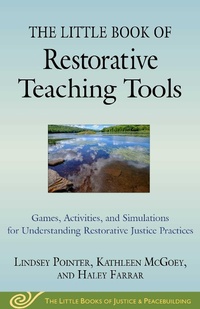
The Little Book of Restorative Teaching Tools
Games, Activities, and Simulations for Understanding Restorative Justice Practices
Published on 10. March 2020
120 pages
978-1-68099-589-3 (ISBN)
Description

Engaging Practices for Integrating Restorative Justice Principles in Group Settings
As restorative practices spread around the world, scholars and practitioners have begun to ask very important questions: How should restorative practices be taught? What educational structures and methods are in alignment with restorative values and principles? This book introduces games as an effective and dynamic tool to teach restorative justice practices. Grounded in an understanding of restorative pedagogy and experiential learning strategies, the games included in this book provide a way for learners to experience and more deeply understand restorative practices while building relationships and improving skills. Chapters cover topics such as:
An ideal handbook for educators, restorative justice program directors and trainers, consultants, community group leaders, and anyone else whose work draws people together to resolve disagreements or address harm, this book will serve as a catalyst for greater creativity and philosophical alignment in the teaching of restorative practices across contexts.
As restorative practices spread around the world, scholars and practitioners have begun to ask very important questions: How should restorative practices be taught? What educational structures and methods are in alignment with restorative values and principles? This book introduces games as an effective and dynamic tool to teach restorative justice practices. Grounded in an understanding of restorative pedagogy and experiential learning strategies, the games included in this book provide a way for learners to experience and more deeply understand restorative practices while building relationships and improving skills. Chapters cover topics such as:
- Introduction to restorative pedagogy and experiential learning
- How a restorative learning community can be built and strengthened through the use of games and activities
- How to design games and activities for teaching restorative practices
- How to design, deliver, and debrief an activity-based learning experience
- In-depth instructions for games and activities for building relationships, understanding the restorative philosophy, and developing skills in practice
An ideal handbook for educators, restorative justice program directors and trainers, consultants, community group leaders, and anyone else whose work draws people together to resolve disagreements or address harm, this book will serve as a catalyst for greater creativity and philosophical alignment in the teaching of restorative practices across contexts.
More details
Persons
Lindsey Pointer is a restorative practices educator, researcher, and practitioner. She has a PhD in Restorative Justice from Victoria University of Wellington in New Zealand, where she helped design and implement the Restorative University initiative. Lindsey is a former Fulbright Fellow and Rotary Global Grant recipient who is passionate about experimenting with new applications of restorative principles and processes and understanding how restorative practices work to transform communities. She has worked internationally with communities in a range of contexts to support the implementation of restorative practices in an engaged, responsive, and fun way. She currently lives in Colorado.
Kathleen McGoey is the executive director of Longmont Community Justice Partnership (LCJP), a nonprofit that implements community- and schools-based restorative practices programs and training. Kathleen's previous experience leading a peacebuilding program on the US-Mexico border sparked her passion and commitment to utilizing relationship-based methods for transforming conflict. She published her first book in 2013 after completing an MA in International Peace and Conflict Studies at the University of Innsbruck, Austria. She lives in Longmont, Colorado.
Haley Farrar is a restorative practitioner and educator at Victoria University of Wellington and Aspen Restorative Consulting. An attorney and former Fulbright Fellow, she now works with individuals and organizations aspiring to implement restorative practices in their lives and communities. Originally from Richmond, Virginia, Haley currently lives in Wellington, New Zealand.
Kathleen McGoey is the executive director of Longmont Community Justice Partnership (LCJP), a nonprofit that implements community- and schools-based restorative practices programs and training. Kathleen's previous experience leading a peacebuilding program on the US-Mexico border sparked her passion and commitment to utilizing relationship-based methods for transforming conflict. She published her first book in 2013 after completing an MA in International Peace and Conflict Studies at the University of Innsbruck, Austria. She lives in Longmont, Colorado.
Haley Farrar is a restorative practitioner and educator at Victoria University of Wellington and Aspen Restorative Consulting. An attorney and former Fulbright Fellow, she now works with individuals and organizations aspiring to implement restorative practices in their lives and communities. Originally from Richmond, Virginia, Haley currently lives in Wellington, New Zealand.
Content
- Front Cover
- Half-Title Page
- Title Page
- Copyright Page
- Table of Contents
- Chapter 1: Introduction
- Why Bring This Style of Teaching to Restorative Justice Practices?
- A Note on Language
- Chapter Overviews
- Chapter 2: Restorative Pedagogy
- Teaching in Alignment with Restorative Values and Principles
- Critical and Feminist Pedagogies: Education as a Liberatory Practice
- Restorative Justice Education as a Liberatory Practice
- Chapter 3: Experiential Learning and Restorative Justice
- An Introduction to Experiential Learning
- Examples of Experiential Learning in Restorative Practices Classrooms
- Chapter 4: Building a Restorative Learning Community
- Building Restorative Communities
- Restorative Learning Communities
- Restorative Rituals and Games
- Chapter 5: Preparing to Teach
- The Need to Know Yourself
- The Need to Know Your Learners
- Chapter 6: How to Design an Experiential Activity for Teaching Restorative Practices
- Chapter 7: How to Design an Activity-Based Class or Training
- Design and Delivery of a Restorative Learning Experience
- Review and Improve the Overall Learning Experience
- Chapter 8: Games and Activities for Your Community
- Read Before Playing: Three Universal Guidelines for Game Facilitation
- 8.1 Games and Activities to Build Relationships
- 8.2 Games and Activities to Understand the Restorative Philosophy
- 8.3 Skills-Development Games and Activities
- Notes
- Acknowledgments
- About the Authors
